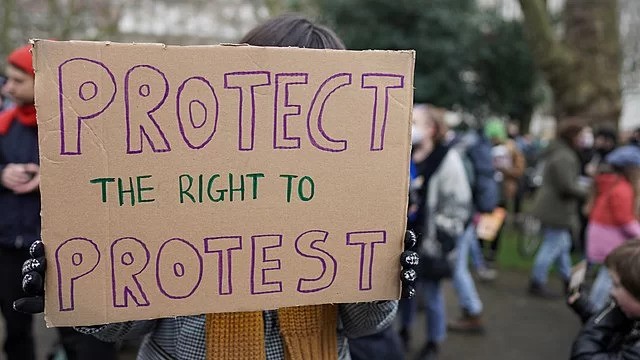
The use of anti-terrorism laws against civil disobedience could have far reaching effects for the trade union movement.
Free Our Unions is supporting an open letter, initiated by the Haldane Society of Socialist Lawyers, opposing the proscription of Palestine Action. The text of the letter is below; you or your organisation can add your names here.
We, as individuals or as organisations representing a broad spectrum of civil society and the legal community, are writing to you, in response to the threat of proscribing the grassroots solidarity and direct action group, Palestine Action.
The United Kingdom has a long and proud history of direct action that opposes military intervention. From Greenham Common to the 2 million marching in London against the invasion of Iraq, British governments of different political persuasions have respected people’s right to peacefully protest. Indeed, as the leading case of R v Jones makes clear : “The appellants acted as they did because they wished to impede, obstruct or disrupt the commission of that crime, or what they believed would be the commission of that crime, by Her Majesty’s Government or the Government of the United States against Iraq in the weeks and days before (as we now know) hostilities began.”
Any attempt to criminalise peaceful direct action including by mislabelling it as ‘terrorism” would raise grave concerns, some of which are listed below for your consideration:
- It would be unwise to blur the very clear lines between peaceful protest and terrorism by using misleading rhetoric. This conflation can underplay the credible dangers of genuine terrorism, legitimise terrorism in the eyes of those members of the public who support this cause, and confer unjustified renown on groups that are unfairly proscribed.
- In a series of acts contrary to international law, the UK govt appears to be using the RAF Brize Norton base to onward service RAF Akrotiri that in turn is used by our allies and the UK to facilitate what the ICJ has found to be a plausible genocide in Gaza. As a state party to the Genocide Convention, facilitating such a genocide would be a particularly egregious breach of international law, by the UK. The UK government, by simultaneously seeking to criminalise those peacefully protesting this genocide using proscription, is further doubling down on these acts, rather than remedying these errors of judgment, as it should.
- Even if it were assessed by the Home Secretary that measures are needed to be taken to deal with this particular direct action group, a wide range of more proportionate, proven and effective remedies are available to her.
- Having to enforce and police the proscription of Palestine Action would create a disproportionate strain on police resources and an ensuing additional and unjustified burden on the justice system to enforce such a proscription. It would leave many ordinary members of the public vulnerable – for example, simply wearing a t-shirt saying “I support Palestine Action” would be seen as violating the proscription and action would need to be taken.
- There are many dangers to proscribing peaceful direct action groups, even if their objectives are those some of us may disagree with. Current and future governments may misuse this precedent to attack other interest groups in future, offering no avenues for peacefully venting dissent. Bottling public anger and frustration creates the breeding ground for violence by or against members of the public.
It is our hope that the Home Secretary will recognise both the moral arguments and the strength of feeling in civil society in this matter and resile from this proscription
 Free Our Unions