Comment by a Free Our Unions supporter
Good news that the Employment Rights Bill has finally passed, against resistance from the House of Lords, the Tories and Reform UK, and employers.
The Employment Rights Act, in its final legislative form – a lot in terms of implementation will depend on a series of consultations – is in multiple areas a step forward. It is also much weakened not only from Labour’s original “New Deal for Working People” in 2021, but from what the party promised during the general election.
Much has rightly been written and said on many different aspects of this weakening, notably in terms of dealing with bogus self-employment, fire and rehire/replace, promoting collective bargaining, and unfair dismissal rights. In terms of the right to strike specifically, the main problem is not so much watering down, but that what even the 2021 original promised was thoroughly inadequate.
More on that below. But first there is an immediate problem which the labour movement needs to take up.
When will the 50% threshold go?
In terms of the right to strike, the ERA means:
• Repeal of the 2023 minimum service levels law (already in practice a dead letter, but obviously now harder to revive in any form);
• Reducing the notice period for industrial action from fourteen days to ten (but not to seven as before 2016);
• Increasing the maximum length of mandate from an industrial action vote from six months to twelve;
• Introduction of some forms of electronic and workplace-based balloting in addition to postal balloting;
• Scrapping the requirement for support from 40% of those entitled to vote for industrial action in health, schools, the fire service, transport, nuclear decommissioning and border security;
• Scrapping the requirement for a 50% turnout for any industrial action ballot to succeed.
The last is perhaps the most significant. Since 2016 a number of important strike ballots have failed under this rule, despite in some cases large majorities voting in favour – notably in the NHS, and just recently in higher education over pay.
The problem is that, whereas the ERA makes scrapping the 40% support threshold in “essential” services immediate on its passing, and other measures in connection to industrial action rules operative after two months, it leaves when the wider 50% turnout threshold is scrapped up to the responsible Secretary of State.
The government has been unclear on when it plans to remove this restriction. Reports have suggested it might be kicked into the long grass, to be implemented only after the introduction of electronic balloting. The government’s implementation “roadmap” suggests electronic balloting will come in from April 2026, but the timetable already seems to be out of date due to passing of the law being delayed. It says nothing clear specifically on the turnout threshold.
It is surely not overly cynical to fear that the government will look for ways to at least delay implementation of this point, for bad reasons including avoiding public-sector strikes at a crucial time for workers’ living standards and the future of public services. The labour movement must vocally demand and actively campaign for a clear, fast timetable to scrap the threshold. At the moment it isn’t.
Step up the fight
During the passage of the bill, unions largely gave up on fighting for measures to strengthen it, even in areas providing very clear targets for campaigning, instead focusing on what a great victory the existing form of the legislation represented. The result was a debate shaped by employer lobbying, backed up by the Tories and the right-wing media, and a largely defensive struggle to prevent further concessions.
Thus the abandonment of the high profile commitment to unfair dismissal rights from day one. Indeed, it is reported that a majority of Labour-affiliated unions gave their blessing to this retreat in order to get the bill passed. (Worth noting that unions have completely failed to raise the crucial demand for workers to have the right to be reinstated if they are found to have been dismissed unfairly.)
Now it has passed, we are seeing even more self-congratulation from union leaders. But the fight is not or should not be over: not only in the wider sense of actually using what expanded collective rights the ERA does provide, but also because large parts of it will be implemented on the basis of various kinds of consultation. This provides numerous opportunities for employers to push to further weaken its impact.
Perhaps also opportunities to push the other way – but only if the labour movement takes them / makes them. We need to get into campaigning mode to fight around the Act’s implementation – as well as pushing for maximum use of any new openings to organise and to organise struggles. This needs to be connected to the fight against wider anti-protest laws too.
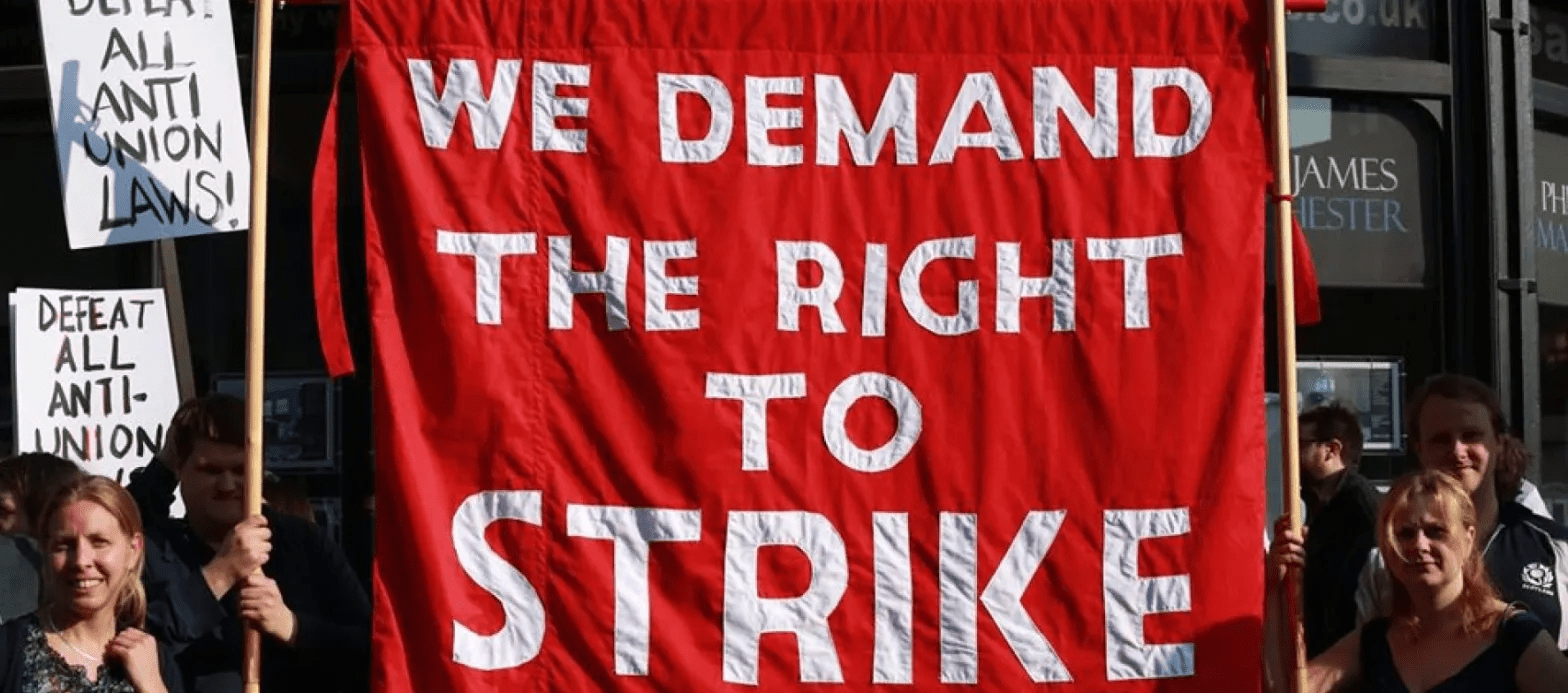
Demand the right to strike!
Even if the 50% turnout threshold is removed early next year, that will still leave in place the vast majority of “anti-union law” restrictions on the right to strike. To take industrial action, workers will still have to jump through the hoops of a complex and slow bureaucratic process, designed to prevent impactful and effective action. Industrial action for anything but narrowly defined workplace/industrial issues will remain illegal, as crucially will workers taking action in solidarity with each other’s disputes.
There are reports that when the contents of the Bill were initially being discussed, representatives of giant public-sector UNISON were central to opposing removal of the ban on solidarity action. It is certainly the case that unions have not campaigned or even made arguments about the pre-2016 anti-union laws. That needs to change. UNISON’s election of a new general secretary may provide an opportunity.
There is already some agitation, led by the Institute of Employment Rights, for an “Employment Rights Bill #2”. That is welcome, though there is not much discussion on how to build an actual campaign for it.
Within an overall view of the ERA’s weaknesses and omissions, we also need a specific and explicit focus on the question of the right to strike and comprehensively abolishing restrictions on it. We should agitate in the labour movement for that in the months ahead.
 Free Our Unions