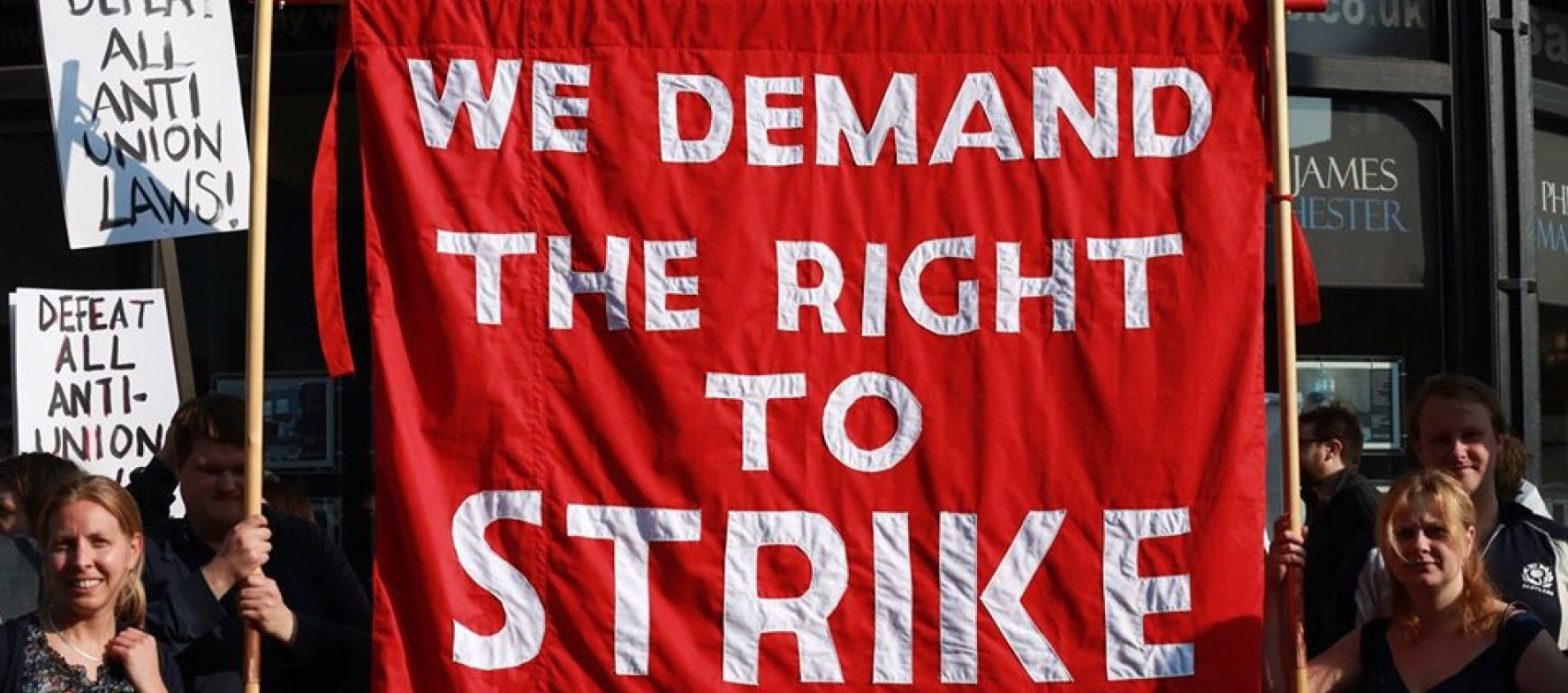
With Labour likely to form the next government, the wider labour movement must push the Labour Party to go further on repealing legal restrictions on the right to organise and strike.
For the appeal / statement referred to in this article, click here.
By Sacha Ismail
Debates around Labour’s “New Deal for Working People”, including possible attempts to further water it down, have tended to touch only lightly on the pivotal issue of anti-union / anti-strike laws.
While representing the first rolling back of anti-union laws since the 1970s, the proposals would simultaneously leave the great bulk of the Thatcherite anti-union laws of the 1980s-90s in place.
The latest version, put up on Labour’s website towards the end of May 2024, makes the following commitments:
“Over the past 14 years, the Conservatives have consistently attacked rights at work, including through the Trade Union Act 2016, the Minimum Service Levels (Strikes) Bill and the Conduct of Employment Agencies and Employment Businesses (Amendment) Regulations 2022 – all of which Labour will repeal to give trade unions the freedom to organise, represent and negotiate on behalf of their workers…
“The law governing trade union statutory ballots is antiquated and fails to recognise the huge steps trade unions have made to engage and communicate with members. The current system of only allowing statutory trade union ballots via the post significantly impacts turnout and hampers democratic engagement with members. Labour will allow modern, secure, electronic balloting and workplace ballots…”
If this is meaningfully carried out, it would mean reversing the laws governing industrial action to where they were in 2015, before the extremely serious attacks of 2016 and 2023, and modifying earlier anti-union laws by removing the insistence on postal ballots specifically. This is no small matter.
The labour movement should mobilise to ensure these commitments, along with others in the New Deal document, are carried out as fast and in as thoroughgoing a form as possible.
However, in terms of anti-strike restrictions – as in other areas – that is nowhere enough. It means accepting the core of the Thatcherite drive to restrict trade union freedom.
Even a solid and better-than-expected implementation of the New Deal would mean:
• A continued ban on solidarity action, strikes and industrial action in support of other workers
• A continued ban on strikes and industrial action for anything other than narrowly defined “trade dispute” issues
• Heavy state regulation of when and by what processes workers can decide to strike etc
• Heavy state regulation of union’s internal procedures
• Heavy limits on picketing
Whether or to what extent we can successfully challenge these kinds of restrictions, in the current political climate, remains to be seen. But we should try.
That is why trade union organisations have launched an appeal calling for repeal of all anti-trade union / anti-strike laws and their replace with strong legal rights for workers and unions – including strong rights to strike and picket.
The statement was initiated by CWU Greater London Combined (telecoms) branch. At its executive meeting this month the Bakers’ Union (BFAWU) took a decision to back the statement and the initiative.
We are calling for trade union organisations at every level to add their names and to get in touch to coordinate campaigning. You can do so here.
 Free Our Unions