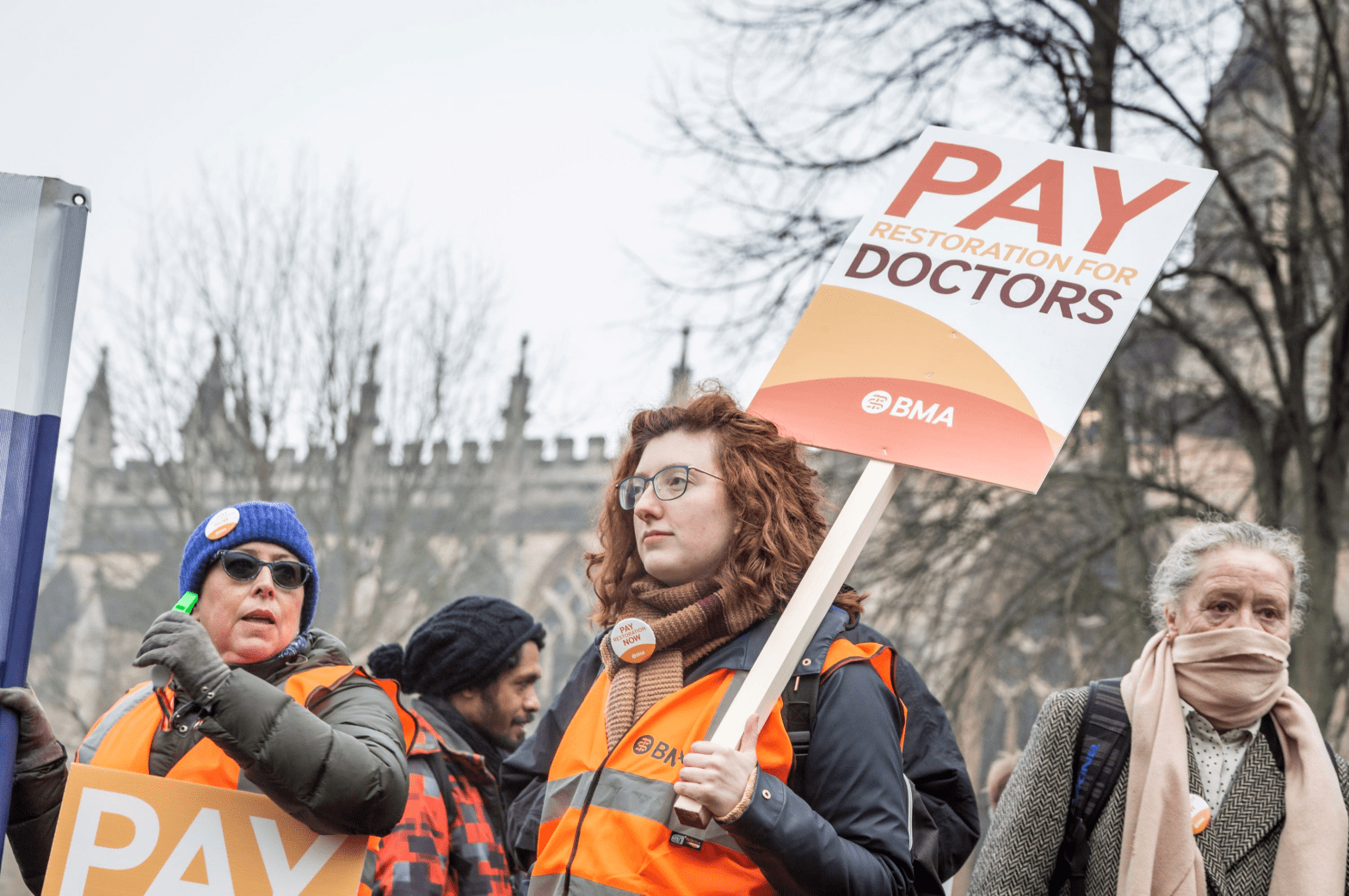
This is the speech given by British Medical Association (BMA) deputy chair Emma Runswick at the 1 May rally in Manchester at which the Green Party launched its new Workers’ Charter. (Emma pictured above; photo from the Fire Brigades Union.) She explains, through the lens of doctors’ and health workers’ struggles, why fighting to scrap the bans on solidarity action and on action for demands wider than narrow “trade disputes” is so crucial.
The GP Workers’ Charter commits to: “Free our unions. Scrap all anti-union and anti-strike laws introduced since 1979. Bring in strong legal rights to strike, picket and protest, including solidarity action and action for political and social causes.”
The BMA is a non-partisan trade union and professional association, currently in disputes across the UK.
For us, the Employment Rights Act brings positive and long overdue reforms to trade union regulation. But I can’t gush about it. The Employment Rights Act is not good enough to protect and promote workers’ rights
It doesn’t even go as far as the Labour Party manifesto did, and some elements have been deliberately delayed to reduce impact on their government and our ability to fight their bad decision making. The shift to online balloting and removal of thresholds has been held back until at least August, over two years since their election possibly later. We must demand the thresholds are abolished immediately, definitely no later than August.
In my time, I want to mention just a couple of the changes – amongst many – beyond the existing Employment Rights Act that we need to see and how they would impact doctors and health workers.
First, the law against Secondary Action, or Solidarity Action needs to be repealed. Secondary action is taken by workers in support of a dispute involving another group of workers.
In the NHS, which is increasingly outsourced, it may be necessary for workers from different employers to collaborate in order to secure safe working conditions. Currently, because of the ban on solidarity action, each group has to construct a different dispute against each employer – this is time consuming and ridiculous, especially when the policies and actions of one employer – for example of workers in the laboratory – affects all of us across a hospital system.
In the private sector, we have agencies employing doctors from abroad – often West Africa – creating systems of multiple jeopardy to prevent doctors from speaking up. If a doctor like my colleague Fiya becomes a troublemaker to them by complaining, as she did about a clinical problem, or her colleagues did about the quality of housing provided to them, or about racism at work, these agencies control and can threaten everything: they don’t just pay their wages, they are also a doctor’s landlord, professional registration and visa status. Challenge through the Employment Tribunal system is slow, slower than a Home Office deportation threat. More settled and empowered workers like me should be able to take action to protect those who are most exploited and at risk of abuse – currently this is prohibited by laws stopping secondary action.
In the NHS, we have some groups of doctors who never want to take action due to moral and professional obligations to patients – for example my colleagues who work with patients with fast-progressing cancers. Those who do non-emergency work in and beyond the health service should be able to take action to ensure good conditions for those who cannot stop working.
In the 1980s, this happened – significant strike action by all sorts of workers supported nurses’ pay disputes.
Secondary action is banned because it works, because it makes us stronger by building solidarity between us, because it would enable us to solve all of these problems. Any party on the side of workers needs to repeal the ban.
The next key issue is the current restriction of trade disputes as only being with an “employer” and only on specific issues. Doctors are affected at work by lots of organisations that aren’t their direct employer. Resident doctors like me, most of us on three year fixed-term contracts, get the worst of this:
- Recruitment bodies, not employers, conduct interviews and allocate jobs.
- Statutory education health bodies conduct annual reviews of competency and can end our employment.
- “Host” NHS Trusts are the actual places we work.
- Royal Colleges run our exams which govern our progression, with regular serious errors like giving incorrect results.
None of those bodies are our employer. None can be subject to a trade dispute or a strike. Most can’t be held accountable via legal routes either – trust me we have looked. They are just unaccountable, despite having control over our lives. It is set up that way deliberately. The thousands of doctors currently being “let go” at the end of fixed term contracts because of NHS funding cuts have hardly any recourse. The legislation holds us back.
And that is before we get to action which would currently be unlawful on wider politics: Palantir’s involvement in the NHS, public health issues, climate.
We are facing so many threats to our health in this country. The burden of avoidable disease is killing us, and overrunning the NHS. Doctors and health workers want a healthy population. So do all of us. Yet we can only hold disputes on a tiny list of workplace issues.
The law has always sought to limit workers’ ability to fight for our interests against bosses. It’s an uneven playing field.
Even under the new law, strike mandates will still require annual ballots. But no company has to seek shareholder permission to underpay workers, no government has to seek referendum permission to make cuts.
The commitment to free our unions is a powerful commitment to even the odds, to free us to organise ourselves to win better lives – at work and in the wider world. All trade unionists must push for that.

