
Free Our Unions is pleased to be contributing to the next meeting of the Birmingham Strike Solidarity Committee, which will take place at 7pm on 31 August, in the Committee Room, Nortons 43-45, Meriden Street, Digbeth B5 5LS.
If you’re in the area, please join us!
Free Our Unions organising meeting – 7pm, Wednesday 9 August
Log in via Zoom here
Meeting ID: 835 3823 9276
Passcode: 683428
Join us for our next open organising meeting, held via Zoom at 7pm on Wednesday 9 August.
Our organising meetings are open to all supporters of the aims of our campaign. We’ll be discussing:
• Mobilising in our unions to prepare defiance to new anti-union laws
• A campaign to demand employers commit to refusing to issue work notices
• For supporters active in the Labour Party, campaigning to demand an incoming Labour government commits to repeal anti-union laws
Rally at TUC Congress, Liverpool: 1pm, Sunday 10 September
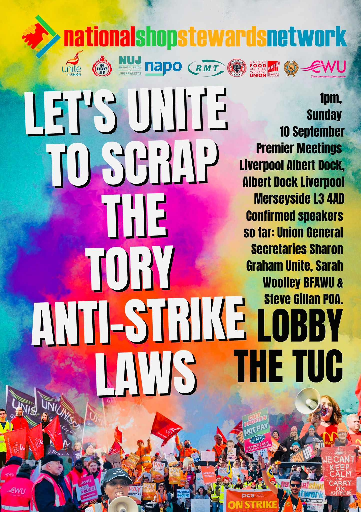
Free Our Unions is supporting the rally and lobby at the TUC Congress in Liverpool, initiated by the National Shop Stewards Network.
We see this as a further opportunity to build pressure inside our unions for an assertive response to the imposition of the Minimum Service Levels Bill, and to galvanise wider opposition to anti-strike laws.
The event takes place at 1pm at Premier Meetings, Liverpool Albert Dock, Liverpool L3 4AD. For more information, see the NSSN website here.
Minimum Service Levels law passes: demand repeal, prepare defiance!
The Tories’ Minimum Service Levels bill has now passed into law. That means the government, in collaboration with employers, now has the power to set “minimum service levels” in rail, health, education services, fire and rescue, border security and nuclear decommissioning.
In the event of strikes by workers in those sectors, employers can then issue “work notices” compelling workers to attend work to provide the minimum service. Unions which do not make “reasonable efforts” to ensure their members comply with work notices could face injunctions and possible fines. Individual workers could also be open to dismissal.
Free Our Unions believes the labour movement must continue and intensify campaigning against the law, on the basis of three key priorities:
Demands on employers to refuse to issue “work notices”
The legislation says employers “may” issue work notices, but not that they are legally obligated to do so. The SNP First Minister of Scotland, Humza Yousaf, has already said the Scottish government will “never issue or enforce” work notices. Unions must demand that other employers make similar commitments.
An obvious first target for such demands is places where the employer either directly is, or is administered by, a political authority controlled by a party which opposes the law. So, local authorities controlled by anti-Tory parties could refuse to issue work notices in the event of strikes by education workers in local authority schools. The Labour-led Greater London Assembly under Mayor Sadiq Khan could refuse to issue work notices in the event of strikes by Transport for London workers. Labour mayoralties in Greater Manchester and Merseyside, which are directly involved in transport provision, could do likewise.
Islington’s Labour council has already passed a motion in support of “the right to strike”, although it stops short of an explicit commitment not to issue work notices.
These demands can be campaigned for politically, via union links to Labour and campaigns of lobbying and protest. But unions could also launch disputes and industrial action ballots, and potentially strikes, to pursue the demand. Such strikes would test the limits of existing laws designed to outlaw “political” strikes, which stipulate that strikes must arise from a “trade dispute” over workers’ terms and conditions between a union and an employer. But there is a strong legal argument that a strike to demand an employer in a sector covered by the minimum service law commits to refusing to issue work notices would be legitimate.
Prepare direct defiance
The first time a strike is called in an affected sector and a work notice issued, the union in question will be faced with a stark and unavoidable choice: will it make “reasonable efforts” to ensure its members comply, or will it refuse, and call on its members (all of them) to strike anyway, despite the risk of injunctions and fines?
Free Our Unions believes we must organise to ensure our unions choose the latter option. The only reliable way to make the law unworkable is to directly defy it. Mass collective action is also the best form of protection from reprisals for individual workers.
Continue to campaign politically for the repeal of all anti-strike laws
Most trade unions have longstanding policies opposing all anti-union laws and supporting their repeal. But there has been remarkably little active campaigning on the issue. Apart from a demonstration in October 2022 organised by Free Our Unions in conjunction with Earth Strike UK, some hastily-organised midweek demonstrations called by the RMT, and one by the TUC, have been the only public, on-the-streets activity in opposition to the Minimum Service Levels Bill.
Despite several unions having policies to call a national demonstration against anti-strike laws, none have done so. Such a demonstration if properly mobilised for, could still have an impact. It would send a message to the government that our movement will not simply accept the new law as a fait accompli, nor simply shrug and hope its impact is not too severe.
Specific campaigning to demand an incoming Labour government makes the widest possible commitment to repeal not only the newest law but all anti-strike laws is also needed. Without significant pressure, a Starmer-led Labour government is certain to compromise as much as possible with the status quo.
We must fight for a full right to strike – in the manner of our choosing, over issues of our choosing, at a time of our choosing.
Islington’s Labour council resolves to “defend the right to strike”
The Labour-led council in Islington, north London, has passed a motion committing the council to “defend the right to strike”. We republish the “resolves” section of the motion below.
We believe Labour councils, and other employers that oppose the Tories’ plans for new anti-strike laws, can go further, and say explicitly that they will not issue “work notices” compelling workers to work during strikes to provide a minimum service.
The SNP First Minister of Scotland, Humza Yousaf, has already said the Scottish government will never issue or enforce work notices. Labour authorities should follow this example.
This Council resolves:
- To defend the right of workers to strike
- Islington Council as an employer will do everything possible within in its powers to protect employees right to strike
- To write to the Government to oppose the changes that will restrict workers’ right to strike
- To show our full solidarity with striking workers, standing on the picket lines
- To continue to support the TUC’s campaign to protect the right to strike
- To continue to work collaboratively with our trade unions who represent our Council workers and encourage union membership to Islington residents.
Unite conference adds voice to national demo calls
The National Policy Conference of Unite, one of Britain’s biggest unions, has passed a number of motions reaffirming the union’s opposition to all anti-strike laws.
One, submitted by Free Our Unions supporters in Unite’s CYNFP Glasgow/Lanarkshire branch, also adds Unite’s voice to calls for a national demonstration against proposed and existing laws, which was also recently endorsed by RMT and FBU.
The text of the motion is below.
Conference re‐affirms its policy of opposition to all anti‐union laws, as adopted at the 2021 Policy Conference: to campaign for the repeal of all anti‐union laws; to defy the anti‐union laws through organised action if necessary; to rally to the aid of any union targeted by the anti‐union laws; to take the lead in campaigning for the repeal of all anti‐union laws if the TUC fails to initiate such a campaign.
Conference notes with concern the lack of progress in implementing the policy agreed at the 2021 conference, especially given threats of further anti‐union laws by the Tories and the impact of the anti‐union laws on strike action in response to the cost‐of‐living crisis, e.g. strikes prevented by the 50% threshold or called off because of threats of legal challenges. Conference therefore resolves to instruct the national Executive Committee to:
- ensure that campaigning against the anti-union laws is an item on the agenda of every meeting of the national Executive Committee.
- ensure that Unite produces hard‐copy and online educational materials explaining the need for the repeal of all anti‐union laws and explaining Unite policy on this issue, for circulation to all members.
- encourage campaigning against the anti-union laws by all levels of our union, from national Executive Council to local branches.
- approach other unions with similar policies on the anti‐union laws with a view to holding a national demonstration for the repeal of, and defiance of, all anti‐union laws.
- use its position as Labour’s biggest trade union affiliate to campaign for Labour Party conference to re‐affirm existing policy for the repeal of all anti‐union laws and for inclusion of this policy in the next Labour general election manifesto, and to seek to work with other Labour‐affiliated unions to achieve these goals.
RMT to call national demo against anti-strike laws by October
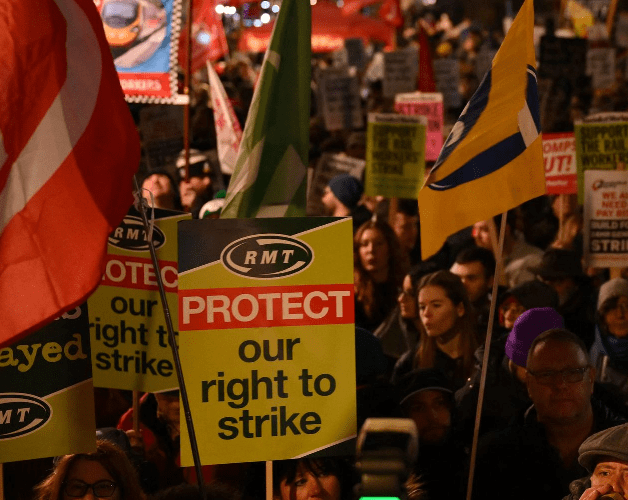
The Annual General Meeting of the RMT has unanimously passed a motion from the union’s Bakerloo line branch, reaffirming the union’s strong opposition to all anti-strike laws, and committing to call a national demonstration by 28 October.
The motion also resolves to continue working with a number of campaigning organisations active on the issue, including Free Our Unions. We look forward to continuing to work with RMT to build opposition and defiance to restrictions on our rights to strike and organise.
We republish the text of the motion below.
FOR A NATIONAL DEMONSTRATION AGAINST ANTI-STRIKE LAWS
This AGM notes:
1. The ongoing strike wave, and the Tories’ plans to impose new anti-union laws in response.
2. Existing RMT AGM policy to call a national demonstration against anti-union laws.
This AGM believes:
1. To stand any chance of blocking the implementation of the new laws, an assertive campaign against them, and to demand a full right to strike, will be necessary. Even if the laws are passed, the labour movement will be in a far better position to confront and defy them if we have spent the period prior to implementation engaged in active campaigning to resist the laws.
2. Protests called by RMT, at Downing Street and in local constituencies, were a good start, and must be followed up with further action, including a national demonstration.
3. Such a demonstration should ideally be called by the TUC, or as wide-as-possible a coalition of unions, but if this cannot be achieved, must be called by those unions prepared to act.
This AGM resolves:
1. That RMT will organise a Saturday national demonstration against anti-strike laws, taking place no later than Saturday 28 October, with the following demands in line with Union Policy:
– No to new anti-strike laws
– Repeal all existing anti-strike and anti-union legislation
– For a full right to organise and strike
– Solidarity with all striking workers
2. To approach other trade unions and the TUC to invite co-sponsorship and participation in organising the demonstration.
3. To invite co-sponsorship and participation in organising the demonstration from relevant campaign groups backed by the union, including the Campaign for Trade Union Freedom, Free Our Unions, and the National Shop Steward Network.
4. To give the maximum degree of assistance and support to Regional Councils and branches in mobilising members and organising transport to the demonstration from their areas.
New campaign video out now

A supporter of our campaign has produced a new video on the fight against anti-strike laws.
Watch and share!
US Supreme Court rules against unions
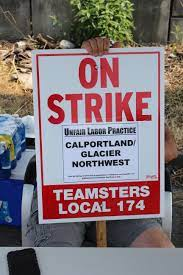
An article reporting on a legal attack on the right to strike in the USA, reposted from the Labor Notes website.
By Alexandra Bradbury
The U.S. Supreme Court’s decision in Glacier Northwest v. Teamsters Local 174 is outrageous—valuing property over workers’ rights. But it could have been much worse.
Unions still have the right to strike. Employers still can’t generally sue unions in state court for losses caused by strikes. But the decision does open the door to whittling away those rights more in the future.
The practical impact of the Court’s decision is that employers will be suing unions more often for alleged property damage caused by strikes—and that therefore unions (and their attorneys) are likely to be more cautious.
But the Court did not do what many had feared it would do in this case: overrule longstanding precedent that employers generally cannot sue unions in state court over activities—like strikes—covered by the National Labor Relations Act.
Instead, it found that this case fell under an already-existing exception for failure to take reasonable precautions to prevent foreseeable, imminent, aggravated damage to employer property.
Workers and unions are right to be furious at this ruling. But we should be careful not to sensationalize or overstate it—which could do more damage to the right to strike than the ruling itself does, by making workers scared to exercise it.
“American workers must remember that their right to strike has not been taken away,” said Teamsters President Sean O’Brien in response to the ruling. “All workers, union and nonunion alike, will forever have the right to withhold their labor.” His statement went on:
The Teamsters will strike any employer, when necessary, no matter their size or the depth of their pockets. Unions will never be broken by this Court or any other.
Today’s shameful ruling is simply one more reminder that the American people cannot rely on their government or their courts to protect them. They cannot rely on their employers.
We must rely on each other. We must engage in organized, collective action. We can only rely on the protections inherent in the power of our unions.
HARDENED CONCRETE
The question the Supreme Court considered in the Glacier case was whether the employer could sue Teamsters Local 174 in state court over the allegedly intentional destruction of the company’s concrete when striking drivers who had set out with deliveries of ready-mix concrete returned their loaded trucks, requiring the company to dispose of it before it set.
Prior court cases say that an employer can’t sue a union in state court over activity arguably covered by the National Labor Relations Act. Instead, the employer has to go to the National Labor Relations Board.
There is an exception, though, if striking employees don’t take reasonable precautions to protect employer property. For example, in one case, employees walked out of a foundry when molten iron was ready to be poured—which the court found could have caused substantial property damage.
This exception is narrow: property damage that is caused by a lack of reasonable precautions. It doesn’t include things like economic losses due to temporary closure of a store or factory, strawberries rotting in the field because farmworkers are on strike, or milk going sour in the fridge because baristas have walked out.
The trial court in Washington state dismissed Glacier’s claim because it found that the Teamsters’ strike action was arguably protected under the National Labor Relations Act. The Washington State Supreme Court affirmed.
The United States Supreme Court has now overruled that decision and sent the case back to the trial court, because it says that—assuming the facts alleged in the employer’s complaint are true—the union did not take reasonable precautions to prevent concrete from hardening.
The Supreme Court did not order the trial court to decide against the union, just that the case be allowed to proceed. And it left open the possibility for the state courts to dismiss the case again, depending on what the NLRB does about a pending unfair labor practices complaint against Glacier related to the same strike.
The NLRB issued its complaint against Glacier after the Washington State Supreme Court affirmed dismissal of the state court case. The U.S. Supreme Court explicitly did not rule on whether the lawsuit would have been preempted if the NLRB had issued the complaint earlier.
CHIPPING AWAY
Depending on how future cases play out in state and federal court, Glacier could end up being a relatively small change to labor law or another in an escalating series of court decisions chipping away at the right to strike.
Already the laws are stacked against powerful strikes. Employers routinely obtain injunctions limiting where and how many strikers can picket; economic strikers can be permanently replaced; secondary targets often can’t be picketed; and so on.
Comparisons to other areas of law, like abortion rights, are useful. Roe v. Wade was not overturned in one night. It took nearly 50 years of legal battles in which courts questioned and undermined Roe v. Wade, until a conservative majority finally overruled it.
Similarly, right-wing attorneys and judges will try to build on Glacier to expand employers’ ability to sue unions. But for the moment, the labor movement may have dodged a bullet.
CORRECTION: This article originally stated that the exception to preemption applied when strikers caused intentional damage or failed to take reasonable precautions. It has been amended to make clear that the only criterion is failure to take reasonable precautions; intent is not considered.
Free Our Unions fringe meeting at Unison NDC: 14 June, 6:30pm

Free Our Unions supporters in Unison are holding a fringe meeting at the union’s National Delegate Conference, to discuss building resistance to anti-strike laws.
The meeting will take place at 6:30pm on Wednesday 14 June, at The Liverpool pub, 14 James Street, L2 7PQ.
We’ll share further details as they’re confirmed.
 Free Our Unions