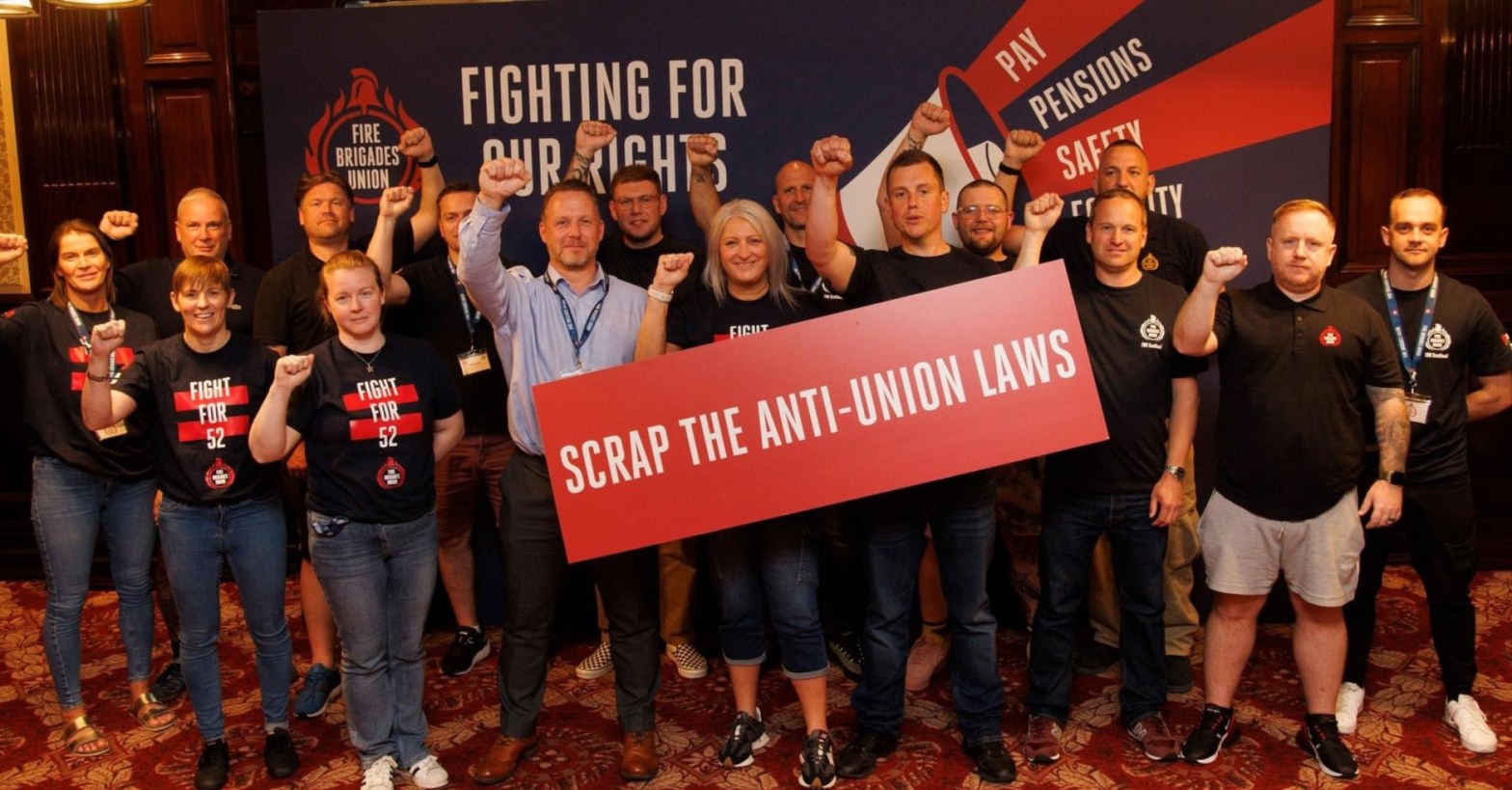
By Sacha Ismail, member of Unison and FBU
The labour movement should organise and campaign to pressure the Labour government to ensure that at least the following is included in its upcoming workers’ rights legislation:
- Complete repeal of the 2016 Trade Union Act
- Complete repeal of the 2023 Minimum Service Levels (Strikes) Act, with no “replacement” such as codes of conduct
- Repeal of the 2022 amendment to the agency worker regulations allowing use of agency workers as strike-breakers
- Amendment of the law to allow workplace and electronic balloting for strikes / industrial action.
See also this motion submitted to TUC Congress 2024 by the Fire Brigades Union (FBU).
Free Our Unions fights for the labour movement to campaign for repeal of all the anti-trade union laws, going back to 1979, and their replacement with strong legal rights for workers and unions, including a strong right to strike. Since our campaign began, we have argued against the idea that repealing the most recent anti-union laws is enough. But in the weeks and months ahead, while maintaining our wider demands, we should bring voice and pressure to bear for the Labour government to carry out its recent commitments on repealing the recent ones.
But is that necessary? If Labour has made commitments recently then it’s committed, surely?
That is not the right way to see things. Here’s why.
In general this Labour leadership and government are not reliable when it comes to carrying out pro-working class demands. Moreover they are undoubtedly continuing to come under major pressure from big business, pressure they are constitutionally inclined to respond to. They have already rowed back on a series of earlier commitments on workers’ and trade union rights.
Labour’s commitments
Beyond those general considerations, let us review where we are on the right to strike and repealing anti-union laws.
The latest version of Labour’s “New Deal for Working People”, published just before the election, does commit to repealing the Trade Union Act 2016, the Minimum Service Levels (Strikes) Act 2023, and the Conduct of Employment Agencies and Employment Businesses (Amendment) Regulations 2022 – the last of which allows the use of agency workers as striker-replacements. It also commits to modifying the anti-union laws to “allow modern, secure, electronic balloting and workplace ballots” for strikes / industrial action. (See p12 here.)
This final pre-election version of the document was published after extensive negotiations with Labour-affiliated trade unions, including a union pushback after rumours about the party watering down the New Deal.
The Labour general election manifesto did not mention these specifics, but did commit to “implementing ‘Labour’s Plan to Make Work Pay: Delivering a New Deal for Working People’ in full” (emphasis added – the plan referred to is the latest version of the New Deal discussed above).
Rowing back?
Discussion about Labour rowing back on some of its workers’ rights commitments have not tended to focus on the question of anti-strike laws. But:
• The government has announced non-implementation and repeal of the Minimum Service Levels Act. But there is now silence on the question of the Trade Union Act – and now reports in the media that the government may amend rather than fully repeal the Act, lowering the turnout threshold for strike votes contained in the legislation rather than abolishing it and maintaining the two week notice period it introduced. The Trade Union Act has been instrumental in hamstringing public-sector strikes in particular over the last decade, notably in the NHS.
• There are also reports that the government may not repeal the amendment to the agency worker regulations on the grounds that it was struck down by the High Court. But the court ruled against the change on grounds of lack of consultation, and the Tories explored bringing it back in a new form. The amendment should be repealed.
• In this context, it does not seem impossible the government could row back on the Minimum Service Levels law too, for instance by promoting “voluntary” codes of conduct for minimum service levels that would still undermine strikes.
This is all vague? Yes, but the problem is the whole situation we find ourselves in is “vague”. We do not have clarity on what the government will do and so everything is reduced to speculation. But silence, reports and the general character of the Labour leadership mean that we should not assume everything will be good. Instead, we should organise, speak out and campaign.
Time to campaign
Labour movement celebration about repeal of the MSL law is fair enough, but it needs to be a springboard for further pressure and demands – which can block further backsliding, maximise what we win now, and put us in the best position to push forward to wider gains. The problem is that instead much of our trade union leadership is presenting it as “job done”.
We should seek to organise and mobilise as much of the labour movement as possible to demand that, in regards to the right to strike, at least the following are included in upcoming employment rights legislation:
• Complete repeal of the 2016 Trade Union Act
• Complete repeal of the 2023 Minimum Service Levels (Strikes) Act, with no “replacement”
• Repeal of the 2022 amendment to the agency worker regulations
• Amendment of the law to allow workplace and electronic balloting.
Labour should, in line with policy passed at its conference, TUC Congress and numerous union conferences, be going much further – to repeal all the anti-trade union laws. The labour movement should start seriously raising that. But holding the party to its general election commitments is the absolute bare minimum we should be demanding immediately.
Rather than resting on its laurels the labour movement should mobilise and agitate through as many channels as possible to make these demands. We need to discuss how.
 Free Our Unions