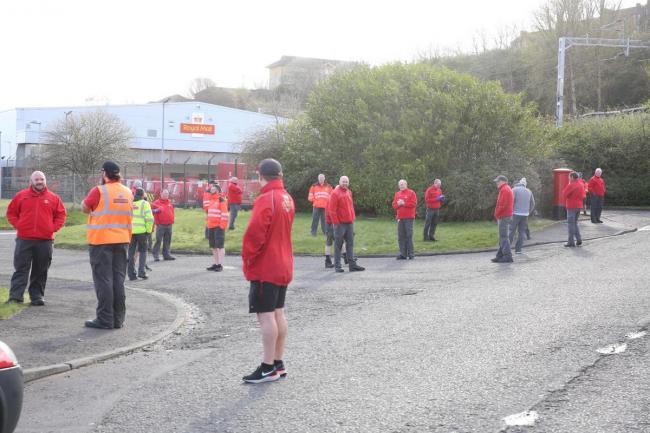
Image: a socially-distanced picket line of postal workers, during a wildcat strike for workplace safety.
By Riccardo La Torre and Sacha Ismail
Originally posted on the website of the Fire Brigades Union, here.
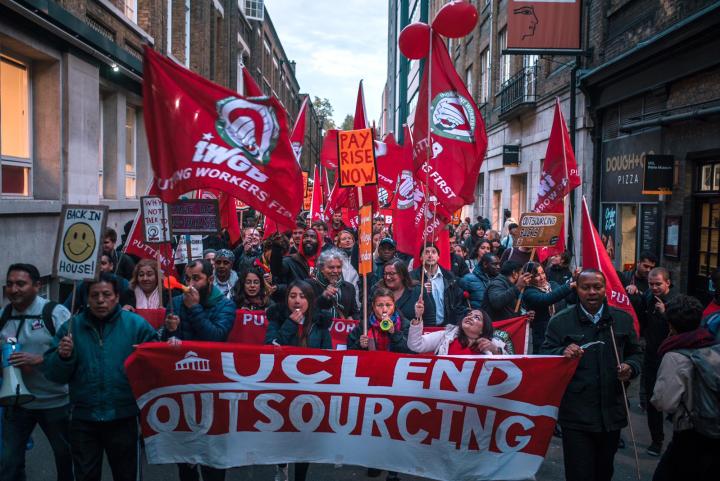
Since the Covid-19 crisis hit, many workers, including those working in hospitals, libraries, construction and in the postal service, have taken unofficial industrial action to stand up for themselves and for safety.
In the face of a government disastrously dragging its feet and putting profits above lives, these actions highlight the central role of workers’ struggles in defending rights, winning new ones and changing society.
During this crisis, employers have not suspended their organisation or paused their struggle against workers. The workers’ movement should not suspend its fight either, but instead do our best to maintain and step it up.
The walkouts we have seen are examples of grassroots workers’ action, decided by workers themselves according to the needs of their struggle – not rules imposed from outside and above, including by the government.
The lockdown and the right to strike
Our movement should welcome this kind of grassroots initiative. In this crisis, moreover, such action is more necessary than ever.
In the midst of the pandemic and lockdown, there is debate about whether the restrictive system that oversees the authorisation of industrial action – endured since Thatcher – is still functioning.
In this crisis, some of the organisations which run legal industrial action ballots on behalf of unions have said that they no longer feel confidently able to perform this function whilst guaranteeing their workers’ safety.
This is not the fault of these organisations or their workers – who deserve the same right to safe working as anyone – but of the anti-trade union laws. There may be immediate ways to resolve this problem, which unions should of course explore; but the issue highlights the absurdity of the law which requires a postal ballot for industrial action to be legal.
Unions and the Labour Party should loudly demand the urgent introduction of alternative balloting methods – including but not limited to online ballots – so that the “normal” right to strike is clearly restored and strengthened.
However, even with online balloting, the bureaucratic hoops workers have to jump through to strike make quick and decisive action impossible: notify an employer of a ballot (seven days), conduct the ballot (usually two weeks or more), and notify the employer of action (two weeks).
When workers are being put in danger through unsafe working practices, such as a lack of PPE, they need to be able to act straight away, not wait weeks and months. This is no better demonstrated than by the Royal Mail workers who recently felt forced to walk out over unsafe working practices, later organising safe and effective socially distanced picket lines.
Firefighters, who regularly put themselves at risk to help others and are highly attuned to issues of health and safety, are also keenly aware of this need to act quickly to address unsafe working practices.
All of this emphasises why workers taking unofficial action deserve support. And why unions using health and safety law to legally organise a refusal to work, without ballots, is a tactic that should be supported, too.
Abolish the anti-union laws
More broadly, on a political level, the issues surrounding the right to strike illustrates why we must fight to radically change the law, so that all workers can decide for themselves when, how and for what demands they take action. We must repeal the laws and abolish the restrictions imposed by Thatcher and Major, maintained under Blair’s New Labour and built on by a new generation of Tories.
First of all, the proposal for new restrictions on transport workers – essential workers heroically providing an essential service in this crisis, but whom the Tories cannot wait to get back to attacking as soon as possible – must be dropped.
Beyond that all anti-union laws must go – not just the 2016 Trade Union Act, which added another layer to the anti-worker structure, but all of them. A position supported unanimously by FBU conference.
The fact that workers feel the need, and sometimes the confidence, to take unofficial action does not negate the fact that the anti-union laws are a serious problem, one which cannot simply be ignored. They are serious barriers to workers taking action, to the building of effective workplace organisation and to unions campaigning confidently and aggressively.
The policy of the movement
Repealing all anti-union laws is a position clearly supported by Labour Party members: recent polling shows they back it 5-1. It is the policy adopted by the party’s democratic structures: since 2015, Labour conference has voted four times to commit to this. It is also the position of the trade union movement, adopted unanimously at TUC Congress 2019 – thanks to the FBU.
At the moment, however, these policies are largely dormant and gathering dust on the left. They should be argued and campaigned for, as a matter of urgency.
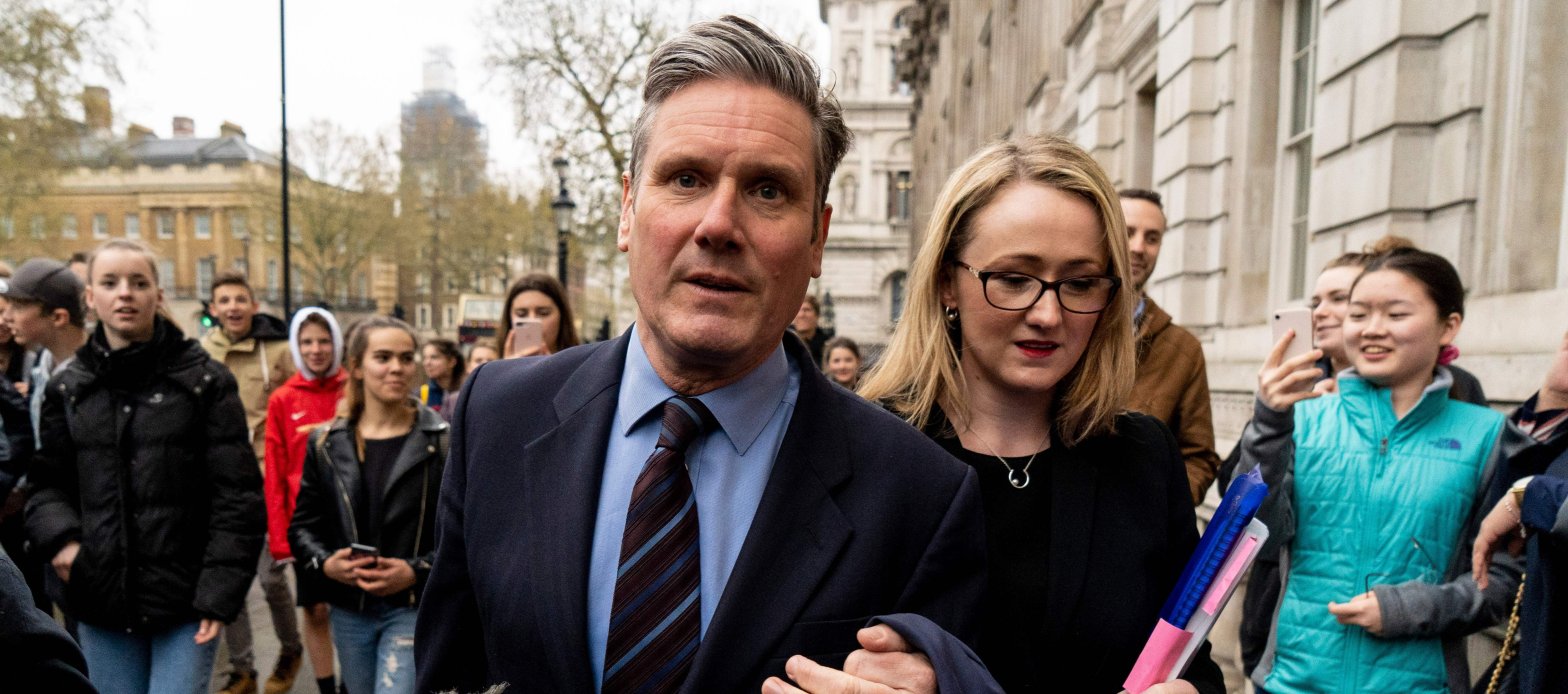
That means we should challenge the new Labour leadership on this. In the campaign to be leader, Keir Starmer emphasised his championing of human rights and his support for workers’ struggles in the past. Angela Rayner was an active trade unionist and not long ago explained clearly and eloquently why all the anti-union laws must go.
Trade unionists and Labour activists should push the party leadership to prove themselves once more by respecting the decisions of Labour Party conference, TUC Congress, and to pledge to lead the movement in the fight against these oppressive laws.
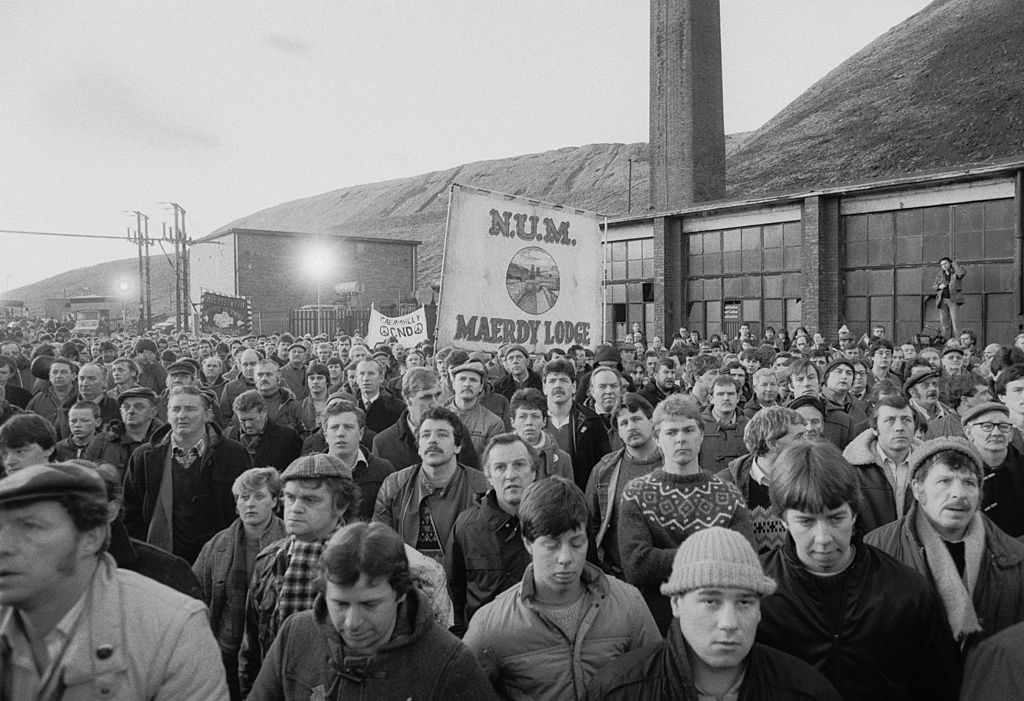
The national fire service strike of 1977, the Grunwick dispute, the iconic Miners’ Strike of ‘84, and the women of Ford Dagenham have shown us how inspiring and powerful our struggle can be when it isn’t shackled by anti-union laws – and why defying and overturning them in the modern era is now key.
The Covid-19 crisis should cement the belief that asserting and demanding – in practice and in law – a real, meaningful right to strike is not some piece of nostalgia, but a cornerstone of our rights as human beings, and workers. If we remember that, we can not only survive this brutal present, but also win a better future.
Riccardo is an FBU National Officer; he and Sacha are activists in the Free Our Unions campaign which organises around these issues and is supported by the FBU (read more in this blog). For more information and to get involved, visit the Free Our Unions website or email freeourunions@gmail.com


 Free Our Unions