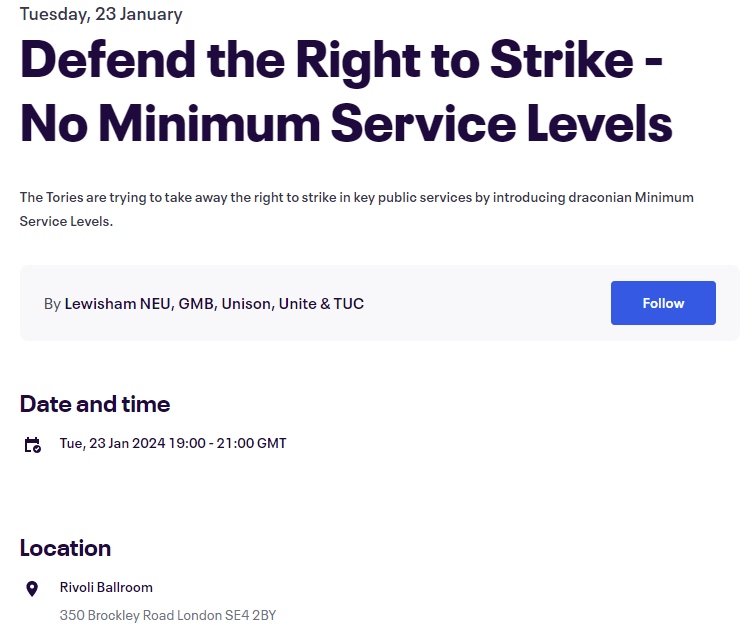
Several unions in the borough of Lewisham, south London, have called a joint campaign meeting on 23 January to plan activity opposing the Tories’ new anti-strike laws.
The meeting will take place at 7pm in the Rivoli Ballroom, 350 Brockley Road, SE4 2BY. Book your place via Eventbrite here.
After TUC special congress: defiance needs action, not just words
By a Free Our Unions supporter
Perhaps the most significant sentence in the resolution passed by the TUC special congress, held on 9 December to discuss the Tories’ latest anti-strike laws, is a commitment that unions will “refuse to tell [their] members to cross a picket line.”
If seriously enacted, this can only mean unions refusing to take the “reasonable steps” to ensure members comply with work notices which the law requires of them. That is the only collective form that “defiance”, “non-compliance”, or “resistance” can realistically take: unions refusing to tell members to comply with work notices and persisting with strikes in the face of injunctions or fines.
But it will take considerable work to bridge the likely gulf between words and deeds. Sadly we currently have a distinctly “telling-members-to-cross-picket-lines” culture in the movement. In multi-union industries, it is standard for non-striking unions to explicitly instruct their members to cross the picket lines of striking unions. Unions telling members to cross their own picket lines may be seen as a bridge too far, even by conservative officials, but with most unions currently not prepared to risk the relatively minor confrontation with the law required for them to tell members not to cross other unions’ picket lines, getting them to straightforwardly refuse to comply with the new law around work notices will be no small task. Nevertheless, it is necessary.
That the special congress, the TUC’s first in 40 years, even took place is significant. The passing of the last legal restriction on strikes, the 2017 Trade Union Act, saw the TUC organise a single lobby of Parliament, and little else. The tone of many delegates’ speeches was clearly defiant. Unite general secretary Sharon Graham said: “Real solidarity to push this back may take us outside the law […] It is better to break the law than break the poor.”
Turning that defiant tone into defiant action means the special congress must be the start of an ongoing campaign, not an opportunity for left bureaucrats to adopt a militant posture before returning to business-as-usual.
The resolution also includes a commitment to campaign for employers to refuse to issue work notices, as the Scottish Government has already done. Some Labour councils, such as Sheffield and Islington, have passed motions, some more strongly worded than others, opposing the law, without explicitly committing to refuse to enact it (even though it seems clear they could do so: Holyrood has faced no rebuke from Westminster for its stance).
Several Labour mayors and council leaders, including London’s Sadiq Khan, have signed a letter criticising the law. It says they will “explore every possible option to avert any prospect of work notices being issued in our areas.” Local and regional TUCs, along with individual unions, must organise local campaigns designed to solidify that “exploration” into explicit commitments not to issue work notices.
Some other language in the resolution, however, is ducking-and-diving dressed up as “resistance”. For example, the commitment to “support affiliates in deploying novel and effective forms of industrial action to maximise resistance to work notices”. Exactly what “novel and effective” forms of action this might entail is not clear, but in any case, calling overtime bans (hardly novel) instead of strikes will not be “resistance to work notices”, but a retreat to an often less impactful form of action in order to “get round” them. This may be tactically necessary in some situations, but it should not be seen as an alternative to building for direct defiance.
The question of a national demonstration has also been fudged. The resolution commits the TUC to organising a national march in Cheltenham in late January, to commemorate the 40th anniversary of the ban on trade unions at GCHQ. That will be positive, but it is not a substitute for what the original TUC congress resolution, and multiple individual unions’ own policies, call for: a national demonstration in London against all anti-strike laws. If, as now seems clear, the TUC will not call such a demonstration, a coalition of as many unions as possible should call it directly. Unions like RMT and FBU, which have been the most vocal on this issue, should take a lead.
Whilst the resolution commits to maintaining pressure on Labour nationally to honour its promise to repeal the law, and implement its New Deal for Working People, it is unfortunate the text did not go further and call for Labour to repeal all legal restrictions on the right to organise and strike. Given that successive TUC congresses, including the one which resolved to call the special congress, have called for this, for the special congress resolution to hold back from restating that demand, and to instead blandly praise Labour’s proposed New Deal as “ambitious”, is a significant watering-down.
The Tories passed the new law, which they initially floated in 2019, in response to the 2022-3 strike wave. Notwithstanding that wave, the labour movement remains in a weak condition. That weakness cannot be overcome at will. But if the better elements of the TUC’s resolution are to be more than warm words, they must lead to the empowering of local labour movement bodies to run campaigning in towns and cities that builds a real movement not only against the new legislation, but against all anti-strike laws.
Sheffield City Council opposes MSL law
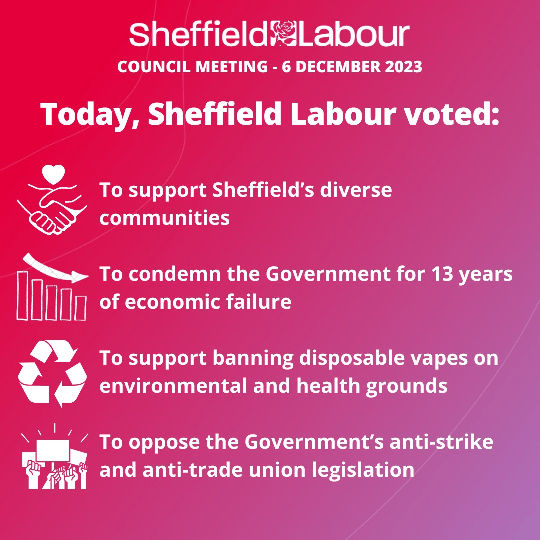
At its 6 December, Sheffield City Council passed a resolution opposing the Tories’ new Minimum Service Levels Act.
Sheffield joins other Labour-led local authorities, including Islington, in publicly opposing the law. None, however, have so far gone as far as the Scottish Government and made an explicit commitment not to issue work notices.
The text of Sheffield’s resolution is below, and online here (pp10-11).
That this Council:-
(a) notes:-
(i) the right to strike is a fundamental British freedom which is protected by international law; this can be seen in the Human Rights Act, Article 11 of the European Convention on Human Rights, the International Labour Organisation’s Convention 87 and Article 6(4) of the European Social Charter;
(ii) the Strikes (Minimum Service Levels) Act 2023 sets out that when employees in relevant sectors democratically vote to strike they can be required to work and sacked if they don’t comply;
(iii) the Joint Committee on Human Rights has expressed concern that this legislation is not compatible with the UK’s commitments to human rights for workers and trade union members; and
(iv) the Regulatory Policy Committee has determined that the impact assessment for this Bill was ‘not fit for purpose’;
(b) believes:-
(i) the Strikes (Minimum Service Levels) Act 2023 is a direct attack on the right to strike fundamental freedom;
(ii) that consecutive Conservative Governments have been carrying out brutal attacks on trade unions for decades, culminating with this most recent attack on the right to strike;
(iii) that this Government, instead of tackling the causes of the cost-of-living crisis, are attempting to cut through the recent wave of strikes by trying to shift the blame from profiteering bosses who have manufactured unsustainable levels of inflation, on to ordinary workers who are exercising their right to fight for dignity and fair pay at work and in their lives;
(iv) the regime initiated by the Strikes (Minimum Service Levels) Act 2023 is draconian, unnecessary and unworkable;
(v) the Act undermines constructive industrial relations and is likely to inflame and prolong disputes; and
(vi) that this Act is a direct attack on the freedoms of the ordinary, hardworking residents of our city; and
(c) resolves:-
(i) to ask the Strategy and Resources Policy Committee to consider how the Council will, if it can use provisions in the Act, continue to protect the rights of its workers to strike and how it should be reflected in our policies, such as the ethical procurement policy;
(ii) to raise these concerns with all relevant bodies – including the Fire and Rescue Authority, Health boards, and any other relevant bodies with employee status;
(iii) to work with local unions and our trades council to oppose this legislation together as effectively as possible; and
(iv) to write to the Rt. Hon. Sir Keir Starmer and demand he pledges an incoming Labour government to reverse fines and other measures taken against any union under the terms of the Strikes (Minimum Service Levels) Act 2023.
We need to get serious about what “non-compliance” means
This is a discussion article written by a Free Our Unions supporter. To respond, please email freeourunions@gmail.com.
The Trades Union Congress meets for a special congress on Saturday 9 December, to discuss the new “minimum service levels” anti-strike laws and possible resistance to them. The congress is only scheduled to take place for a few hours, and it seems likely most unions’ delegations will be comprised of senior national officials. There has been no opportunity for wider democratic scrutiny of whatever proposal the TUC general council plans to put to the congress, and therefore no opportunity for rank-and-file bodies within unions to propose amendments or additions.
A lobby is planned outside the congress venue; it is good there will be some agitational presence, but given the lack of transparency and scrutiny over what the congress will actually debate, it is hardly clear what attendees will be “lobbying” delegates to do. The resolution from the TUC’s regular congress which mandated the organisation of a special congress also included commitments to build a campaign of “non-compliance”, as well as a national demonstration. The latter commitment is the easier; it is frankly scandalous that, despite the plans for MSL laws being first announced in the Tories’ 2019 manifesto, the only on-the-streets mobilisations against them have been a few midweek-evening rallies outside Parliament, coinciding with votes on the bill, and one protest organised by Free Our Unions in alliance with Earth Strike UK.
A national demonstration would never have stopped the laws by itself, and now the bill has become an act, certainly won’t lead to its repeal. But it could have been, and could still be, a focal point for mobilising opposition and an element in a wider campaign. Organising a national demonstration is something the TUC could organise more or less at will. Several unions have also had longstanding policies to call a demo. If the special congress fails to set a date for one, a “coalition of the willing” of individual unions should take the initiative. It is an affront to their internal democracy that they have failed to act on the decisions of their own annual general meetings.
The question of “non-compliance” is more complex, but must be seriously confronted. So far, there has been some stirring but less-than-specific talk from union leaders about, variously, “non-compliance”, “defiance”, and “resistance” to the laws. Some have talked about the need for mass strikes to protest the sackings of any workers dismissed for defying the law. But this latter proposal frames resistance as something devolved to individual workers, with the mass movement then taking action to defend them if they are disciplined. Given that such action would itself likely require breaking existing laws (e.g., the ban on strikes in solidarity with other workers), it makes little sense to defer the question of defiance in this way.
There is significant potential for political campaigning focused around demands on employers to refuse to issue work notices. The legislation says only that employers “may” issue work notices, not that they must, leaving individual employers free to decide not to, thereby enabling “all-out” strikes to take place. The Scottish Government has already taken this step; other employers, especially transport authorities administered by Labour administrations such as Transport for London, could easily follow suit. Given that Labour has committed to repeal the law within its first 100 days in government, it would be ludicrous if its administrations were involved in enacting in now, given there is no legal requirement for them to do so.
But it is certain that some employers — especially the Westminster government itself — will issue work notices. The movement as a whole therefore needs to be clear about what “non-compliance” with the law will mean in practise. The point at which unions, as collective organisations, are expected to “comply” with the law is by “taking reasonable steps to ensure” that members named in work notices do in fact attend work during strikes. Therefore, the only possible form of “non-compliance” is for unions to refuse to take such steps, and to then persist with strikes in the face of any resultant court injunctions, or potential fines, arising from their failure to cajole their own members into scabbing. This will be a level of direct confrontation with the state that the British labour movement has not undertaken in a generation. It is not something to be advocated lightly. But, unless we are to accept a continual narrowing of our horizons and a slow grinding down of unions from potential instruments of class struggle into glorified insurance brokers and personal-injury lawyers, it is necessary.
It is also clear that senior trade union officials, with an “institutional” relationship to unions and tasked with protecting its finances, will be extremely reticent to commit to a course of action that risks those finances. There is no immediate easy fix for this problem; bigger, wealthier unions could commit to underwrite any fines faced by smaller unions, giving them more confidence to defy the laws without risking total financial collapse, but this would require a significant increase in a culture of practical solidarity. Given different unions within the same industry invariably instruct their members to cross the picket lines of other unions, this might be deemed unlikely.
One possibility is that unions may attempt to fulfil their legal obligations in a bare-minimum way — for example sending members a pro forma email saying words to the effect of, “You have been named in a work notice and it is our legal obligation to encourage you to attend work”. Again, this would make the question of defiance an individual, rather than collective, matter. If this happens, workers named in work notices should aim to refuse “en masse” rather than in ones-and-twos. But workers will unquestionably be in a stronger position if our unions, as organisations, defy the law, rather than grudgingly complying and hoping individuals resist.
As significant as the 2022-3 strike wave has been, the stark reality is that the labour movement is not in good health. Union membership is declining, and shop floor organisation in any workplaces is threadbare. It is a marker of the less-than-ideal situation that the largest and most forceful strikes in the NHS, for example, have been organised by craftist professional associations like the RCN and BMA, rather than the largest union, Unison. Attempting to organise mass defiance of the law from this low base, shaped by years of defeats and an entrenched culture of compliance with the already heavily-restrictive legislative regime, is difficult. But the very least we can do is talk specifically about what defiance must mean in the current context, and seek a serious discussion in the movement about what will be necessary to achieve it.
The 9 December TUC special congress seems likely to be only a truncated and stage-managed forum for such discussion. Rank-and-file activists must seek to organise others, within the structures of their own unions, through Trades Councils, and via campaigning bodies like Free Our Unions.
Lobby the TUC special congress, 9 December
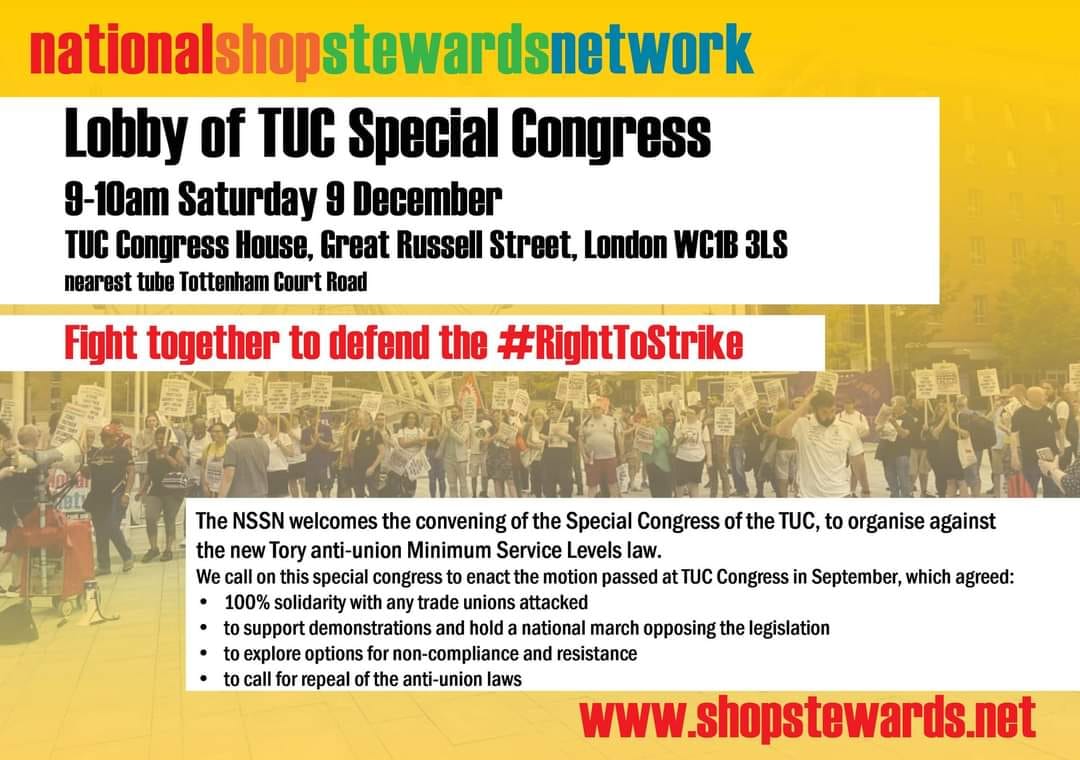
The National Shop Stewards Network has called a lobby outside the TUC special congress, 9-10am, Saturday 9 December, at Congress House (Great Russell Street, London WC1B 3LS).
The special congress has been called following a resolution to the TUC’s regular congress in September, which also called for a campaign of “non-compliance” and a national demonstration against anti-strike laws.
Please join the lobby to demand that the TUC enacts its democratically-agreed policy.
For more info, see the NSSN website here.
TUC calls special congress for 9 December
The Trades Union Congress has called a special congress for 9 December.
The TUC’s website says:
The TUC has announced it will hold a special Congress to discuss the next stage of campaigning against the Conservatives’ anti-strike laws.
The event will take place at Congress House on Saturday 9 December 2023, from 10am-1pm.
The TUC says more details on the special Congress will follow in the coming weeks, including on media accreditation.
It is rare for the TUC to seek to convene the whole trade union movement at a special Congress outside of the TUC’s usual flagship annual event in September.
A special Congress last took place over 40 years ago in 1982, to fight Margaret Thatcher’s anti-union legislation.
The TUC points to exceptional circumstances given the “unprecedented attack on the right to strike”.
New regulations
The announcement comes after the government laid regulations for minimum service levels in rail, the ambulance service and border security.
Ministers have said these new rules will be rushed into force by the end of the year. Ministers are also consulting on rules affecting workers in hospital settings, schools, universities and fire services.
This is despite warnings from unions and employer groups that the plans are unworkable.
The laws will mean that when workers lawfully vote to strike, they could be forced to attend work – and sacked if they don’t comply.
TUC research found a massive 1 in 5 workers in Britain – or 5.5 million workers – are at risk of losing their right to strike as a result of the Strikes (Minimum service levels) Act.
TUC General Secretary Paul Nowak said:
“After 13 long years of Conservative government, nothing works in this country anymore.
“But instead of getting on with fixing the mess they have created, the Conservatives are hellbent on making things worse.
“These new laws represent an unprecedented attack on the right to strike. They are unworkable, undemocratic and almost certainly in breach of international law.
“This is the last thing our crumbling public services or our dedicated frontline workers need – these draconian laws will poison industrial relations and drag out disputes.
“The UK already has some of the most restrictive trade union laws in Europe. Now the Tories want to make it even harder for people to win fair pay and conditions.
“That’s why we are calling this once in a generation special Congress.
“Unions will keep fighting this spiteful legislation. We won’t stop until it is repealed.”
Tories announce minimum service levels: prepare defiance!
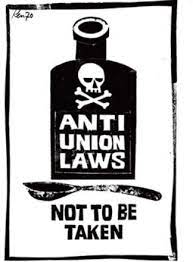
The government has now set the minimum service levels in three of the sectors covered by the new Strikes (Minimum Service Levels) Act.
For Border Force and some HM Passport Office staff, the minimum service stipulates that services “should be provided at a level that means they are no less effective than if a strike were not taking place”, and must “ensure all ports and airports remain open.”
For ambulance staff, the minimum service level says “vital services” must continue “throughout any strike”, with all life-threatening calls, or calls “where there is no reasonable clinical alternative to an ambulance response” are responded to.
For passenger rail, the minimum service level has been set at 40% of timetabled train services. For strikes by rail engineering and infrastructure workers, the minimum service level stipulates that services must be able to run on a series of “priority routes”, between 6am and 10pm.
The government’s wording is less than specific. What does “a level that means they are no less effective than if a strike were not taking place” actually mean? On the rail, how does a requirement to run 40% of timetabled services translate into determining a staffing complement involving signalling and maintenance staff, as well as station staff and train crew?
The legislation itself gives the government license to be unclear, because the responsibility for issuing the “work notices” that specify the staffing required, and will actually compel workers to attend work, lies with individual employers. The Act says employers “may” issue work notices, but not that they must. That means there is significant scope for labour-movement campaigning to demand that employers refuse to do so.
The Scottish government has already said it will not comply with the legislation, by not issuing work notices. This means that, for example, workers on government-run ScotRail services will be unaffected by the law and can continue with all-out strikes. Other public authorities run by parties that oppose the Act should make a similar commitment — for example, Sadiq Khan’s mayoralty in London. Khan is the chair of the Transport for London board; a commitment from him that TfL and subsidiary companies such as London Underground Ltd. will refuse to issue work notices would have a major impact.
Our unions must campaign to demand these commitments, but we can’t rely on them. We also need organisation to prepare direct defiance if work notices are issued. Individual workers defying work notices in ones and twos could be picked off — mass defiance will, obviously, be immeasurably more powerful.
The Trades Union Congress has called a special congress for 9 December to discuss resistance to the laws. That’s an important step and could be an important forum for discussion and coordination. But the congress is only scheduled to take place from 10am to 1pm; how much can really be discussed or decided in three hours? Union branches, Trades Council, and regional and national bodies within unions must also call meetings to discuss and plan campaigning. The meeting called by Battersea and Wandsworth Trades Council on 29 November is one example.
Currently, Labour is committed to repealing the Act when next in government, as well as the 2016/7 Trade Union Act which legislated for turnout thresholds in ballots. But without pressure, it will go no further, and may renege on even these commitments. A new initiative from the Greater London Combined branch of the CWU aims to mobilise union bodies to apply that pressure.
The labour movement as a whole needs a three-fronted campaign: holding Labour to its commitments and pushing them further; demanding employers refuse to issue work notices; and preparing mass defiance if and when work notices are issued.
Free Our Unions aims to empower rank-and-file union activists — with briefings, bulletins, model motions, and other resources — to push within their unions for increased activity on this issue. The new laws are not only an attack on workers’ rights, but an attack on democracy.
Nottingham East CLP calls on Labour councils “not to cooperate” with anti-strike legislation
Nottingham East Constituency Labour Party has passed a resolution calling on Labour councils “not to cooperate” with new anti-strike legisation.
They can do this by committing, in advance, to refuse to issue or enforce the “work notices” the Tories’ Minimum Service Levels Bill says employers “may” issue. Councils taking this stance could mean that workers in local education authority (LEA) schools, and any council-operated transport services, would not face work notices undermining their strikes.
Activists are due to meet local Labour councillors to discuss the “no work notices” demand. The text of the resolution is below.
The TUC Congress overwhelmingly passed a motion against the Tories Minimum Service Levels legislation which effectively outlaws strikes in public services and other industries which they regard as essential like transport, health, social services etc.
Congress calls on the next Labour government to immediately repeal MSLs, the Trade Union Act 2016 and take urgent steps to remove other anti-union laws. Congress pledges 100% solidarity with any trade unions attacked under these MSL laws. Congress agrees we must use all means necessary to defeat the unjust MSLs laws.
We welcome Keir Starmer announcing that Labour will repeal that legislation on coming to power and so we call on councillors and other representatives of the Labour Party to state they will not cooperate with that legislation.
How do we defeat the anti-union laws? – meeting hosted by Battersea & Wandsworth Trades Council, 29 November

A public meeting organised by London labour movement organisations, hosted by Battersea and Wandsworth Trades Council at the Bread & Roses
7pm, Wednesday 29 November
The Bread & Roses, 68a Clapham Manor Street, London SW4 6DZ
The Tories’ Minimum Service Levels law represents a huge new attack on our already heavily suppressed right to strike. TUC Congress in September voted for a campaign of resistance and non-compliance. What does that mean in practice? How do we build that campaign? And can we simultaneously build the level of political pressure necessary to force a Labour government to repeal the anti-union laws, not just the most recent ones but all of them (as the TUC policy also demanded)?
We will also discuss how this fight connects to organising against low pay, precariousness and outsourcing. The meeting will hear from London PCS facilities management workers in dispute and hold a collection for their strike fund.
You can just turn up but if possible please register to give us a sense about numbers. You can also make a donation to the PCS members in dispute by opting for a paid registration.
Provisional speakers will include (more info shortly):
• Maria Exall, TUC President 2022-3 and Communication Workers’ Union (CWU) Greater London Combined
• Riccardo la Torre, National Officer and anti-union laws lead for the Fire Brigades Union (FBU)
• Plus reps and activists from unions including PCS, RMT and Unison
Join us to discuss how we take forward this crucial struggle for our movement.
More information: paulette_romain@hotmail.co.uk (Paulette Romain, PCS London and SE Regional Chair)
Register via Eventbrite
Free Our Unions organising meeting — 7pm, Thursday 19 October
Log in via Zoom here
Meeting ID: 835 3823 9276
Passcode: 683428
Join us for our next open organising meeting, held via Zoom at 7pm on Thursday 19 October.
Our organising meetings are open to all supporters of the aims of our campaign. We’ll be discussing:
• A report-back from Labour Party conference
• A campaign to demand employers commit to refusing to issue work notices
• The new initiative launched by the Greater London Combined branch of the CWU
 Free Our Unions
