VIDEO: Discussing anti-strike laws with the Green Party Trade Union Group

On Friday 20 August, Free Our Unions co-organiser Daniel Randall addressed the Green Party Trade Union Group’s monthly meeting. A video of Daniel’s presentation, and the subsequent discussion, is below. Scroll down for an edited transcript of Daniel’s opening speech.


My name’s Daniel Randall, I’m a railway worker and a rep for the RMT union. I’m speaking here as a co-organiser of Free Our Unions. Thanks very much for the invite, I’m looking forward to this discussion.

I’ll start by giving a quick introduction to what Free Our Unions is and what we do, for those that may not have heard of us. We’re a grassroots labour movement campaign against anti-union and anti-strike legislation, that exists to raise awareness of how such legislation makes our lives as workers worse. We organise information campaigns, public events, and direct action, and our supporters are active inside their own unions fighting for those unions to adopt a radical approach to these issues. We’re supported by four trade unions at national level – FBU, RMT, PCS, and IWGB – and dozens of local union branches and committees, as well as some Labour Party organisations.

Free Our Unions organises on a very open basis, via open organising meetings. We produce regular briefings and materials for supporters to use in their workplaces and communities. We don’t want that to be a passive relationship, whereby passive supporters dutifully hand out materials produced by some distant centre, but an active one, whereby supporters themselves are producing materials explaining the relevance of anti-union laws to the spheres of activity they’re involved in. If you want to stay in touch with our campaign on an individual level, there’s a contact form you can fill in on our website.

The Green Party TU Group has already taken a strong stance, in policy terms, against anti-union and anti-strike legislation, so I’m fairly confident I don’t have to spend any time convincing you that it’s necessary to oppose them.

Nevertheless, as trade unionists who organise on a day-to-day basis within the constraints these laws impose on us, including their deadening effecting on consciousness, it can be useful to take a step back and think about the issue in context, in order that we can strengthen the foundations of our opposition. So what I’d like to do with this talk – and I don’t intend to speak for more than 15 minutes – is give a bit of background in terms of how we in Free Our Unions approach the issues, and then talk about why I think there are particular possibilities for collaboration between our campaign and yourselves as Green trade unionists, that I hope we can explore.

As I’m sure many of you know, Britain has what Tony Blair once, proudly, called “the most restrictive union laws in the western world.” How unions organise, when and how we can take industrial action, and over what issues, are all severely restricted by this legislative regime. Any worker aged around 45 or under has spent more or less their entire working life under it. The laws which most constrain us today began to be introduced under Thatcher, and were progressively added throughout the subsequent decades of Tory rule and, disgracefully, were left entirely intact by 13 years of Labour government.

The constraints of these laws seem so solid that it often feels somewhat fantastical to imagine things could ever be any different. The idea, for example, that workers could get together in the staff room or canteen, take a vote there and then to strike, and walk out the door – and for that to be perfectly legal and legitimate – seems unimaginable to many…

…to such an extent that well-meaning figures in our own movement recoil from the ostensible radicalism of demanding the restoration of such rights, and feel it necessary to cringingly preface their comments about anti-union laws with assurances that “no-one wants to go back to the bad old days of the 1970s.”

There was indeed much about the 1970s that was bad – both in general, and in terms of the trade union movement as it was then (or so I’m told: I wasn’t there personally). But we should make no apology for aspiring to least the levels of legislative freedom and social power that organised labour had then – and in fact much greater levels.

That contraction of horizons also leads to a tendency to think of anti-union laws really only in terms of the most recent – the 2016 Trade Union Act, which included the imposition of turnout thresholds in industrial action ballots. But that law is only one facet of the legislative restrictions on our rights to organise and take action, and in many ways not the worst. So a big focus of our work in Free Our Unions has been to try and resist, and push back against, that ideological retreat to only talking about the most recent anti-union laws, and maintain a perspective of confronting the older laws – the laws which prohibit workplace balloting, which prohibit striking in solidarity with other workers, and which prohibit striking over political issues.

It’s an important moment for the labour movement to step up our campaign against these laws now because this legislative regime is set to get worse. I’m sure you’ve all heard of the Police Bill; that bill will restrict yet further our rights to protest and dissent. Free Our Unions has published an extensive briefing examining the effect the bill will have on unions and workplace organising, which you can read on our website, freeourunions.org.

Beyond this, the Tories also have a manifesto commitment to implement so-called “minimum service requirements” during transport strikes, something that will obviously directly affect me and my workmates, and you and yours if you work in the transport industry. It’s not yet clear exactly how they envisage the system working here, but in other countries with similar laws, they often involve transport unions designating a section of their membership as exempt from striking so those workers can provide the legally-stipulated “minimum service”, meaning unions essentially have to facilitate scabbing. The political aim here is very clear: to minimise the impact of strikes, and essentially reduce them to the status of a protest rather than a leveraging of workers’ power.

We don’t know what the timescale for the implementation of the new law is yet. Government priorities have obviously been recalibrated by the pandemic, but this is something the government is still committed to and could decide to bring forward at any time. If these new laws are passed, they won’t stop with transport workers. The government already has a list of “essential services” which are subject to additional restrictions under the 2016 Trade Union Act, which includes education, healthcare, and the fire service. If they impose “minimum service requirements” on transport workers, I have no doubt those sectors will be next.

I want to talk now about some specific points of convergence between the fight against anti-union laws and your potential political priorities as Green trade unionists. In the interests of full disclosure, I myself am a Labour Party member and a supporter of the revolutionary socialist group Workers’ Liberty. But, although some of our activity historically has been oriented to policy issues within Labour, Free Our Unions isn’t a solely Labour-focused campaign.

The first point of convergence I want to suggest is around the question of democracy. I know the Green Party is strongly committed to democratic reform; I would argue that restrictions on the right to strike are one of the most significant brakes on meaningful democratic action in Britain today, and that repealing anti-union and anti-strike laws would represent as meaningful an expansion of democracy as reforming the electoral system.

Without a full right to strike, we’re essentially subject to the dictatorship of the boss. Democracy ends as soon as we set foot in the workplace. In a context in which our hard-right, nationalist government is proposing legislation to restrict the right to protest, to further restrict workers’ rights to organise and strike, gerrymandering constituency boundaries, and more, I think you have to say that this adds up to a serious assault on democracy. The first mass workers’ movement in this country, Chartism, was a movement for democracy, a movement against the dictatorship of the rich. The contemporary labour movement needs to reclaim some of that spirit today, and I think you, as members of a party strongly committed to an expansion of democracy, could help to leaven that by making campaigning against anti-union laws a strategic priority.

The second point of convergence is around the obviously central question of climate change. As I’m sure many of you know, the origin of the term “green” as a political label lies in a trade union struggle – the “Green Bans” movement of Australian construction workers in the 1970s, who leveraged their class power, their power over production, to shut down environmentally and socially destructive construction projects. If you’re not familiar with this episode I strongly urge you to learn about it; in my view it is one of the world-historic high-points of rank-and-file-led trade unionism that was both politically and industrially radical. So, if only in a nominative sense, the Green tradition is linked to a class-based, workplace-based, union-based struggle.

We desperately need a new “Green Bans” movement today. We need workers to have the freedom to strike not only over narrow economic issues – so-called “official trade disputes” – but over political issues, so that they could leverage their class power to demand radical climate action from the government. We need the freedom to strike in solidarity with others, including with youth climate strikers. And workers in high-emissions industries need to the freedom to strike to demand transition and conversion, recapturing the spirit of the Lucas Aerospace workers who, in the 1970s, developed a plan to repurpose their employer’s productive capacity away from making military hardware in order to make medical equipment and renewable energy technology. I imagine that the statement “climate change is caused by capitalism” is uncontroversial in this room; if that’s the case, and if we see the working class as a key anti-capitalist actor – the key anti-capitalist actor, I would argue – then we are impelled to confront the legal shackles the capitalist state has placed on us, in order to protect itself.

Free Our Unions is currently supporting Earth Strike, a network of anti-capitalist activists that emerged from the climate strike movement, in a new initiative called “Empower the Unions”. This initiative aims to connect trade unionists and climate activists, drawing on traditions of working-class direct action for the environment, such as the Green Bans movement, the Lucas Plan, and more recent struggles like the occupation of the Vestas wind turbine factory on the Isle of Wight in 2009, in order to highlighting how anti-union laws inhibit such action today. That’s one specific area of activity in which I’d invite Green Party trade unionists to work alongside us.

The formal political situation in this country is very bleak, and I’m sure none of us expect, on any kind of short or medium-term timescale, the election of a government likely to repeal these laws. I think it will be a social imperative to break and defy these laws much sooner than we have any prospect of seeing them repealed. In fact, I believe that’s already the case. But I also believe that continually highlighting these laws, raising consciousness around them, and explaining their essential nature as statutory weapons of class warfare in the hands of the bosses and their state, which menace the future of the planet as well as constraining our democratic rights, and demanding their abolition – even when that demand isn’t immediately likely to be won… these are all essential parts of the means by which our movement can develop the confidence to defy the laws.

That, ultimately, is what Free Our Unions exists to do, and if you agree with the perspective I’ve sketched out today, I hope we can discuss how we might work together to advance it.


Andy McDonald MP says: “Labour is committed to repealing anti-union laws”.

Andy McDonald MP, Labour’s Shadow Secretary of State for Employment Rights and Protections, has said “Labour is committed to repealing anti-trade union laws”. This is a welcome commitment; we urge Andy and the Labour Party to go further, and state concretely what this commitment means.

Even under Jeremy Corbyn and even at the high point, policy-wise, of the 2019 manifesto, the Labour leadership’s stance on repealing the anti-union laws and promoting the right to strike remained unclear and inadequate. (See here for what we said in some detail at the time.) There is no reason to thinking that the Starmer leadership will do better without a lot more pressure.

Here are some of the issues:

• At the moment the party’s official announcements say nothing about the anti-union laws or about the right to strike. A tweet from a Shadow Cabinet member and an article on LabourList are no substitute for the whole leadership arguing for this vocally. Again, it is worth noting that even Corbyn’s leadership was reticent to talk about the anti-union laws (except the 2016 Trade Union Act) and even more reticent to talk about, let alone enthusiastically champion, the right to strike. We need clarity and we need vocal and active campaigning.

• “Repeal anti-trade union laws”? Which ones? There were nine in place before Tony Blair came to office in 1997 (for a list and review of them, see here; for a summary of their impact here). The 2016 Trade Union Act added another storey to an already very tall building.

• Under Labour’s plans, will workers be any more restricted in their rights to strike, picket, etc., than they were before 1979, when anti-strike laws were imposed by Thatcher? If so, in what ways? And why?

• Will workers still have to go through slow, carefully regulated balloting procedures? What is wrong with – among other possible methods – simply meeting together and voting to strike, as was possible before the 1980s? Why shouldn’t workers decide themselves how they want to take decisions about industrial action?

• Will 1980s restrictions on picketing, in terms of numbers and which workplaces can be picketed, remain?

• Will the ban on striking in solidarity with other workers remain? (Note that before Thatcher workers could strike in solidarity with any other workers, not just those separate from but connected to them in some degree.)

• Will the ban on striking over wider social and political issues than just industrial disputes remain?

The labour movement should push for clarity on these questions. It should demand they are answered in line with the clear policies passed at Labour Party conference and TUC Congress (see here) for repeal of all anti-union laws and their replacement with strong positive rights, including to strike and picket.

Labour has clear conference policies on repealing ALL the anti-union laws. It should fight for them!

The Labour leadership is making a series of policy announcements about workers’ rights, coming out of the “Workplace Power” review overseen by Deputy Leader Angela Rayner and Shadow Secretary of State for Employment Rights Andy MacDonald.

On Twitter, in response to a question from Momentum, and in an article on LabourList, MacDonald said that “Labour is committed to repealing anti-trade union laws”.

This is welcome as far as it goes, but what exactly it means remains to be seen.

The whole Labour Party, including its leadership, should recognise, argue and campaign for the policies on this agreed by Labour Party conference. This is something we advocate both for reasons of labour movement democracy and because the policies agreed by Labour conference are clear and strong.

What are they?

Labour conference policy

• The 2015 conference voted unanimously that “Workers’ rights, including the right to strike, are essential to the labour movement’s ability to stand up for workers’ interests, and democracy”. And that a Labour government should “introduce a comprehensive package of employment rights compliant with ILO core conventions and European human rights obligations… legislate for strong rights to unionise, win recognition and collective bargaining, strike, picket and take solidarity action”.

• The 2017 conference voted unanimously that “Strong unions, freed from legal shackles and bolstered by positive legal rights, will be key to tackling poverty, insecurity and inequality, transforming society and creating an economy that works for the many, not the few. For unions to be effective, workers need an effective right to strike”. And therefore to: “Repeal the TU Act and anti-union laws introduced in the 1980s and 90s” (ie under the Thatcher and Major Tory governments).

• The 2018 conference voted overwhelmingly that “Labour will form a radical government; taxing the rich to fund better public services, expanding common ownership, abolishing anti-union laws and engaging in massive public investment”.

• The last Labour Party conference, in 2019, voted overwhelmingly twice (in two separate motions) that “in power Labour will… repeal all anti-union laws, facilitating worker-led activism over social and political issues, including climate change.” To make itself even clearer, the same conference also voted by a clear majority to reference back part of the National Policy Forum’s “Economy Business and Trade” report dealing with these issues, with the following written explanation: “This is inadequate. The 2017 Conference unanimously passed a policy repealing the anti-trade union laws implemented by the Conservative governments in the 1980s and also the 2016 Trade Union Act… This has so far not been widely reported or noticed. The policy document should reflect Labour Party policy and state clearly the importance of introducing strong legal rights to join, belong and recruit others to a union, to strike and to picket freely including in solidarity with other workers”.

TUC Congress policy


The Labour leadership should also take on board the policy passed by TUC Congress 2019 (in addition to those passed by many individual unions):

“Congress welcomes recent Labour Party conference policy (2015, 2017, 2018) to repeal all anti-union laws and replace them with strong legal rights for workers and unions, including rights to strike and picket.

“Congress believes it is crucial the next Labour government acts quickly to implement this policy.

“Congress believes workers need strong rights to join, recruit to and be represented by an independent union; strike/take industrial action by a process, at a time and for demands of their own choosing, including in solidarity with any other workers and for broader social and political goals; and picket freely…

“Congress welcomes Labour’s commitment to reviving collective bargaining but believes that – to quote the Institute of Employment Rights – “collective bargaining without the right to strike is collective begging”.”

Support the Bexley refuse workers – rally at Bexley Civic Offices, 21 July, 6pm!

Picture taken from the Justice for Refuse Workers and Cleansers Facebook page

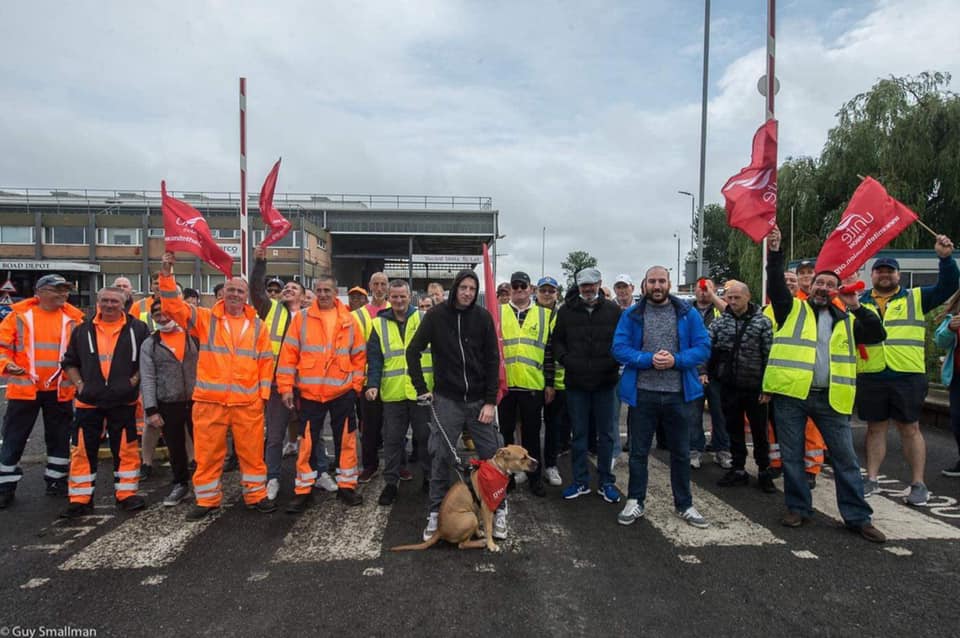
Unite reports “heavy handed policing” of the strike by refuse workers in Bexley, South East London, over the living wage, pay progression and back pay.

Unite’s Ruth Hydon says: “We want to be very clear to the police that their heavy-handed approach to a perfectly legal picket must stop. Our members have a right to withhold their labour and picket their workplace and it is simply not acceptable for the police to intimidate them.”

The strikers and their supporters will rally on Wednesday 21 July at Bexley Civic Offices, 2 Watling Street, Bexleyheath DA6 7AT, from 6pm. See you there!

Labour Women’s Conference says: repeal all anti-union laws!

The Labour Party Women’s Conference, held online in late June, passed a motion demanding: “Repeal all anti- trade union laws and create new rights and freedoms for trade unions to help them win a better deal for working people.”

This was part of a composite motion on “women and the economy”, which can be viewed online here.

The motion adds to the growing library of strong policies passed across the labour movement, including the Labour Party, supporting the repeal of all anti-union and anti-strike laws. Rank-and-file activists must ensure our movement turns these words into action and organises strong and active campaigning against anti-union legislation.

Empower the Unions launch videos now online

Free Our Unions is supporting Empower the Unions, a new initiative from Earth Strike UK, a group of anti-capitalist activists in the climate movement. The campaign aims to unite environmental activists and trade unionists to resist laws that prevent unions from fighting for the climate. Check out the Facebook page here.

Videos from the online launch event are now available. We share a selection here.

Speakers included Professor Gregor Gall; Daniel Randall, RMT activist and Free Our Unions co-organiser; Dave Smith of the Blacklist Support Group; Verity Burgmann, co-author of Green Bans, Red Union; Janine Booth, RMT Disabled Members Advisory Committee secretary; and Vicki Morris, editor of the Save Vestas blog during the Vestas wind turbine factory workers’ occupation.


Panel featuring Gregor Gall, Daniel Randall, and Vicki Morris

Janine Booth on why and how we should fight anti-strike and anti-union laws

Verity Burgmann, co-author of Green Bans, Red Union, on the legacy of Australian construction workers’ “green bans” movement of the 1970s

Blacklisted former construction worker Dave Smith on what we can learn from the “green bans” approach

A legal briefing from Professor Gregor Gall

An introduction to Empower the Unions

Online meeting – 7pm, Tuesday 20 July (REARRANGED) – 1871 and the fight for free trade unions

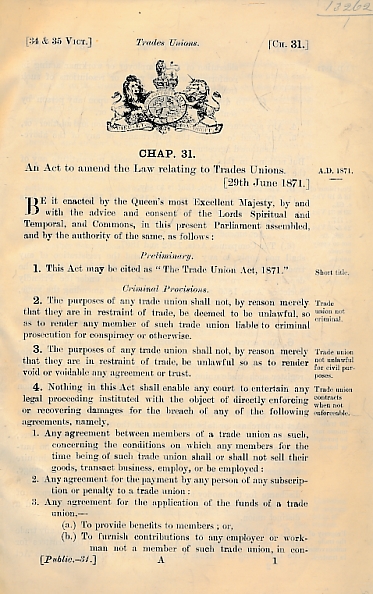
Join the Free Our Unions campaign and the Fire Brigades Union for a meeting and discussion marking the 150th anniversary of the 1871 Trade Union Act, to draw lessons from the 19th century struggle for our fight against anti-union laws and for free trade unions for today. This meeting has been rearranged from 29 June.

Speaker: Simon Hannah, Lambeth Unison branch secretary, author, and Free Our Unions activist

Chair: Riccardo La Torre, National Officer, Fire Brigades Unions

Tuesday 20 July, 7pm
Log in via Zoom here

June 2021 is the 150th anniversary of the 1871 Trade Union Act, which fully legalised unions in the UK. It was followed in 1875 by an act which legalised picketing. The result is that in the late 19th century trade unions and workers’ struggles were far less legally restricted than they are today.

In 1799 unions were banned by the Combination Acts. They were partially legalised in 1824, but this was quickly followed by harsh restrictions on trade union action – restrictions remarkably similar in content to what exists now.

The 1871 and 1875 victories were the result of half a century of militant working-class struggle. They were also the result of the radical political movements which erupted in the late 1860s and 1870s.

What lessons can we learn from these events for the fight to free our unions from anti-union laws and state and employer interference today?

Log in via Zoom here.
Facebook event here.

Earth Strike UK: Empower the Unions – online rally, 2pm, Sunday 27 June

Free and active unions have a vital part to play in the just transition to a zero-carbon future. The anti-union and anti-strike legislation designed to suppress union activity is a direct obstacle to a greener world.

Earth Strike UK: Empower the Unions is a new initiative by Earth Strike UK, supported by Free Our Unions. Empower the Unions aims to unite environmental activists and trade unionists to resist legislation that restricts our rights to organise and strike and empower unions to take the action necessary to safeguard our future.

Join us at 2pm on Sunday 27 June for an online rally to kick off this new campaign!

The rally will feature contributions from activists including:

• Janine Booth (Secretary, RMT Disabled Members’ Advisory Committee)
• Dave Smith (Blacklist Support Group)
• Verity Burgmann (Co-author of Green Bans, Red Union: The Saving of a City)
• Gregor Gall (Industrial relations professor and labour movement activist)
• Vicki Morris (Socialist activist involved in the Vestas wind turbine workers’ campaign in 2009, editor of the Save Vestas blog)

Sign up to attend here. Facebook event here.