Court win on right to strike

By Janine Booth, Free Our Unions supporter

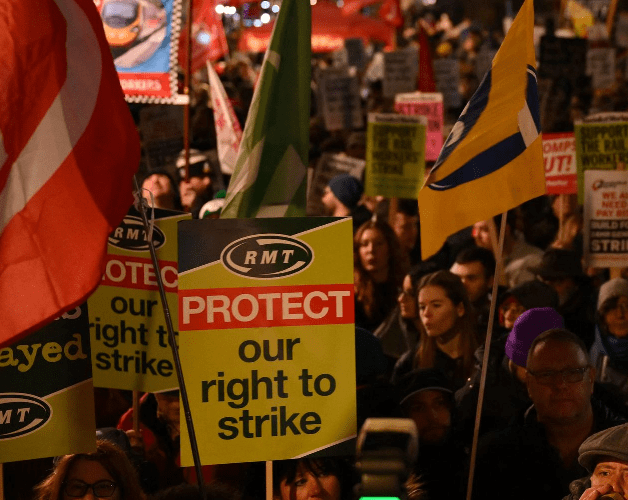
The UK Supreme Court ruled on Wednesday 17 April that UK law allowing employers to discipline (but not sack) workers for striking is in conflict with the European Convention on Human Rights (ECHR).

The judges stated that, “If employees can only take strike action by exposing themselves to detrimental treatment, the right dissolves” and added that “it is hard to see what pressing social need is served by a general rule that has the effect of excluding protection from sanctions short of dismissal for taking lawful strike action”. 

The ECHR is incorporated into UK law by the Human Rights Act 1998. The usual course following a judgment such as this is that the UK government will table a ‘statutory instrument’ to Parliament to correct the conflict – in other words, to specify in UK law that it is unlawful for employers to discipline workers in any way for taking part in official industrial action.

However, it is possible that a Tory government worrying that its days are numbered may decide not to do this – as there is no legal requirement for it to do so – or may decide instead to repeal the ECHR provisions or even the whole Human Rights Act. Right-wingers have frequently called for this, often on the basis of spurious (and racist) arguments about ‘foreign criminals’.

Until UK law is amended to comply with today’s judgment, employers are still allowed under UK law to discipline strikers, although any striker disciplined can take a case to the European Court of Human Rights. However, this is a lengthy process. Today’s judgment concludes a case that has taken four years.

Trade union Unison took the case to employment tribunal in 2020 on behalf of its member, care worker Fiona Mercer. The union won the initial court case, but while the employer was willing to accept the result and not appeal, the Tory government appealed and succeeded in overturning the tribunal decision. Today’s judgment overturns the appeal result and restores the original decision.

Unison reported that the Supreme Court judges were “scathing of the government’s failure to provide the minimum protection UK workers should have been granted”.

Fiona had been involved in a dispute her employer, north-west-based charity AFG, over its plans to cut sleep-over payments.

UNISON general secretary Christina McAnea said: “This is the most important industrial action case for decades. It’s a victory for every employee who might one day want to challenge something bad or unfair their employer has done.

Fiona Mercer said: “I’m delighted at today’s outcome. Although it won’t change the way I was treated, it means irresponsible employers will now think twice before behaving badly towards their unhappy staff. If they single strikers out for ill-treatment, they’ll now be breaking the law.”


The full text can be found here.

Leeds Council opposes anti-strike laws

Leeds City Council has passed a resolution opposing the government’s “Minimum Service Levels” Act. Although the resolution stops short of an explicit commitment to never issue work notices, it takes a strong stance in favour of the right to strike.

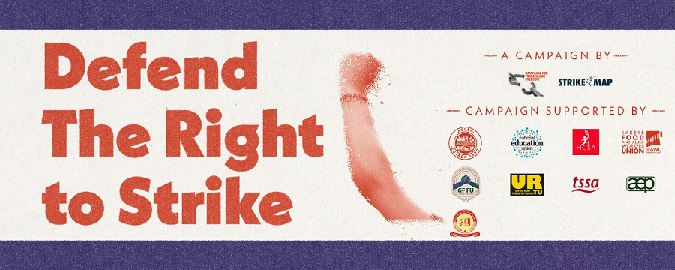
The text of the resolution is below, and available on the council website here. Leeds joins other Labour councils, including Sheffield and Islington, in taking such a stance. StrikeMap and the Campaign for Trade Union Freedom are currently running an online campaign encouraging people to write to their local representatives to demand councils make “no work notices” pledges.


That Council believes that the right to strike is a fundamental British freedom and believes that the Strikes (Minimum Service Levels) Act 2023 is just the latest direct attack on this freedom.

Council regrets the over the past 14 years the Government have continually eroded pay, and to an even greater degree when inflation hit a 41 year high of 11.1%.

Council regrets the Government’s failure to deal with the cost-of-living crisis and failure to outlaw poor employment practices, which Council believes have caused recent strike action.  Council further regrets this legislation as an attempt to shift the blame onto ordinary workers who have resorted to striking to achieve fair pay and dignity at work.

Council further believes that the regime created by the Strikes (Minimum Service Level) Act 2023 is both unworkable and unnecessary and is an attack on the freedoms of working people in Leeds.

Council resolves to request a paper to Executive Board to consider these issues further and calls on the Government to repeal anti-trade union legislation.

Write to your councillor to demand “no work notices”

The Campaign for Trade Union Freedom, Strike Map, and a number of other organisations have partnered to launch a new initiative encouraging activists to write to their local councillors to demand councils commit not to issuing work notices.

Some councils have already passed policies opposing the Minimum Service Levels Acts, and the Scottish and Welsh devolved governments have made “no work notices” commitments. One Academy trust has also committed not to issue work notices.

A sustained campaign of pressure could force similar commitments from other employers, including local authorities. You can use the campaign’s online tool to write to your councillors here.

Largest Academy Trust rules out “work notices”: make others do the same!

By an NEU activist in a United Learning School

Schools Week has announced that United Learning (UL), the largest Academy Trust in England, operating 89 schools and employing 7,000 staff, has stated it will not use the Minimum Service Law (MSL) to issue “work notices” instructing staff to strike-break.

The Trust is quoted as saying that use of the law would “damage industrial relations and harm [their] image as an employer”. Use of the law would make it “impossible to retain the goodwill and discretionary effort of staff; harder to retain staff; and the reputational impact would make it harder to attract new staff… In the end, this would have a more negative impact on children and parents than the strikes themselves.”

The Trust describes the MSL as “wrong in principle and in its details likely to be self-defeating in practice.”

Employers are not required to issue work orders under the MSL. UL state it is “inconceivable that any employer will in fact choose to do so.”

That is, in the context of schooling in 2024, a rational management policy and a damning rebuke to the government. UL adds that the idea of a minimum service level was not one that could be “coherently applied to schools”.

A National Education Union (NEU) official informed me that: “The union did not have a role to play in UL’s MSL position and we have not been privy to their reasoning. As far as we are aware they are the first Trust to make this commitment.”

It is essential that the NEU now press every one of the Academy Trusts to make a similar commitment. Activists and reps must not leave this work to officials and union leaders, this is work we should press for right now, using the precedent created by UL as a lever to get similar pledges across the sector.

After Cheltenham demo: keep up campaigning, build for open defiance

By a Free Our Unions supporter

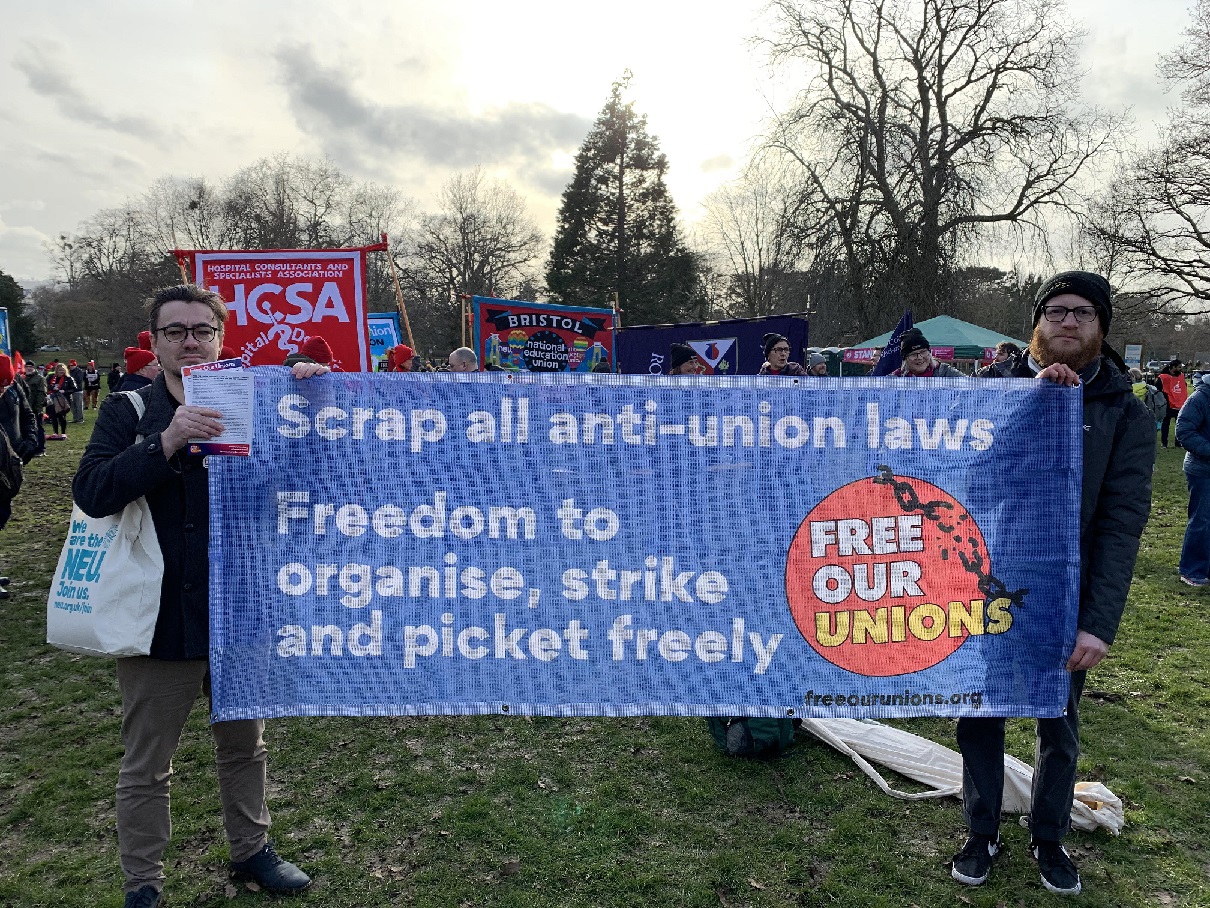
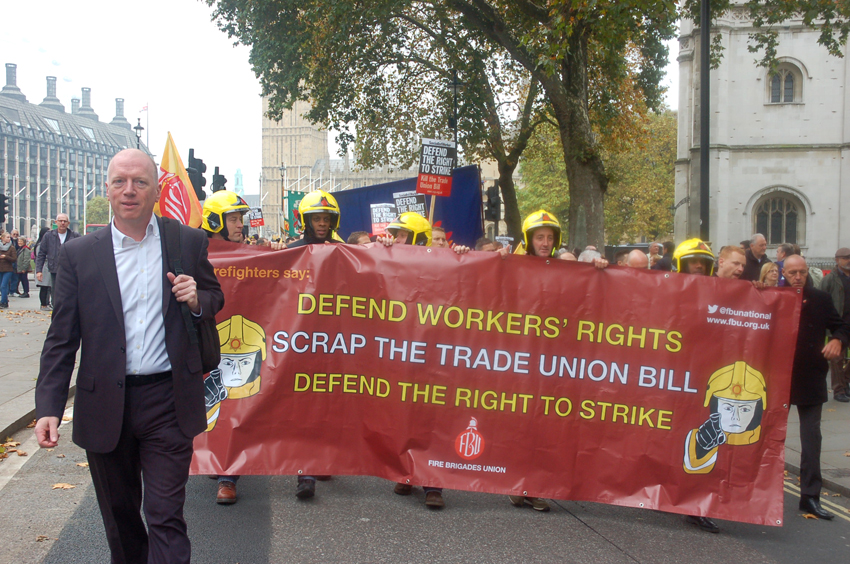
Thousands of trade unionists marched in Cheltenham today (27 January), to mark the 40th anniversary of the Thatcher government’s ban on unions at Government Communications Headquarters (GCHQ), and protest contemporary anti-strike laws, including the new Strikes (Minimum Service Levels) Act.

That the demonstration took place at all is positive. For the trade union movement to mobilise as the trade union movement, bringing together unions from across the economy, is important in itself. The Cheltenham demonstration must be the launchpad for an ongoing campaign against anti-strike legislation that seeks to build open defiance.

Further demonstrations must take place in London. Actions elsewhere in the country are important, but visible protest in the capital and principal seat of power are essential. And unions must step up their mobilisation. Many marchers reported their unions’ mobilising efforts as sluggish, reflected in a fairly small turnout which had mostly drifted away before the rally had finished.

At that rally, there were stirring words in many union leaders’ speeches. Unite’s Sharon Graham gestured towards defiance, invoking the slogan of the 1921 Poplar Labour councillors’ rates rebellion to declare “it’s better to break the law than break the poor.” The RMT’s Mick Lynch reminded the crowd that “the official position of the TUC is for non-compliance.” The NEU’s Daniel Kebede said that, whilst Labour’s commitment to repeal the Minimum Service Levels Act was welcome, it must be a “first step”, and that unions must push Labour to go further and repeal all legal restrictions on the right to organise and strike.

But Lynch was also on the mark when he opened his speech by promising the dwindling crowd that he would be brief, as “no-one wants to hear a load of general secretaries waffling on”. Unfortunately, and whilst there were some rank-and-file voices on the platform, that is mostly what the rally consisted of. And with few real signs of unions using their resources to generate ongoing campaigning, involving their grassroots members, it is hard to see even the better speeches as much more than hot air.

Where defiance was referred to, it was often posed as something that would happen in the event that a worker was sacked for defying work notices. But a mass strike to protest such a sacking might well involve a confrontation with the law itself: if unions are prepared to countenance such a confrontation, why wait for anyone to be sacked? Why not go for confrontation with the law at the earliest possible point in the process, by refusing to take the “reasonable steps” called for by the Act to ensure members comply with work notices?

Undoubtedly, many union leaders are now in “get Labour into power” mode, having little strategy for winning reform beyond this. Whilst a Labour government will be preferable to a Tory one, simply waiting for it is not good enough. And, if Labour does not feel under pressure from sustained campaigning, there is a risk it will backslide on its existing commitments, and will certainly not go beyond them.

The rank-and-file conference called for in the FBU’s motion to TUC congress would be a useful place to discuss how to build the campaign we need. In the meantime, union branch meetings, Trades Councils, and campaign meetings can provide space for discussion and coordination.

Troublemakers At Work meeting on the Minimum Service Levels with Tim van Tinteren (Aslef), Emma Runswick (BMA), and Ian Allinson (Author of Workers Can Win) – 7pm, 1 Februaryclick here for details

Free Our Unions public meeting with Matt Wrack (FBU GS and TUC President) – 7pm, 15 Februaryclick here for details

Online meeting – Thursday 15 February, 7pm: The fight for the right to strike, with Matt Wrack (FBU)

After the TUC Special Congress of 9 December, and the demonstration in Cheltenham on 27 January, what are the next steps in the fight against anti-strike laws – not only the most recent, but all existing restrictions on our right to strike?

Join Free Our Unions for a discussion meeting, with speakers including Matt Wrack, General Secretary of the Fire Brigades Union and President of the TUC, and more TBC.

Sign up via Eventbrite here

Log in via Zoom here

Meeting ID: 835 3823 9276
Passcode: 683428


How do we beat the Minimum Service Levels Act? Online meeting, 7pm, 1 February

The Troublemakers At Work network, founded at a conference in July co-hosted by Strike Map, NHS Workers Say No, and various other left and labour movement bodies, is hosting an online meeting at 7pm on 1 February to discuss building resistance to the Minimum Service Levels Act.

Speakers:

Tim Van Tinteren, Aslef activist
Emma Runswick, BMA
Ian Allinson, author of Workers Can Win

Chair:

Kate Edwards, NHS Workers Say No

Click here to register for the meeting on Zoom.

23 January: Lewisham unions meet to plan campaigning against anti-strike laws

Several unions in the borough of Lewisham, south London, have called a joint campaign meeting on 23 January to plan activity opposing the Tories’ new anti-strike laws.

The meeting will take place at 7pm in the Rivoli Ballroom, 350 Brockley Road, SE4 2BY. Book your place via Eventbrite here.

After TUC special congress: defiance needs action, not just words

By a Free Our Unions supporter

Perhaps the most significant sentence in the resolution passed by the TUC special congress, held on 9 December to discuss the Tories’ latest anti-strike laws, is a commitment that unions will “refuse to tell [their] members to cross a picket line.”

If seriously enacted, this can only mean unions refusing to take the “reasonable steps” to ensure members comply with work notices which the law requires of them. That is the only collective form that “defiance”, “non-compliance”, or “resistance” can realistically take: unions refusing to tell members to comply with work notices and persisting with strikes in the face of injunctions or fines.

But it will take considerable work to bridge the likely gulf between words and deeds. Sadly we currently have a distinctly “telling-members-to-cross-picket-lines” culture in the movement. In multi-union industries, it is standard for non-striking unions to explicitly instruct their members to cross the picket lines of striking unions. Unions telling members to cross their own picket lines may be seen as a bridge too far, even by conservative officials, but with most unions currently not prepared to risk the relatively minor confrontation with the law required for them to tell members not to cross other unions’ picket lines, getting them to straightforwardly refuse to comply with the new law around work notices will be no small task. Nevertheless, it is necessary.

That the special congress, the TUC’s first in 40 years, even took place is significant. The passing of the last legal restriction on strikes, the 2017 Trade Union Act, saw the TUC organise a single lobby of Parliament, and little else. The tone of many delegates’ speeches was clearly defiant. Unite general secretary Sharon Graham said: “Real solidarity to push this back may take us outside the law […] It is better to break the law than break the poor.”

Turning that defiant tone into defiant action means the special congress must be the start of an ongoing campaign, not an opportunity for left bureaucrats to adopt a militant posture before returning to business-as-usual.

The resolution also includes a commitment to campaign for employers to refuse to issue work notices, as the Scottish Government has already done. Some Labour councils, such as Sheffield and Islington, have passed motions, some more strongly worded than others, opposing the law, without explicitly committing to refuse to enact it (even though it seems clear they could do so: Holyrood has faced no rebuke from Westminster for its stance).

Several Labour mayors and council leaders, including London’s Sadiq Khan, have signed a letter criticising the law. It says they will “explore every possible option to avert any prospect of work notices being issued in our areas.” Local and regional TUCs, along with individual unions, must organise local campaigns designed to solidify that “exploration” into explicit commitments not to issue work notices. 

Some other language in the resolution, however, is ducking-and-diving dressed up as “resistance”. For example, the commitment to “support affiliates in deploying novel and effective forms of industrial action to maximise resistance to work notices”. Exactly what “novel and effective” forms of action this might entail is not clear, but in any case, calling overtime bans (hardly novel) instead of strikes will not be “resistance to work notices”, but a retreat to an often less impactful form of action in order to “get round” them. This may be tactically necessary in some situations, but it should not be seen as an alternative to building for direct defiance.

The question of a national demonstration has also been fudged. The resolution commits the TUC to organising a national march in Cheltenham in late January, to commemorate the 40th anniversary of the ban on trade unions at GCHQ. That will be positive, but it is not a substitute for what the original TUC congress resolution, and multiple individual unions’ own policies, call for: a national demonstration in London against all anti-strike laws. If, as now seems clear, the TUC will not call such a demonstration, a coalition of as many unions as possible should call it directly. Unions like RMT and FBU, which have been the most vocal on this issue, should take a lead.

Whilst the resolution commits to maintaining pressure on Labour nationally to honour its promise to repeal the law, and implement its New Deal for Working People, it is unfortunate the text did not go further and call for Labour to repeal all legal restrictions on the right to organise and strike. Given that successive TUC congresses, including the one which resolved to call the special congress, have called for this, for the special congress resolution to hold back from restating that demand, and to instead blandly praise Labour’s proposed New Deal as “ambitious”, is a significant watering-down.

The Tories passed the new law, which they initially floated in 2019, in response to the 2022-3 strike wave. Notwithstanding that wave, the labour movement remains in a weak condition. That weakness cannot be overcome at will. But if the better elements of the TUC’s resolution are to be more than warm words, they must lead to the empowering of local labour movement bodies to run campaigning in towns and cities that builds a real movement not only against the new legislation, but against all anti-strike laws. 

Sheffield City Council opposes MSL law

At its 6 December, Sheffield City Council passed a resolution opposing the Tories’ new Minimum Service Levels Act.

Sheffield joins other Labour-led local authorities, including Islington, in publicly opposing the law. None, however, have so far gone as far as the Scottish Government and made an explicit commitment not to issue work notices.

The text of Sheffield’s resolution is below, and online here (pp10-11).


That this Council:-
(a) notes:-
(i) the right to strike is a fundamental British freedom which is protected by international law; this can be seen in the Human Rights Act, Article 11 of the European Convention on Human Rights, the International Labour Organisation’s Convention 87 and Article 6(4) of the European Social Charter;
(ii) the Strikes (Minimum Service Levels) Act 2023 sets out that when employees in relevant sectors democratically vote to strike they can be required to work and sacked if they don’t comply;
(iii) the Joint Committee on Human Rights has expressed concern that this legislation is not compatible with the UK’s commitments to human rights for workers and trade union members; and
(iv) the Regulatory Policy Committee has determined that the impact assessment for this Bill was ‘not fit for purpose’;

(b) believes:-
(i) the Strikes (Minimum Service Levels) Act 2023 is a direct attack on the right to strike fundamental freedom;
(ii) that consecutive Conservative Governments have been carrying out brutal attacks on trade unions for decades, culminating with this most recent attack on the right to strike;
(iii) that this Government, instead of tackling the causes of the cost-of-living crisis, are attempting to cut through the recent wave of strikes by trying to shift the blame from profiteering bosses who have manufactured unsustainable levels of inflation, on to ordinary workers who are exercising their right to fight for dignity and fair pay at work and in their lives;
(iv) the regime initiated by the Strikes (Minimum Service Levels) Act 2023 is draconian, unnecessary and unworkable;
(v) the Act undermines constructive industrial relations and is likely to inflame and prolong disputes; and
(vi) that this Act is a direct attack on the freedoms of the ordinary, hardworking residents of our city; and

(c) resolves:-
(i) to ask the Strategy and Resources Policy Committee to consider how the Council will, if it can use provisions in the Act, continue to protect the rights of its workers to strike and how it should be reflected in our policies, such as the ethical procurement policy;
(ii) to raise these concerns with all relevant bodies – including the Fire and Rescue Authority, Health boards, and any other relevant bodies with employee status;
(iii) to work with local unions and our trades council to oppose this legislation together as effectively as possible; and
(iv) to write to the Rt. Hon. Sir Keir Starmer and demand he pledges an incoming Labour government to reverse fines and other measures taken against any union under the terms of the Strikes (Minimum Service Levels) Act 2023.