
With a Labour government now an apparent certainty, the Greater London Combined branch of the Communication Workers Union (CWU) has launched a new charter setting out the policies unions must demand of Labour around the right to strike.
Free Our Unions strongly supports this initiative and encourages supporters to propose support for the charter in their own union branches.
The charter is below as a Google Form. We will carry further information about this initiative soon.
Hackney Trades Council demands no “work notices”

Hackney Trades Union Council, in north east London, has passed a resolution calling on the local council as an employer to commit not to issue “work notices” under the new Minimum Service Levels law.
We republish the text of the motion below, and encourage supporters to submit similar motions to their local TUC.
This Trades Council notes the passing of the Strikes (Minimum Service Levels) Act which allows the government, in six industrial areas, to compel workers to work and cross picket lines in strikes they have voted for. . The SNP First Minister of Scotland, Humza Yousaf, has said the Scottish government will never issue or enforce work notices. This Trades Council calls on Hackney Council to give an undertaking not to issue work notices in any disputes in the borough. The Trades Council encourages all union branches locally to support each other in the face of any employer intimidation.
Report from the Campaign for Trade Union Freedom AGM

By Sacha Ismail and Matthew Hull, Free Our Unions
Attending the Campaign for Trade Union Freedom‘s AGM, on 21 September, underscored that the CTUF contains many people who are extremely knowledgeable on the anti-union laws, workers’ rights more generally and trade unionism, and well connected in the broad labour movement.
It also underscored the weaknesses of the CTUF, despite its wide paper institutional trade union support. There were only 19 people present – including several people involved in Free Our Unions. The meeting lasted only fifty minutes; there was a bit of a feel of going through the motions.
Coming a week after TUC Congress agreed extensive policy on fighting the new Minimum Service Levels law and the other anti-union laws – policy which, however, it is very far from a given the TUC and union leaders will seriously carry out – there was surely a need for more serious discussion.
It was a friendly meeting, perhaps with less of a vibe of sectarianism towards other campaigns than at previous CTUF / Institute of Employment Rights events. BFAWU General Secretary Sarah Woolley chaired it in a professional and welcoming manner.
John Hendy KC spoke eloquently and informatively about the implementation of the Minimum Service Levels law and how unions can resist it. He also spoke about the need to demand Labour repeals all the anti-union laws, specifying the first one passed under Thatcher in 1980.
This is absolutely right, but:
• Hendy said the 2019 New Deal for Working People from which the Labour leadership is now retreating contains this demand. It doesn’t.
• In 2016-19 the CTUF and Hendy themselves largely dropped the demand in order to avoid embarrassing the Labour Party leadership.
• Crucially: the bulk of unions, including left-wing ones, and many with conference policy for repealing the pre-2016 anti-union laws, do not argue let alone campaign for it. As if to illustrate this situation, the meeting re-elected former Unite General Secretary Len McCluskey (not present) as a CTUF Vice President; but Unite under McCluskey did virtually nothing to fight for repeal of the pre-2016 anti-union laws, and in some instances was hostile to raising the demand, despite its conference policies.
The intention here is not to go on the attack, but to indicate the scale of the challenge in getting our movement to genuinely assert this demand. (On the other hand there are many footholds to climb on, many of them carved out by Free Our Unions and its allies since 2018. The policy passed at this year’s TUC Congress is reflective of that.)
At the meeting there was also some discussion, in response to comments from an FOU supporter, about a national demonstration. There was some defensiveness about the fact unions with policy to organise one have done nothing beyond calling for the TUC to do so – especially from RMT President Alex Gordon. There was, however, also acknowledgement that there is a sluggishness that needs breaking through.
On a political campaign to repeal all anti-union laws; getting a national demo; and the third central point in the policy passed at TUC Congress, a strategy of non-compliance with the Minimum Service Levels law – the CTUF should discuss with Free Our Unions and others about how to step up agitation throughout the labour movement.
“Unshackle the unions so workers can set the agenda”
The Trade Union Coordinating Group’s recent pamphlet Workers’ Rights: What Should a Labour Government Deliver? collates policy proposals from the TUCG’s affiliated unions.
The pamphlet can be read online here. Below, we republish the Fire Brigades Union’s contribution to the pamphlet, which focuses on the need to repeal anti-strike laws.
The FBU welcomes the commitments from the Labour Party to repeal the 2023 Strikes (Minimum Service Levels) Act and the 2016 Trade Union Act. The UK has some of the most restrictive strike laws in Europe and the FBU is pleased that Labour have reaffirmed its intentions to repeal some of the most draconian anti-union measures. The FBU also welcome the New Deal for Working People and its commitments to protect and enhance employment and workers’ rights. But these commitments don’t go far enough.
Although these commitments mark an important start, the Labour Party needs to go further. A Labour government must repeal all anti-union laws and replace them with a strong programme of workers’ rights, including a legally protected right to take strike action and picket. A Labour government that unshackles the unions could revolutionise the world of work and strengthen the capacity of workers to protect their rights and fight for better conditions.
FREE TRADE UNIONS
A true commitment to the enhancement of workers’ rights would include ensuring employment rights from day one and lifting all anti-union laws, going back to the first of such legislation introduced under Thatcher.
The stringent requirements on unions before taking action undermines the ability of workers to bargain collectively and bring about change. Repealing these laws is crucial in empowering workers to be able to organise and fight effectively.
At present, the barriers and thresholds unions have to meet before industrial action can be taken mean we are fighting with our hands tied behind our backs. The prolonged attack on trade unions’ ability to take action has been central to attempts to weaken the labour movement, allowing for decades of driving down wages, insecure work and worsening conditions.
Workers need free trade unions, free of the draconian restrictions placed on them. We need the right to strike enshrined in law for workers to be able to stand up for their rights effectively and fight for better pay and conditions.
Trade unions also need the right to take wider political action to challenge injustices, from taking solidarity action with other workers to the fire safety crisis exemplified by the Grenfell Tower fire and the rapidly developing threat of climate change.
DEFENDING OUR GAINS
The Tory government are proceeding with an agenda to undo many of the rights previously enshrined under European Union law. The FBU is clear that these gains need to be defended. A commitment from the Labour Party to guaranteeing and improving the workers’ rights set out in European law, such as the working time directive, TUPE, holiday pay and annual leave requirements, would be a welcome indicator of a policy programme that prioritises workers.
With the prospect of a Labour government, now is the time to push for policies that would allow the trade union movement to advocate more effectively for our members and other workers. Giving power to workers, so we can vastly improve pay and conditions across many sectors, must be part of the radical agenda implemented by the next Labour government.
TUC votes for “non-compliance” with anti-strike laws
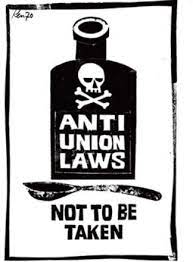
The 2023 congress of the TUC, which concluded on 13 September, voted for several resolutions demanding the repeal of all anti-union and anti-strike laws. One resolution also called for a campaign of “non-compliance” with the laws, a national demonstration against them, and a special congress to build resistance. The texts can be read here (pp12-15).
Free Our Unions welcomes the adoption of these resolutions. Now it’s up to rank-and-file trade unionists to get active within our unions to ensure they’re enacted, in full.
Join our open organising call at 7pm on Thursday 27 September to discuss how we can do that.
Free Our Unions organising meeting — 7pm, Wednesday 27 September
Log in via Zoom here
Meeting ID: 835 3823 9276
Passcode: 683428
Join us for our next open organising meeting, held via Zoom at 7pm on Wednesday 27 September.
Our organising meetings are open to all supporters of the aims of our campaign. We’ll be discussing:
• A report-back from TUC Congress
• A campaign to demand employers commit to refusing to issue work notices
• For supporters active in the Labour Party, campaigning to demand an incoming Labour government commits to repeal anti-union laws
“Reasonable steps”? Resist!
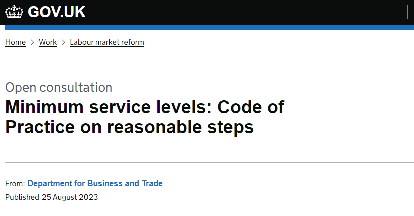
Following the passing of the Minimum Service Levels Bill, which requires unions to take “reasonable steps” to ensure their members comply with work notices, the government has launched a consultation to determine what those “reasonable steps” should be.
The consultation, which the TUC has described as “a sham”, can be read online here.
Unions’ only engagement with this exercise should be to tell the government that we will not allow our own organisations to be dragooned into becoming administrators of scabbing.
Faced with unjust, undemocratic laws that shackle what should be fundamental human rights, there is only one “reasonable step” we can take: resistance.
New Free Our Unions bulletin now available
Our new bulletin, setting out our view on the next steps in the fight against anti-strike laws, is now available to download.
The bulletin also includes a model motion for submission to trade union branches. Download the PDF below. If you want printed copies for distribution in your workplace, please email us at freeourunions@gmail.com.
The passing of the Tories’ Strikes (Minimum Service Levels) Act is a major new shackle on our right to strike, already heavily restricted.
What the law says
The new law allows the government to set a “minimum service level” in six industrial areas (health; fire and rescue; education; transport; nuclear decommissioning and radioactive waste management; border security). In the event of a strike, employers in the sector can issue a “work notice” compelling workers to work in order to provide the government-stipulated “minimum service.” The law states that employers should consult with unions when drawing up work notices, rendering unions administrators of scabbing.
Once a work notice has been issued, unions must “take reasonable steps to ensure that all members of the union who are identified in the work notice comply with the notice”. If they fail to take such steps, any strike is no longer legally “protected”, meaning individual workers could be subject to dismissal and unions can be liable for damages. It is likely employers could seek high-court injunctions against strikes in such circumstances.
What we can do
Free Our Unions believes our trade unions must resist these restrictions by:
Campaigning to demand employers refuse to issue work notices
Humza Yousaf, the SNP First Minister of Scotland, has already said that the Scottish Government will “never issue or enforce” a work notice. Unions must demand other employers, especially local authorities, make the same commitment. A council refusing to issue work notices could render the law ineffective with regard to strikes in LEA-controlled schools, and in transport services administered by local government.
Wider political campaigning, including a national demonstration
If the Trades Union Congress won’t call a national demonstration, unions that have policy supporting one – such as RMT, FBU, PCS, and others – should collaborate to call it.
Preparing direct defiance
We cannot rely on the law being inoperable, or assume it can be sabotaged by tactics such as coordinated “sick-outs”. Such tactics may be useful in specific workplaces, but to really make the law unworkable we need to break it. Unions must refuse to take any action to ensure “that all members of the union who are identified in the work notice comply with the notice.” They must support workers named in work notices in joining strikes in defiance of the notice, and be prepared to take further action, including both legal and industrial action, to defend any members disciplined or dismissed for such defiance.
Defiance of the law is not something to be called for lightly, and will not be easy to organise. Workers will be cautious about taking action that could risk our jobs. The only way to mitigate that risk is to take such action en masse, rather than in small groups which could see individual workers picked off and sacked.
Our unions are large, bureaucratic institutions with staff and property portfolios that union officers are in some sense “custodians” of. Many will be reluctant to put trade unions, as institutions, at risk of financial losses. But the alternative – complying with a law that forces unions to scab-herd – is the road to terminal decline for unions.
The FBU has rightly called for a labour-movement emergency conference to discuss our response to the passing of the law, as well as for a “mass campaign of non-compliance.” We need to discuss how we build the confidence necessary to defy the law from the workplace up.
Placing demands on Labour
It is highly likely Labour will replace the Tories at the next election. The Labour leadership has said it opposes the law and will repeal it, but without sustained pressure this pledge could be junked like others have been.
Unions must demand Labour repeals this and all legal restrictions on our right to strike.
Pass this motion!
This [branch, Trades Council, etc.] notes the passing of the Strikes (Minimum Service Levels) Act. This represents a further restriction on our already constrained right to strike.
This branch endorses the Fire Brigade Union’s call for a “mass campaign of non-compliance”, a national demonstration to demand the repeal of the law, and an emergency labour-movement conference to discuss and organise defiance.
This branch believes our movement must resist this, and existing anti-strike laws, by:
- Campaigning to demand employers, especially Labour authorities, commit to refusing to issue work notices
- Preparing direct defiance, including refusing to instruct members to comply with work notices
- [For Labour-affiliated unions: demand the Labour leadership commits to repealing this law]
This branch resolves to:
- Organise a public meeting, in collaborations with other branches and Trades Councils, to organise opposition to the law
- Support the work of the Free Our Unions campaign
- Submit this motion to [appropriate regional/national body] and request that our union contacts other unions to organise a national demonstration and labour-movement conference to discuss resistance to the law
More motions on anti-strike laws from TUC Congress

We’ve already publicised motions from the RMT and FBU to the upcoming TUC Congress on the topic of anti-strike laws. Here, we republish other motions on the same issue from other unions.
Motion 01 Trade union and employment rights (Unite)
Congress condemns the renewed attack on trade union rights including proposals to undermine industrial action in the Strikes (Minimum Service Levels) Bill and calls for the repeal of all anti-union laws.
Congress also condemns the fact that trade union rights could also be undermined by other legislation such as the Public Order Bill and the Retained EU Law Bill.
Congress believes that attacks on trade union rights and on employment rights more widely further demonstrates the case for the devolution of employment law.
Congress notes that the House of Lords voted to exclude Scotland from the Strikes (Minimum Service Levels) legislation, but this was overturned by the Tory majority in the House of Commons.
Congress also notes the letter to the UK parliamentary under secretary of state from the Scottish Government cabinet secretary for well-being economy, fair work and energy reiterating opposition to the Bill and calling for its abandonment.
Congress further notes that devolution of employment law is the policy of the Labour Party in Scotland and supported by the current Scottish Parliament.
Congress calls upon the General Council to oppose any new anti-trade union legislation and campaign for the:
i. repeal of all current anti-trade union legislation
ii. devolution of employment law to Scotland
iii. Labour government (if elected in the next two years) to repeal all anti-trade union laws within 12 months of gaining office
iv. introduction of a bill of rights providing positive employment and trade union rights – including strong rights to collectively bargain and to take strike action.
Amendment from Equity:
At the end of paragraph 2, insert the additional sentence: “Workers in many transnational and globalised industries are also denied meaningful rights to organise disputes or demonstrate solidarity internationally.”
Motion 02 Workers’ rights/trade union rights (NASUWT)
Congress is concerned that increasing use of insecure, intermittent and precarious employment relationships has resulted in widespread job insecurity and denies workers access to basic employment rights, many of which are at serious risk of being further eroded.
Conference asserts that anti-trade union restrictions represent a direct attack on workers’ rights to fair pay, decent jobs and good terms and conditions and must continue to be resisted.
Congress decries the fact that trade unions are subjected to draconian legislation that severely impacts on workers’ ability to organise and defend their rights at work.
Congress calls on the General Council to:
i. build coalitions to campaign against further restrictive trade union legislation
ii. build an appropriate industrial response to defend workers’ right to strike
iii. resist any further restrictive trade union legislation and demand:
– the repeal of all anti-union laws
– stronger rights for unions to access workplaces, win recognition, and establish collective bargaining rights
– the right for trade union members to vote online during industrial action ballots.
Amendment from Unison:
Insert new paragraph 4: “Congress congratulates the unions and the TUC who took the UK government to court and defeated new laws that allowed employers to use agency workers to break strikes. Congress agrees with the High Court that the government acted unfairly, unlawfully, and irrationally. Unions will always act to safeguard workers’ rights.”
Amendment from British Dietetics Association:
In final paragraph point iii., delete the first sub-point and replace with “the repeal of the Trade Union Act 2016 and all other anti-trade union legislation”. In final paragraph sub-point, replace full stop with comma and add at end: “and statutory elections for executive committees and general secretaries”.
Motion 05 Stop employer intimidation and defend the right to strike (UCU)
Congress notes the right, articulated under Article 11 of the European Convention on Human Rights and the Trade Union and Labour Relations (Consolidation) Act 1992, to join a union and participate in industrial action.
Congress condemns the actions of university employers making punitive deductions to UCU members’ salaries (up to 100 per cent of salary) for participating in lawful action short of strike action (including a marking and assessment boycott) in furtherance of their campaign to improve pay and conditions. Congress also condemns other employers using similarly draconian measures elsewhere to attempt to intimidate workers into not taking industrial action.
Congress believes this is part of a co-ordinated attack by employers, supported by the Conservative government, on the right of working people to advance their interests through industrial means.
Congress believes these attacks are designed to intimidate workers, especially those who are low-paid, casualised, women, disabled, alongside Black and migrant workers.
Congress applauds the bravery of UCU members in continuing their action short of strike action despite vindictive pay deductions.
Congress condemns all attacks on trade unionists right to participate in industrial action.
Congress calls on the TUC to lead:
i. an industrial campaign to defend the right to engage in all forms of industrial action
ii. a political campaign to lobby opposition parties to enshrine the right to strike in
statute and to repeal all anti trade union laws
iii. a public campaign to defend the right to participate in industrial action.
Read the full motions booklet below:
TUC Congress: support RMT and FBU motions!
RMT and FBU have submitted motions to the upcoming TUC Congress (10-13 September, Liverpool) on the Minimum Service Levels Bill. We reproduce both motions below.
We encourage supporters to lobby their unions’ TUC delegations to support these motions. If passed, we need to ensure they’re enacted!
RMT motion (P03)
Congress notes that, not content with their complete betrayal of workers following the P&O scandal, the Tory Government’s Strikes (Minimum Service Levels) Bill now represents the biggest attack on trade union rights and values since the 1900 Taff Vale judgement against one of RMT’s predecessors, the Amalgamated Society of Railway Servants, which ruled unions could be sued and compelled to pay for damages for the impact of their strike action.
The new Bill compels unions to instruct members to comply with work notices to cross picket lines. Members not complying can be dismissed and unions not complying lose their immunity from prosecution.
Congress notes the Bill gives the government sweeping powers to extend minimum service levels across the economy, curtailing the ability of every trade union to protect their members during the ongoing cost of living crisis and beyond, indeed the International Labour Organisation has criticised the legislation as a threat to the fundamental rights of workers in Britain.
Congress agrees we must use all means necessary to defeat this unjust law and calls on the General Council to proactively seek to,
• Legally challenge the legislation;
• Coordinate demands from affiliates that employers, devolved governments, and local authorities do not issue work notices;
• Hold a national march opposing the legislation and calling for repeal of the anti-union laws
• Organise a Special Congress, size to be determined, to explore options for non-compliance and resistance;
• Mobilise support for any affiliate seeking assistance, whose union and members are sanctioned for non-compliance.
FBU motion (P04)
Congress condemns the Minimum Service Levels (MSLs) legislation, the most draconian attack on trade union rights in living memory.
Congress notes that the MSLs legislation effectively outlaws effective strike action in key sectors.
Congress agrees that we have no choice but to build mass opposition to the MSLs laws, including a strategy of non-compliance and non-cooperation to make them unworkable.
Congress welcomes Humza Yousaf’s pledge to the STUC congress that the Scottish Government “will never issue or enforce a single work notice” under the MSLs legislation.
Congress calls on all devolved administrations to refuse to implement the MSLs legislation and to work with the trade union movement to render them inoperable.
Congress further calls on Labour-led local authorities, mayors, fire authorities and other public bodies to refuse to implement the MSLs laws.
Congress welcomes calls by affiliates for mass demonstrations against the MSLs legislation and mandates the TUC to support these demonstrations.
Congress pledges 100% solidarity with any trade unions attacked under these MSL laws.
Congress supports the campaign for mass non-compliance, up to and including industrial action, to defeat these pernicious MSL laws.
Congress reaffirms its longstanding policy to campaign for the repeal of all anti-union laws and for positive legal rights for trade unions.
Congress calls on the next Labour government to immediately repeal MSLs, the Trade Union Act 2016 and take urgent steps to remove other anti-union laws.
 Free Our Unions