Rally and planing meeting, 24 January (called by CTUF, StrikeMap, and others)

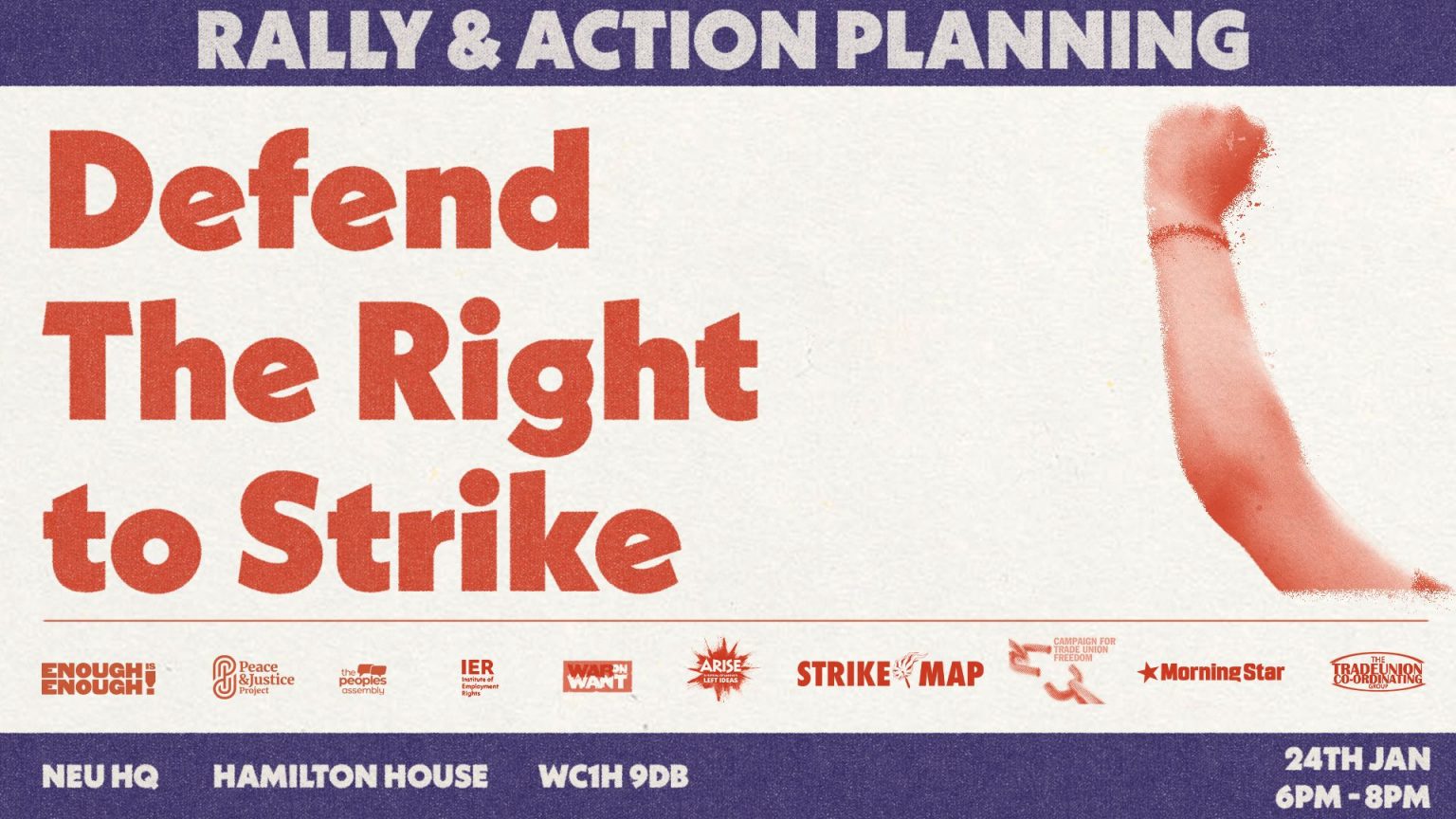
The Campaign for Trade Union Freedom has called a rally and planning meeting for activity against anti-strike laws on 24 January, 6pm at the National Education Union HQ in central London (see here for details).

Free Our Unions supports this meeting and encourages activists to attend.

With 12 top-table speakers currently billed, the event seems to be more rally than planning meeting. We hope that a substantial amount of time in the meeting will be reserved for discussion and planning.

Discussion: The “Workers’ Bill of Rights” is welcome, but we need clarity and drive on right to strike

This discussion article was written by a Free Our Unions supporter. We welcome responses and further contributions. Email freeourunions@gmail.com with submissions.


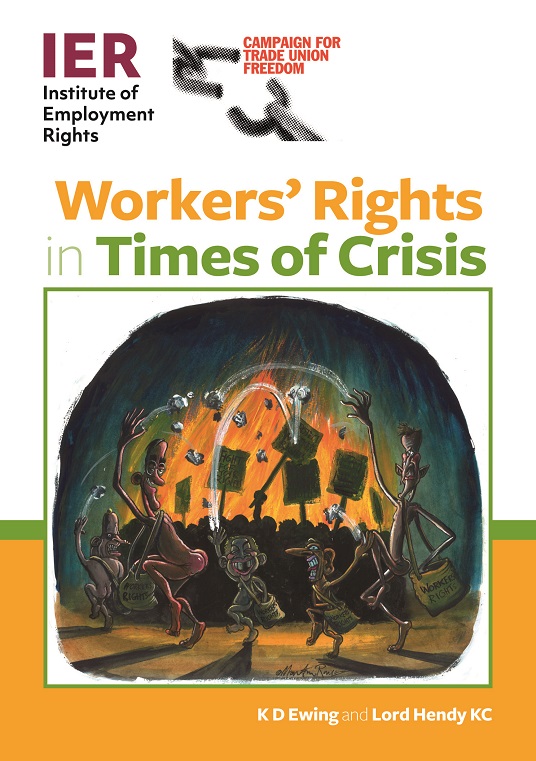
At its event in London on 3 December, the Institute of Employment Rights (IER) called for comments on and responses to its new Workers’ Rights in Times of Crisis pamphlet and the “Workers’ Bill of Rights for an Age of Crisis” that concludes it. Here are some comments. It would be much appreciated if IER, and connected organisation CTUF, republish this article on their websites.

The pamphlet is an excellent educational resource, drawing together key facts about the situation facing workers in the UK and how it is shaped by the increasingly disastrous framework of labour law. I hope the IER will put the text or a PDF online for free at some point.

The “Workers’ Bill of Rights” proposals, focused on restoring and expanding collective bargaining between unions and employers (but ranging much more widely), are welcome and useful. The pamphlet is also right to call for escalated pressure on the Labour Party, not complacency that a Labour government will automatically make a difference

I want to focus on the right to strike, the main focus of Free Our Unions and a decisive issue for workers’ rights more broadly, for the labour movement’s wider demands, and indeed for all struggles for social justice.

The fact we currently face a bitter defensive struggle is no reason to stop thinking about these longer-range demands. Whether or not we defeat the new minimum service law, the question will remain what the labour movement’s positive demands are and, very practically, which laws a Labour government will repeal and which it will keep. The labour movement must actively shape that argument – indeed ensure it is an argument at all – pushing for the strongest possible right to strike and the maximum trade union freedom. Otherwise we face a repeat of what happened under Blair, when all the anti-union laws were maintained, paving the way for new restrictions later on.

During the period when the IER was advising Jeremy Corbyn’s Labour leadership, it increasingly soft-pedalled and retreated on the question of repealing all anti-strike / anti-union laws.

The new pamphlet represents a shift back towards a clearer position. It eloquently explains the need for solidarity action – strikes in support of other workers, with a different employer – to be legalised, and for the labour movement to be forthright and unapologetic in making this demand.

Let us note but leave aside for now the question of why a left-wing Labour leadership was the occasion for the IER to make an opportunist shift: the exact opposite of what was necessary! On the right to strike at least, the demands in the Workers’ Bill of Rights are still insufficiently clear. What it says is good, but needs concretising.

It says:

“Every worker shall have the right to participate in industrial action for the protection and promotion of their economic, social and political interests and not to be penalised for doing so, and every union shall have the right to organise and support industrial action, subject only to the rules of the trade union in question.”

That is much stronger than what the IER mostly said in 2015-19, and particularly 2017-19, pointing strongly in the right direction.

But in addition to these general principles, we need clarity on the essential point that to establish those rights we need to win repeal of all the anti-strike / anti-union laws, back to the first one passed under Thatcher in 1980. We need their replacement with strong legal rights – but repeal is essential.

We also need to spell out more definitely, concretely and specifically the rights we want, both in terms of removing current restrictions and the positive legal rights that should replace them. This must include rights for workers and unions:

• To strike / take industrial action at times, for demands and by decision-making processes of their own choosing.
• To picket any workplace, in any numbers.
• To strike / take industrial action in solidarity with any workers.
• To strike / take industrial action over any issue, including any broader social or political question.

Last but not least, need a mass agitational campaign in the labour movement to establish clear and active support for these demands, as the precondition for winning them.

The IER should work with Free Our Unions and others to make this happen.

Discussion: unions must call national demo against new anti-strike laws

By a Free Our Unions supporter

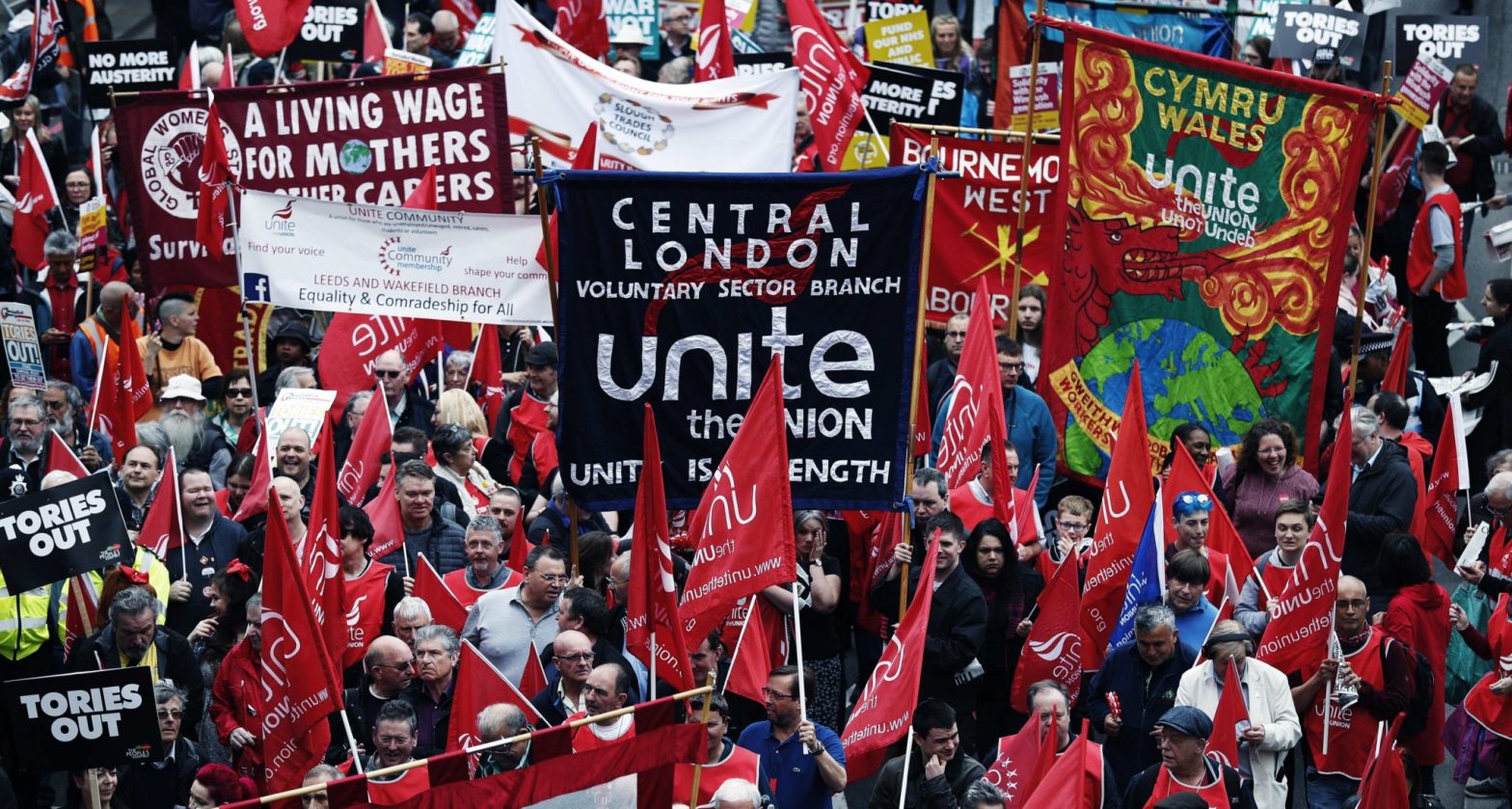
After months of mainly silence or bullish dismissiveness, unions have started to sound the alarm about the Tories’ new proposals for a “minimum service” law, and at least nod to the need for protest. Fire Brigades Union general secretary Matt Wrack has called for a “mass movement of resistance”, and rail and transport union RMT has called an emergency protest (Monday 16 January, 6pm, Downing Street).

It’s a start but we need much more. Unions should call a national demonstration.

We need to bury the consoling notion that the introduction of such a law will lead to mass protests and unrest at some unspecified point in the future, after it has passed. It might, but we shouldn’t bank on it – and the time to protest is now. We need to bury the idea that such laws don’t really matter, because unions will just work harder to get over them. The Tories are introducing these new restrictions for a reason – just as they had reason to introduce all the previous restrictions. Of course we should work to get over and round the restrictions, but they do make a difference every day. We need to demand their abolition, through repeal of the anti-union laws.

We need mass protests now to stop the new law (and re-raise the idea of abolishing the other anti-union laws). Even if we fail to stop it, the more and the more vigorous our protests, the more likely we will get mass protest, defiance and determined industrial action in the future. (In 1972, when strikes defeated and rendered inoperative the Industrial Relations Act, they came after very big union demonstrations before it passed.)

We need a stream of local actions, protests, meetings and events. We need the message of protest against this new law, and all anti-union laws, to be woven into the messaging of ongoing strikes and demonstrations. We also need national action to show the government (and, in a different way, the Labour Party) we are serious. That’s why we need a national demonstration.

I mean a national demonstration specifically about the issue of the new anti-strike law (obviously it can say other things too, but that should be the clear and central focus), in London, on a Saturday, soon. I mean a serious attempt to mobilise tens of thousands.

Unions should call such a demonstration. If it comes to it, even just one union would do, obviously working as widely as possible with bits of unions and other organisations.

We should agitate in our unions, Labour Parties and other organisations for this to happen urgently.

Here’s a suggestion for a motion for union branches and other bodies:

Call a national demonstration against the new anti-strike law!

Notes:
1. The seriousness of the Transport Strikes (Minimum Service Levels) Bill, which would ban all-out strikes in a range of important sectors (not just transport).
2. That this comes on top of over a dozen anti-strike and anti-union laws passed since 1980.

Believes:
1. That we need a flowering of local action to stop the Bill, and national action too.
2. That unions should call an urgent national demonstration specifically on this issue, in London, on a Saturday, making a serious attempt to mobilise at least tens of thousands.

Resolves:
1. To discuss what action we can take locally, by ourselves and working with other unions.
2. To call on our union to call a national demonstration to stop the anti-strike Bill, in London, on a Saturday, soon, working with other unions as much as possible.
3. To call for, and push for our union and the whole movement to call for, repeal of all the anti-union laws.

Tories plan a dictatorship of the boss

In 1997, Tony Blair approvingly described Britain as having “the most restrictive union laws in the western world.” There is no legally-enshrined right to strike; unions are forced to jump over a series of bureaucratic hurdles in order to take action; strikes for political demands are illegal; strikes in solidarity with other workers are illegal.

13 years of Labour government from 1997-2010 left those restrictions, built up by Tory governments throughout the 1980s and early 90s, entirely untouched. David Cameron’s government tightened restrictions even further with the 2016 Trade Union Act, which imposed turnout thresholds on industrial action ballots – an arbitrary measure not applied to any other sphere of democratic life.

The 2019 Tory manifesto promised still more restrictions, committing to implement legally-mandated minimum service requirements during transport workers’ strikes. Where such laws exist in other countries, they often entail unions agreeing with employers, sometimes via an arbitration body, to exempt a portion of their membership from participation in a strike, in order to ensure the minimum service. In other words, they turn unions into administrators of scabbing. The 2021 AGM of the RMT union passed a resolution committing the union to “non-complicity” in setting minimum service levels.

In response to an upsurge in workers’ action during 2022, the Tories have developed plans for yet more restrictions. Senior figures like Liz Truss and Grant Shapps published proposals for extensive new laws. A Transport Strikes (Minimum Service Levels) Bill was announced in October 2022.

Now Rishi Sunak’s government has unveiled details of plans for further restrictions. The proposals extend minimum service requirements beyond the rail industry, to health, education, fire, ambulance services, and nuclear commissioning, giving employers in those sectors the right to dismiss employees who refuse to work if designated as part of the minimum service complement during strikes.

The proposal entrenches a de facto dictatorship of the boss. It means that even workers who have voted, via the onerous and arbitrary balloting procedures set by the state, to go on strike can be ordered to work by the employer. All restrictions on the right to strike are not only an affront to workers’ rights, but an affront to democracy and civil liberties.

The best time for the labour movement to have launched an active, on-the-streets campaign of direct action against threatened new restrictions on the right to strike was in 2019, when the Tories unveiled the commitment in their manifesto. The second best time was any time since. The third best time is now.

That campaign must confront not only the proposed new restrictions, which are universally opposed across the labour movement and which Labour has committed to repeal in government, but all existing ones. A defence of “the right to strike” which functions to defend an abject status quo against getting any worse is not really a fight for “the right to strike” at all.

The campaign must include meetings, in workplaces and communities, rallies, demonstrations and protests, alongside an expansion of solidarity with existing and future strikes to help them win. Although the House of Lords may knock some of the worst edges off the Tories’ proposals, current parliamentary arithmetic means the new laws are likely to be passed in some form. This means the labour movement must also prepare to defy them. We will be better placed to organise that defiance if we have spent the period prior to the imposition of the new laws actively mobilising against them.

Free Our Unions aims to contribute to that mobilisation by connecting rank-and-file trade unionists who want to catalyse action on the issue in their own workplaces and unions. But the core campaign must be run by unions themselves, under their own banners, with their own resources, mobilising their own members directly – not “outsourced” to any external body or campaign coordination.

Our next organising meeting, open to all supporters of our campaign, will discuss how we can organise most effectively. Join us via Zoom at 7pm on 17 January.

Islington council stands with striking workers

Islington borough council, in north London, has passed a resolution supporting striking workers, and opposing anti-union laws.

The resolution notes that “decades of anti-union laws have given us the tightest regulations on strikes in the advanced industrial world”, and indicts the Tories for having “repeatedly undermined the right to strike”. The council has resolved to write to the Secretary of State for Business, Energy, and Industrial Strategy to express its opposition to anti-union laws.

Other Labour councils should follow suit!

The full text of the resolution can be read online here, on page 50.

Free Our Unions organising meeting, 19 December, 7pm

We’ll be holding an open organising meeting for our campaign on Monday 19 December at 7pm. All supporters are welcome.

We’ll discuss the Tories’ Transport Strikes (Minimum Service Levels) Bill, plus Sunak’s recent threats of further restrictions on strikes, and how we can organise resistance. The meeting will be focused on suggestions for practical activity.

Log in via Zoom here, or using the following code:

Meeting ID: 835 3823 9276
Passcode: 683428

Motion to Unite policy conference 2023

The Glasgow Not for Profit Sector branch of Unite has passed the following motion, for submission to Unite’s 2023 policy conference. If you’re a member of Unite, please consider proposing a similar motion in your branch.


Conference re-affirms its policy of opposition to all anti-union laws, as adopted at the 2021 Policy Conference: to campaign for the repeal of all anti-union laws; to defy the anti-union laws through organised action if necessary; to rally to the aid of any union targeted by the anti-union laws; to take the lead in campaigning for the repeal of all anti-union laws if the TUC fails to initiate such a campaign.

Conference notes with concern the lack of progress in implementing the policy agreed at the 2021 conference, especially given threats of further anti-union laws by the Tories and the impact of the anti-union laws on strike action in response to the cost-of-living crisis, e.g. strikes prevented by the 50% threshold or called off because of threats of legal challenges.

Conference therefore resolves to instruct the national Executive Committee to:

  • ensure that campaigning against the anti-union laws is an item on the agenda of every
    meeting of the national Executive Committee.
  • ensure that Unite produces hard-copy and online educational materials explaining the need for the repeal of all anti-union laws and explaining Unite policy on this issue, for circulation to all members.
  • encourage campaigning against the anti-union laws by all levels of our union, from national Executive Council to local branches.
  • approach other unions with similar policies on the anti-union laws with a view to holding a national demonstration for the repeal of, and defiance of, all anti-union laws.
  • use its position as Labour’s biggest trade union affiliate to campaign for Labour Party
    conference to re-affirm existing policy for the repeal of all anti-union laws and for inclusion of this policy in the next Labour general election manifesto, and to seek to work with other Labour-affiliated unions to achieve these goals.

Unite to resist anti-union laws

Free Our Unions activists are looking forward to participating in the conference held on 3 February by the Campaign for Trade Union Freedom and Institute for Employment Rights. We encourage all supporters of our campaign to attend the conference if they can.

We’re also reaching out to those campaigns to propose united activity to resist anti-union laws. See below for our open letter, which we’ll be distributing at the conference.

Comrades,

The Tories’ Minimum Service law, already making its way through Parliament, threatens to undermine our already heavily restricted right to strike even further. Senior Tories have promoted plans for even more extensive restrictions to follow.

RMT’s demonstration at Old Palace Yard on 2 November, prior to the TUC’s lobby, was the first piece of union-led, on-the-streets activity against the new laws since the Minimum Service Bill was proposed in Parliament. Prior to this, the 10 October demonstration at BEIS, organised by ourselves along with Earth Strike, was the first demonstration on this issue since then-PM Liz Truss announced the bill.

Much, much more is needed.

Almost every union has policy to oppose not only the proposed new laws, but all existing restrictions on rights to organise and strike. To stand any chance of stopping new laws from being implemented, or even blunting their worst elements, we need those policies to be enacted. And, if new restrictions are implemented, our movement will be in a better position to subvert and defy them if it has spent the previous period organising an assertive, visible fight against the laws. Campaigns like ours can help catalyse the resistance we need, led by unions themselves. We can do this most effectively if we work together.

Our aim should not to be to act as bodies to whom unions can outsource their campaigning on this issue, but to give rank-and-file trade unionists support in mobilising within their unions to ensure unions themselves are using their substantial reach and resources to organise campaigning directly. This could entail producing joint materials, including motions, briefings, and other literature, for activists to use in branches and other union committees. We also propose a joint committee, open to all labour movement activists who want to organise on this issue, to build towards a national, union-led demonstration – something several unions, including RMT and Unite, have policy to organise.

We look forward to participating in the discussions at the CTUF/IER conference, and hope we can work together to build a movement of resistance to all anti-union laws, and for a full right to organise and strike.

In solidarity,
Free Our Unions