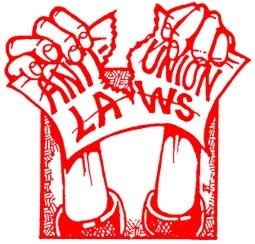
Tories plan a dictatorship of the boss

In 1997, Tony Blair approvingly described Britain as having “the most restrictive union laws in the western world.” There is no legally-enshrined right to strike; unions are forced to jump over a series of bureaucratic hurdles in order to take action; strikes for political demands are illegal; strikes in solidarity with other workers are illegal.

13 years of Labour government from 1997-2010 left those restrictions, built up by Tory governments throughout the 1980s and early 90s, entirely untouched. David Cameron’s government tightened restrictions even further with the 2016 Trade Union Act, which imposed turnout thresholds on industrial action ballots – an arbitrary measure not applied to any other sphere of democratic life.

The 2019 Tory manifesto promised still more restrictions, committing to implement legally-mandated minimum service requirements during transport workers’ strikes. Where such laws exist in other countries, they often entail unions agreeing with employers, sometimes via an arbitration body, to exempt a portion of their membership from participation in a strike, in order to ensure the minimum service. In other words, they turn unions into administrators of scabbing. The 2021 AGM of the RMT union passed a resolution committing the union to “non-complicity” in setting minimum service levels.

In response to an upsurge in workers’ action during 2022, the Tories have developed plans for yet more restrictions. Senior figures like Liz Truss and Grant Shapps published proposals for extensive new laws. A Transport Strikes (Minimum Service Levels) Bill was announced in October 2022.

Now Rishi Sunak’s government has unveiled details of plans for further restrictions. The proposals extend minimum service requirements beyond the rail industry, to health, education, fire, ambulance services, and nuclear commissioning, giving employers in those sectors the right to dismiss employees who refuse to work if designated as part of the minimum service complement during strikes.

The proposal entrenches a de facto dictatorship of the boss. It means that even workers who have voted, via the onerous and arbitrary balloting procedures set by the state, to go on strike can be ordered to work by the employer. All restrictions on the right to strike are not only an affront to workers’ rights, but an affront to democracy and civil liberties.

The best time for the labour movement to have launched an active, on-the-streets campaign of direct action against threatened new restrictions on the right to strike was in 2019, when the Tories unveiled the commitment in their manifesto. The second best time was any time since. The third best time is now.

That campaign must confront not only the proposed new restrictions, which are universally opposed across the labour movement and which Labour has committed to repeal in government, but all existing ones. A defence of “the right to strike” which functions to defend an abject status quo against getting any worse is not really a fight for “the right to strike” at all.

The campaign must include meetings, in workplaces and communities, rallies, demonstrations and protests, alongside an expansion of solidarity with existing and future strikes to help them win. Although the House of Lords may knock some of the worst edges off the Tories’ proposals, current parliamentary arithmetic means the new laws are likely to be passed in some form. This means the labour movement must also prepare to defy them. We will be better placed to organise that defiance if we have spent the period prior to the imposition of the new laws actively mobilising against them.

Free Our Unions aims to contribute to that mobilisation by connecting rank-and-file trade unionists who want to catalyse action on the issue in their own workplaces and unions. But the core campaign must be run by unions themselves, under their own banners, with their own resources, mobilising their own members directly – not “outsourced” to any external body or campaign coordination.

Our next organising meeting, open to all supporters of our campaign, will discuss how we can organise most effectively. Join us via Zoom at 7pm on 17 January.
Islington council stands with striking workers

Islington borough council, in north London, has passed a resolution supporting striking workers, and opposing anti-union laws.

The resolution notes that “decades of anti-union laws have given us the tightest regulations on strikes in the advanced industrial world”, and indicts the Tories for having “repeatedly undermined the right to strike”. The council has resolved to write to the Secretary of State for Business, Energy, and Industrial Strategy to express its opposition to anti-union laws.

Other Labour councils should follow suit!

The full text of the resolution can be read online here, on page 50.

Free Our Unions organising meeting, 19 December, 7pm

We’ll be holding an open organising meeting for our campaign on Monday 19 December at 7pm. All supporters are welcome.

We’ll discuss the Tories’ Transport Strikes (Minimum Service Levels) Bill, plus Sunak’s recent threats of further restrictions on strikes, and how we can organise resistance. The meeting will be focused on suggestions for practical activity.

Log in via Zoom here, or using the following code:

Meeting ID: 835 3823 9276
Passcode: 683428

Motion to Unite policy conference 2023

The Glasgow Not for Profit Sector branch of Unite has passed the following motion, for submission to Unite’s 2023 policy conference. If you’re a member of Unite, please consider proposing a similar motion in your branch.


Conference re-affirms its policy of opposition to all anti-union laws, as adopted at the 2021 Policy Conference: to campaign for the repeal of all anti-union laws; to defy the anti-union laws through organised action if necessary; to rally to the aid of any union targeted by the anti-union laws; to take the lead in campaigning for the repeal of all anti-union laws if the TUC fails to initiate such a campaign.

Conference notes with concern the lack of progress in implementing the policy agreed at the 2021 conference, especially given threats of further anti-union laws by the Tories and the impact of the anti-union laws on strike action in response to the cost-of-living crisis, e.g. strikes prevented by the 50% threshold or called off because of threats of legal challenges.

Conference therefore resolves to instruct the national Executive Committee to:

  • ensure that campaigning against the anti-union laws is an item on the agenda of every
    meeting of the national Executive Committee.
  • ensure that Unite produces hard-copy and online educational materials explaining the need for the repeal of all anti-union laws and explaining Unite policy on this issue, for circulation to all members.
  • encourage campaigning against the anti-union laws by all levels of our union, from national Executive Council to local branches.
  • approach other unions with similar policies on the anti-union laws with a view to holding a national demonstration for the repeal of, and defiance of, all anti-union laws.
  • use its position as Labour’s biggest trade union affiliate to campaign for Labour Party
    conference to re-affirm existing policy for the repeal of all anti-union laws and for inclusion of this policy in the next Labour general election manifesto, and to seek to work with other Labour-affiliated unions to achieve these goals.

Unite to resist anti-union laws

Free Our Unions activists are looking forward to participating in the conference held on 3 February by the Campaign for Trade Union Freedom and Institute for Employment Rights. We encourage all supporters of our campaign to attend the conference if they can.

We’re also reaching out to those campaigns to propose united activity to resist anti-union laws. See below for our open letter, which we’ll be distributing at the conference.

Comrades,

The Tories’ Minimum Service law, already making its way through Parliament, threatens to undermine our already heavily restricted right to strike even further. Senior Tories have promoted plans for even more extensive restrictions to follow.

RMT’s demonstration at Old Palace Yard on 2 November, prior to the TUC’s lobby, was the first piece of union-led, on-the-streets activity against the new laws since the Minimum Service Bill was proposed in Parliament. Prior to this, the 10 October demonstration at BEIS, organised by ourselves along with Earth Strike, was the first demonstration on this issue since then-PM Liz Truss announced the bill.

Much, much more is needed.

Almost every union has policy to oppose not only the proposed new laws, but all existing restrictions on rights to organise and strike. To stand any chance of stopping new laws from being implemented, or even blunting their worst elements, we need those policies to be enacted. And, if new restrictions are implemented, our movement will be in a better position to subvert and defy them if it has spent the previous period organising an assertive, visible fight against the laws. Campaigns like ours can help catalyse the resistance we need, led by unions themselves. We can do this most effectively if we work together.

Our aim should not to be to act as bodies to whom unions can outsource their campaigning on this issue, but to give rank-and-file trade unionists support in mobilising within their unions to ensure unions themselves are using their substantial reach and resources to organise campaigning directly. This could entail producing joint materials, including motions, briefings, and other literature, for activists to use in branches and other union committees. We also propose a joint committee, open to all labour movement activists who want to organise on this issue, to build towards a national, union-led demonstration – something several unions, including RMT and Unite, have policy to organise.

We look forward to participating in the discussions at the CTUF/IER conference, and hope we can work together to build a movement of resistance to all anti-union laws, and for a full right to organise and strike.

In solidarity,
Free Our Unions

Solidarity with education workers in Ontario

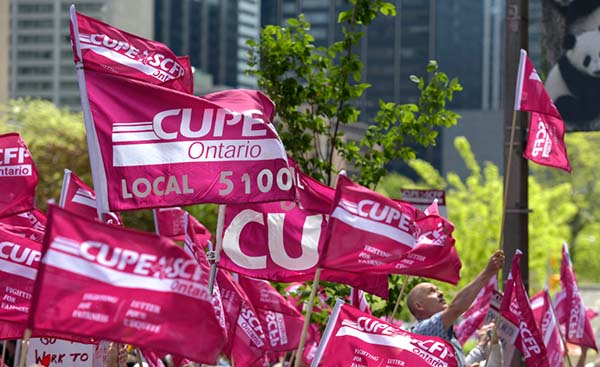
Education workers in Ontario, Canada, are facing down repressive anti-union laws imposed by the province’s right-wing government. The following article, reposted from the Guardian (3 November), gives the background.

We’ll be publishing further info on how we can support the workers soon.


The premier of Canada’s most populous province is under fire for a “draconian” bill that would fine school support staff C$4,000 (US$2,900) a day for striking, prompting concerns that Ontario is eroding fundamental workers’ rights – and setting a troubling precedent.

Doug Ford’s conservative government tabled legislation this week that would unilaterally impose a contract on education workers, and levy hefty fines for striking. The move escalates a bitter dispute over pay for education workers, including custodians, early childhood educators and educational assistants.

Justin Trudeau has waded into the standoff, the prime minister sharply criticizing the Ontario government decision to “suspend people’s rights and freedoms”.

The Canadian Union of Public Employees, which represents 55,000 education workers, has called for an 11.3% raise for its workers – often the lowest-paid in schools – arguing that stagnant wage growth and high inflation have hit the lowest earners hardest.

The government has countered with a 2.5% annual raise for the lowest-income workers and 1.5% raises for others.

With little progress on negotiations and a strike planned on Friday, the government fast-tracked Bill 28.

If passed, the controversial legislation – which fines workers C$4,000 a day and the union C$500,000 for striking – would mark the first time in the county’s history that the right of workers to collectively bargain and to strike could be legally stripped away.

The government acknowledges its bill breaches the country’s Charter of Rights and Freedoms and the Human Rights Code, but says its priority is averting a strike.

Ontario’s government is invoking a rarely used legal mechanism known as the notwithstanding clause, which allows provincial governments to override certain portions of the charter for a five-year time period.

Quebec has long used the clause to pass its language rights laws, but most governments have been hesitant to use the mechanism, said constitutional lawyer Ewa Krajewska.

“The Ford government has been much quicker to reach for the clause and the worry from a constitutional rights perspective is that it’s becoming increasingly normalized to invoke it,” she said. “And I’m concerned that every time there’s a bit of a blow-up about rights and legislation, the government is just going to invoke the notwithstanding clause. The fact that they’re willing to go to it so quickly should give everyone pause.”

Canada’s justice minister called it “exceedingly problematic”, but Krajewska says there is little the federal government can do to stop it.

Lawyers say they are also troubled by the government’s pre-emptive use of the clause which would shield Bill 28 from judicial review.

“The Ford government is essentially saying it is above the law. This is not just an attack on the fundamental charter rights, human rights and labor rights of education workers. It’s also an attack on our constitutional democracy and the rule of law,” said Adrienne Telford, a constitutional and labour lawyer.

Canada’s top court recognised workers’ right to strike in 2015. In cases where employees are deemed essential, the right to strike is replaced by arbitration.

Telford said that Ontario’s attempt to unilaterally impose a contract and working conditions was even more worrying.

“Workers weren’t even allowed to exercise their right to strike. It’s pre-emptively taken that away. But what’s even more shocking is that the government isn’t replacing their fundamental right to strike with the right to arbitration,” she said. “Basically, this is an attempt by the government to avoid having to appear before an independent arbitrator and not get what it wants.”

Ford has long styled himself as a champion of the working class, but the row has prompted one union that previously endorsed him to call for the premier to reverse course.

Earlier this week, a branch of Labourers’ International Union North America, Canada’s largest construction union, lobbied the province’s education minister to restore collective bargaining rights.

The Ontario Bar Association also condemned the move, calling the uncertainty surrounding fundamental rights “potentially destabilizing” and prompting fears the short term gains won by Ford’s government could come at a cost to society “that might not be recognised until it’s too late”.

“In theory, governments could just include the notwithstanding clause in every piece of legislation that they have,” said Telford. “What is the point of fundamental rights and freedoms if they can just be pre-emptively and overridden – and shielded from review by a court?”

Help us raise funds to organise against Tory anti-strike laws

CLICK HERE TO DONATE TO OUR CROWDFUNDER

Free Our Unions is organising action to stop new anti-union laws – and for a coordinated national campaign against this threat and against existing anti-union laws, led by our unions. 

To effectively build towards this, we need increased resources. We are looking to raise £2,000. Will you chip in to help us reach our goal?

The Tory threat

Since the Summer, the UK Government has floated proposals for dangerous new anti-union laws. The Tories have already enabled bosses to use agency workers to break strikes. They sat back while P&O sacked 800 workers in one day.

Now they are bringing in legislation to ban all-out transport strikes – and very clear this is just the first step in a whole raft of new anti-strike laws. 

The Tories are divided amongst themselves but absolutely united in attacking strikes, unions and the working class.

They are pushing for:

• So-called ‘minimum service levels’ in certain industries – essentially forcing unions to scab on their members

• Forcing unions to ballot members on every single pay offer bosses make – enabling employers to string workers along and delay strike action

• Raising ballot thresholds even further to make strike action within the law 

• Other, onerous bureaucratic restrictions aimed at making strike action increasingly difficult to organise within the law

We cannot sit back while the Tories launch yet more attacks on our democratic rights as workers.

We need to organise NOW

Our right to organise and strike is under attack right now.

This threat cannot be defeated through legal action or conference speeches alone. And our movement cannot wait for these new anti-union laws to be introduced before we fight back.

Free Our Unions is calling on our trade unions to rise to the challenge and launch a popular, national campaign to grab public attention and assert our right to organise.

If we fight hard now, we stand the best chance of stopping these attacks, defying them if they do pass, and getting them repealed – or some combination of those things. If we don’t find, there is a greater danger these laws will come in and stick.

The cost-of-living emergency is only getting worse. Meanwhile, unions are growing in popularity and public prominence. Now is the time to make the case openly for strong, free and independent working class organisations free of bureaucratic legal constraints.

Our plan

In response to these new threats, Free Our Unions has already produced briefings and campaign materials, hosted fringes at Labour Party Conference and TUC Congress, sent speakers around the country, and held the first demonstration nationally against the Tories’ new anti-union threats. All of which was expensive.

And there is so much more to do. Despite the growing strike wave, so much of our movement isn’t confronting the threat of new anti-union laws head on.

Free Our Unions needs your help if we are going to step up our activity. If we reach our target of £2,000, we will:

• Produce more copies of our accessible briefings informing rank-and-file members about the dangers of these new threats and send them out

• Produce an updated pamphlet on campaigning to overturn the anti-union laws

• Send speakers and campaign materials to union branches, local political parties, and other organisations to build momentum behind our campaign 

• Organise more protests at sites of power to bring this issue to the top of the labour movement agenda

• Campaign for our union officials to live up to their rhetoric and launch a national campaign against the anti-union laws

Any donation, however small, makes a difference. But £20 could enable us to print hundreds of leaflets. £50 or £60 could enable us to print thousands, or get speakers to meetings around the country. Two or three hundred will allow us organise a second, bigger protest, or produce a new campaigning pamphlet. If we reach our target, we can look further ahead – and potentially look to organise more powerful events, like training and organising events.

Please chip in to help us reach our target, and then join our campaign.

Labour and climate activists protest against anti-union laws

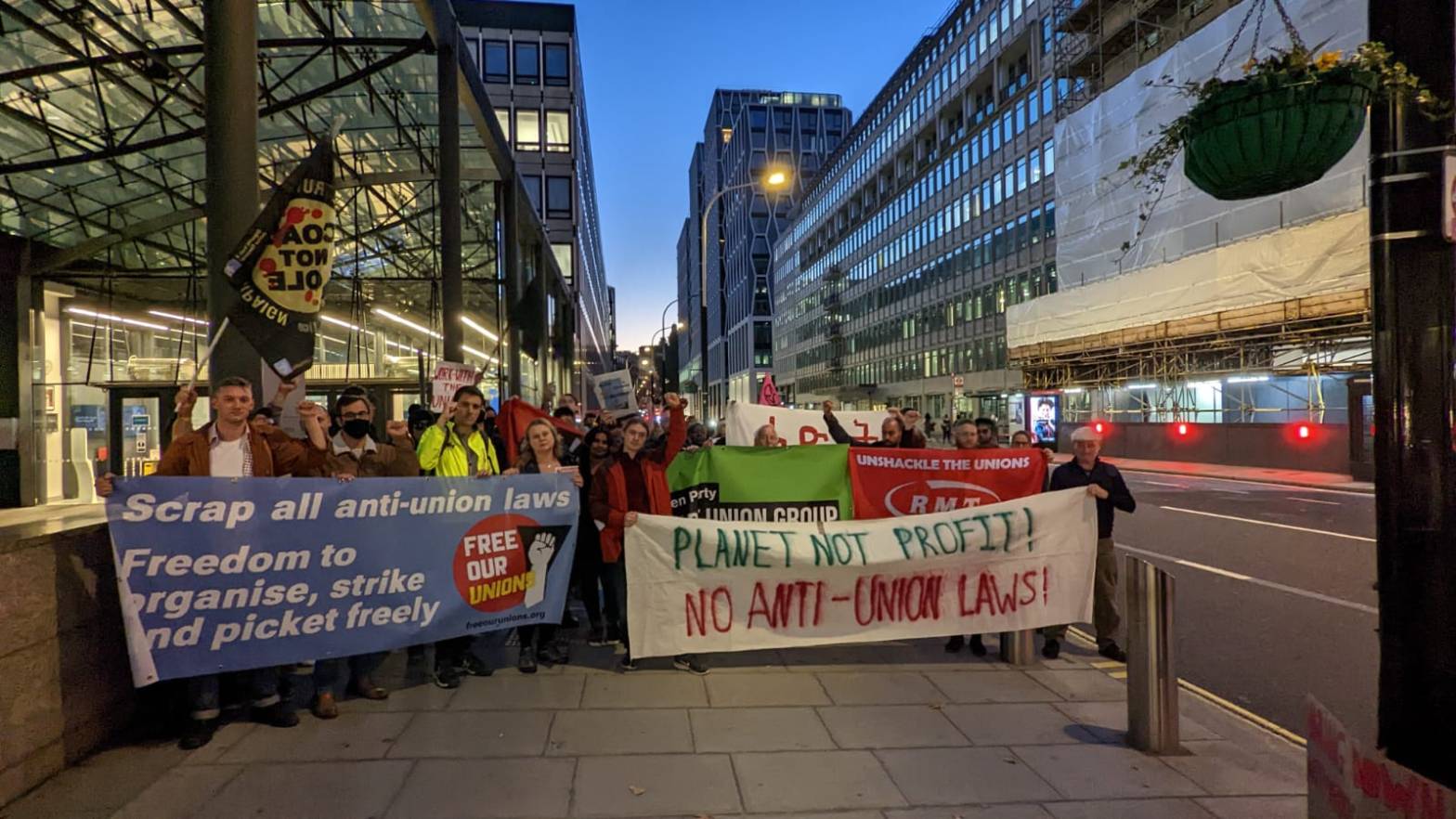
Around 80 activists from a range of campaign groups and unions protested outside the Department for Business, Energy, and Industrial Strategy (BEIS) on 10 October, as part of an action called by Free Our Unions and Earth Strike UK’s Empower the Unions initiative. As far as we know, this is the first piece of direct action called specifically to protest the Truss government’s plans for new anti-union laws since Truss revealed the policy.

BEIS was chosen because it will likely be central to developing the legislation for new restrictions on strikes, and because it is a key department in terms of climate policy. Free Our Unions has sought active coordination with activists from the climate movement, and Earth Strike UK’s Empower the Unions initiative seeks to highlight the specific ways in which anti-union laws constrain workers’ ability to take action in defence of the climate.

Speakers at the protest included Mark Boothroyd (A&E nurse and Unite activist); Sab (Earth Strike UK activist and Industrial Workers of the World organier); Ruth Cashman (Lambeth Unison); Jared Wood (RMT London Transport Regional Organiser); Ria Patel (Green Party Equality and Diversity spokesperson); EC (PCS rep); Andy Warren (firefighter and local rep for the FBU); Hamish (Exctinction Rebellion Trade Unionists); and Benedict Flexen (Earth Strike UK: Empower the Unions).

Speeches were punctuated by chanting, accompanied by drumming from the Extinction Rebellion samba band.

Following the protest, an assembly took place in a venue nearby, discussing various aspects of the politics of anti-union laws, and proposals for campaigning on the issue forward in our workplaces and unions.


Free Our Unions fringe at TUC congress – Tuesday 18 October, 6pm

We’re holding a fringe meeting at the rescheduled TUC congress in Brighton. The meeting will take place at 6pm in the Friends Meeting House (Ship Street, BN1 1AF).

We’ll discuss what unions can do to resist the implementation of new anti-union laws, and campaign against existing ones. Speakers include John Leach (Assistant General Secretary, RMT) and Maria Exall (CWU), with more tbc.

All congress delegates and labour movement activists welcome!

Protest on 10 October: Stop Truss’s new anti-union laws!

5:30, Monday 10 October
Department for Business, Energy, and Industrial Strategy (BEIS), 1 Victoria Street, London SW1H 0ET

Facebook event here.

On 10 October the Free Our Unions campaign and Earth Strike / Empower the Unions are holding an assembly and protest at the Department for Business, Energy and Industrial Strategy in London to oppose the threat of new anti-trade union laws that Liz Truss, in the context of the strike wave, has signalled as one of her top priorities.

We are also demanding the scrapping of all existing anti-union laws and their replacement with strong workers’ rights. We demand the right to strike and picket freely, including in solidarity with other workers and over political issues like the climate crisis.

We are in the midst of a cost of living crisis, ecological crisis, and facing new attacks on workers rights by the ruling class. New and existing anti-union laws prevent us from legally taking strike action on issues relating to social and environmental issues. We need to empower our union to challenge and abolish these laws or break them.

The wider trade union and labour movement needs to mobilise to stop these new laws. We will be organising protests to get the ball rolling.

Join us at BEIS on 10 October. For more information or to add your support to the protest email freeourunions@gmail.com