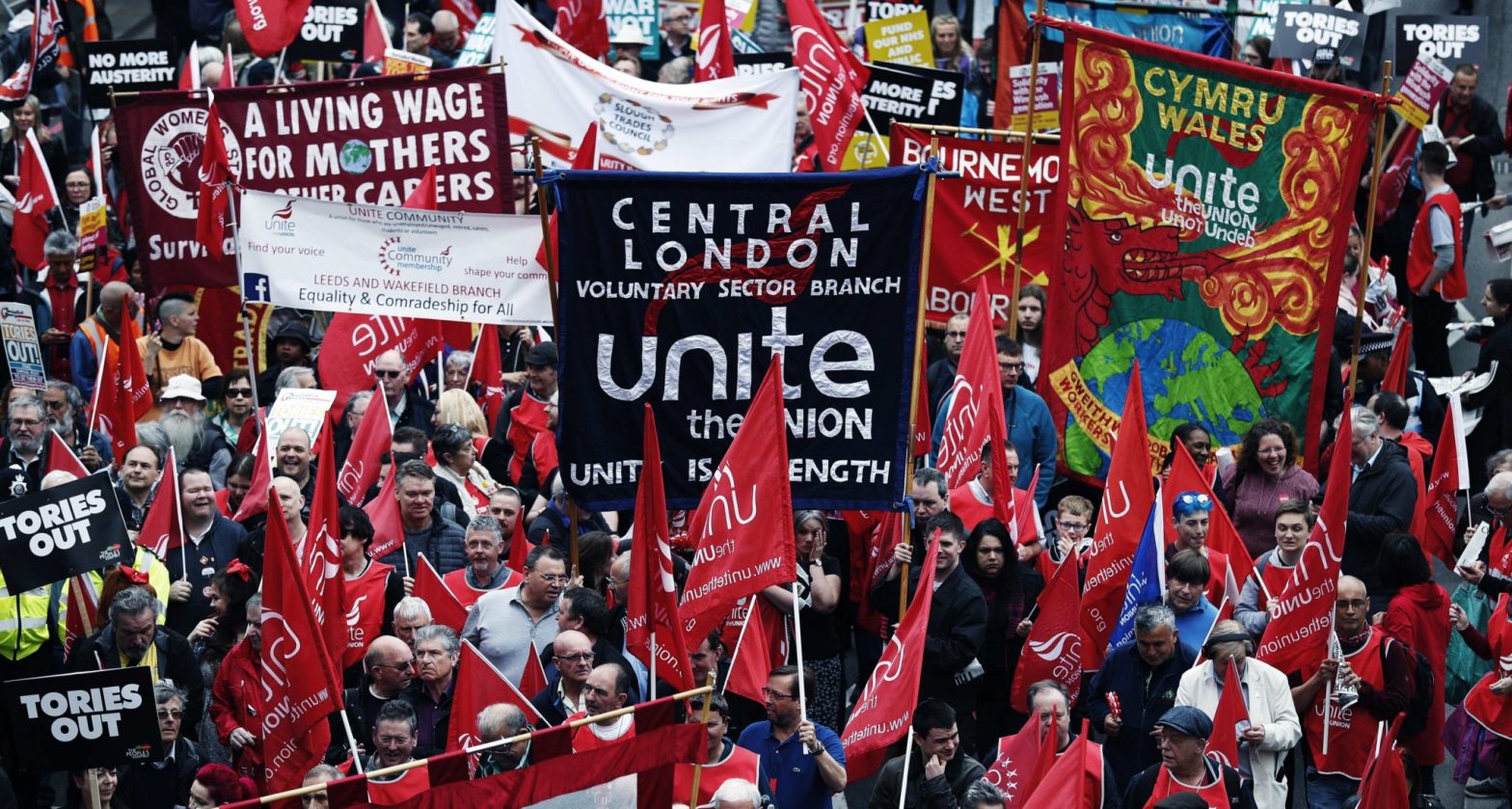
RMT Bakerloo branch calls for a national demo: pass a motion in your branch!

The Bakerloo line branch of the RMT union has passed a resolution calling for their national union to call a Saturday demonstration against the threat of new anti-strike laws. The text of their resolution is below, followed by a more general motion for wider use.

Please consider submitting it in your union branch.


This branch notes the ongoing strike wave, and the Tories’ plans to impose new anti-union laws in response. This branch further notes historic RMT AGM policy to call a national demonstration against anti-union laws.

This branch believes the protest called by RMT on 16 January was a good start, and must be followed up with further action, including a national demonstration.

This branch therefore calls for the RMT to organise a Saturday national demonstration against anti-strike laws, taking place no later than 19 June 2023 (the anniversary of the start of our union’s strikes on national rail), with the following demands in line with union policy:

– No to new anti-strike laws
– Repeal all existing anti-strike and anti-union legislation
– For a full right to organise and strike
– Solidarity with all striking workers

This branch believes the demonstration should be co-organised with as wide a coalition of other unions as possible, but by RMT directly if necessary.


Notes:
1. The seriousness of the Transport Strikes (Minimum Service Levels) Bill, which would ban all-out strikes in a range of important sectors (not just transport).
2. That this comes on top of over a dozen anti-strike and anti-union laws passed since 1980.

Further Notes:
1. Demonstrations called by the RMT at Downing Street on 16 and 30 January.
2. The national day of action called by the TUC against the anti-strike laws on 1 February, in parallel with a mass strike of over 500,000 workers across multiple industries.

Believes:
1. The labour movement must organise specific campaigning, at local and national level, against the Bill. An assertive campaign, conducted in parallel with and through the ongoing strike wave, could force the Tories to back down. And, even if the Bill is implemented, we will be in a stronger position to resist and defy its restrictions if we have spent the period prior to implementation organising active opposition to it.
2. This must include an urgent national demonstration specifically on this issue, in London, on a Saturday, with a serious attempt to mobilise at least tens of thousands.

Resolves:
1. To discuss what action we can take locally, by ourselves and working with other unions.
2. To call on our union to call a national demonstration to stop the anti-strike Bill, in London, on a Saturday, soon, working with other unions as much as possible.
3. To call for, and push for our union and the whole movement to call for, repeal of all the anti-union laws.
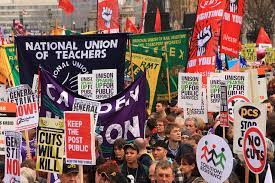
Add your support: for a national demonstration against anti-strike laws

As part of our efforts to mobilise rank-and-file trade unionists to push for our unions to call a national demonstration against anti-strike laws, we have launched a petition on change.org.

Add your name here.


Please consider submitting a motion calling for a national demonstration in your own trade union:

Call a national demonstration against the new anti-strike law!

Notes:
1. The seriousness of the Transport Strikes (Minimum Service Levels) Bill, which would ban all-out strikes in a range of important sectors (not just transport).
2. That this comes on top of over a dozen anti-strike and anti-union laws passed since 1980.

Believes:
1. That we need a flowering of local action to stop the Bill, and national action too.
2. That unions should call an urgent national demonstration specifically on this issue, in London, on a Saturday, making a serious attempt to mobilise at least tens of thousands.

Resolves:
1. To discuss what action we can take locally, by ourselves and working with other unions.
2. To call on our union to call a national demonstration to stop the anti-strike Bill, in London, on a Saturday, soon, working with other unions as much as possible.
3. To call for, and push for our union and the whole movement to call for, repeal of all the anti-union laws.

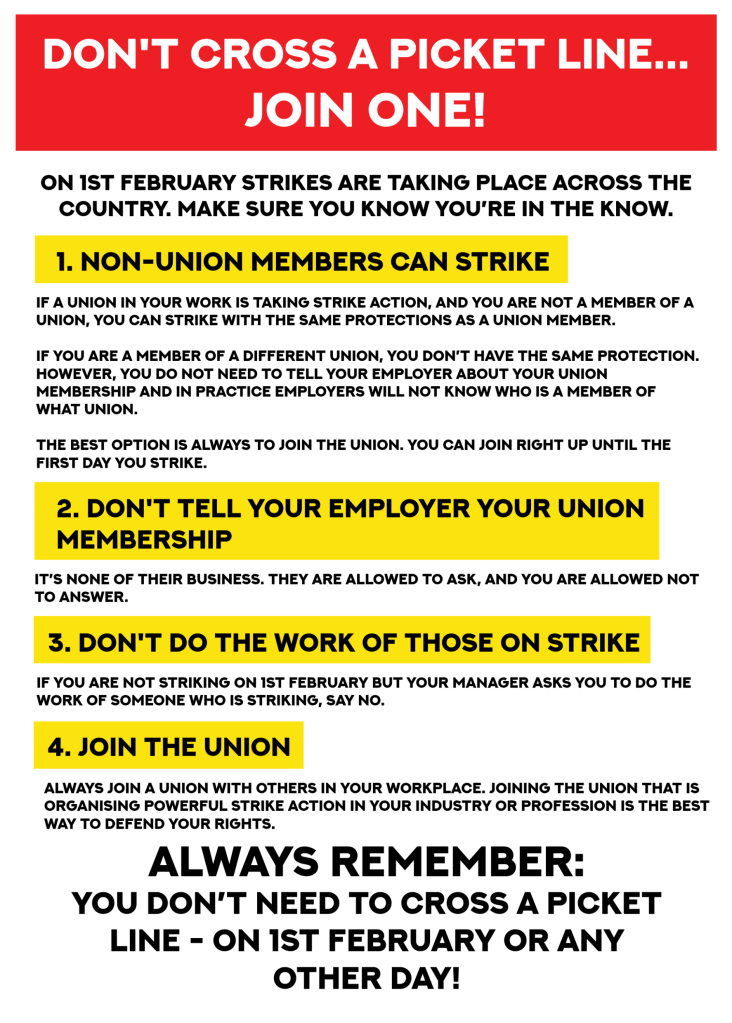
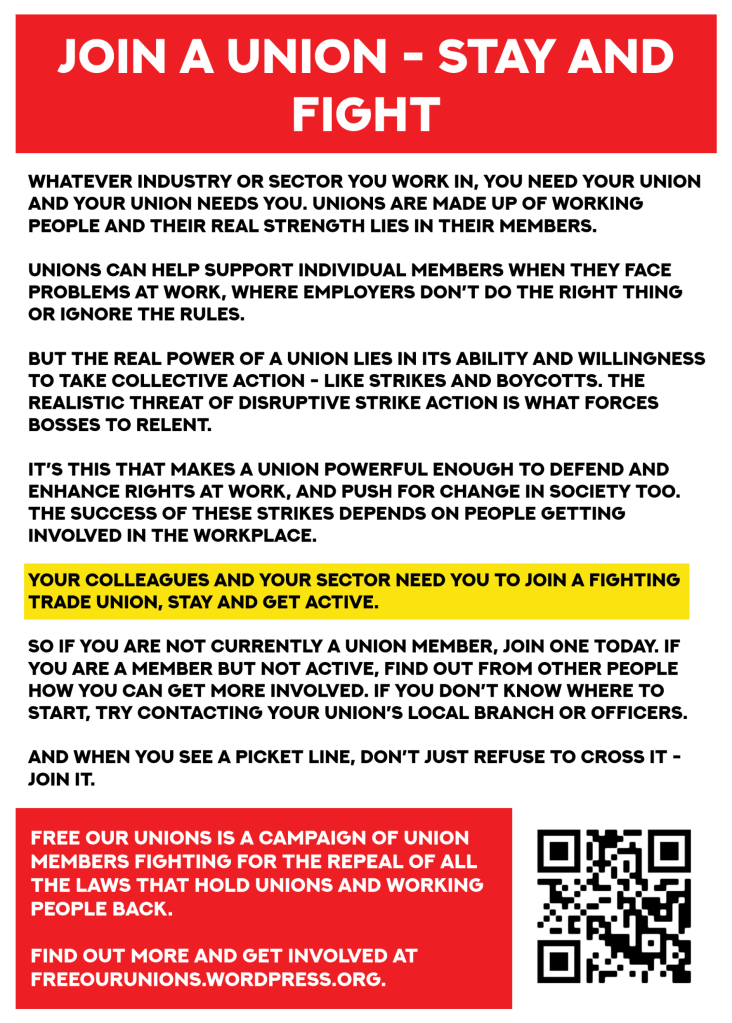
Don’t cross a picket line – join one!

Throughout the current strike wave, misinformation and disinformation has circulated – usually from employers, but sometimes from union officials too – about our rights in multi-union workplaces/industries where one or several, but not all, unions are striking. Some union officials have effectively instructed members to cross the picket lines of other unions.

Free Our Unions produced this leaflet, which we distributed on picket lines and at rallies on the 1 February strike, to counter this misinformation, and as a contribution to efforts to rebuild cultures of solidarity in which refusal to cross picket lines is the default instinct. An updated version will be available for use beyond 1 February.

After the mass strike and day of action: Free Our Unions open organising meeting, 7pm, 7 February

After the mass strike and TUC day of action against new anti-strike laws on 1 February, join us to discuss next steps in the fight against the Tories’ plans for new restrictions on the right to strike.

Our next organising meeting, open to all supporters of the campaign, will take place on Tuesday 7 February, at 7pm.

Log in via Zoom here, or by using:

Meeting ID: 835 3823 9276
Passcode: 683428

We need discussion and planning, not just rallies

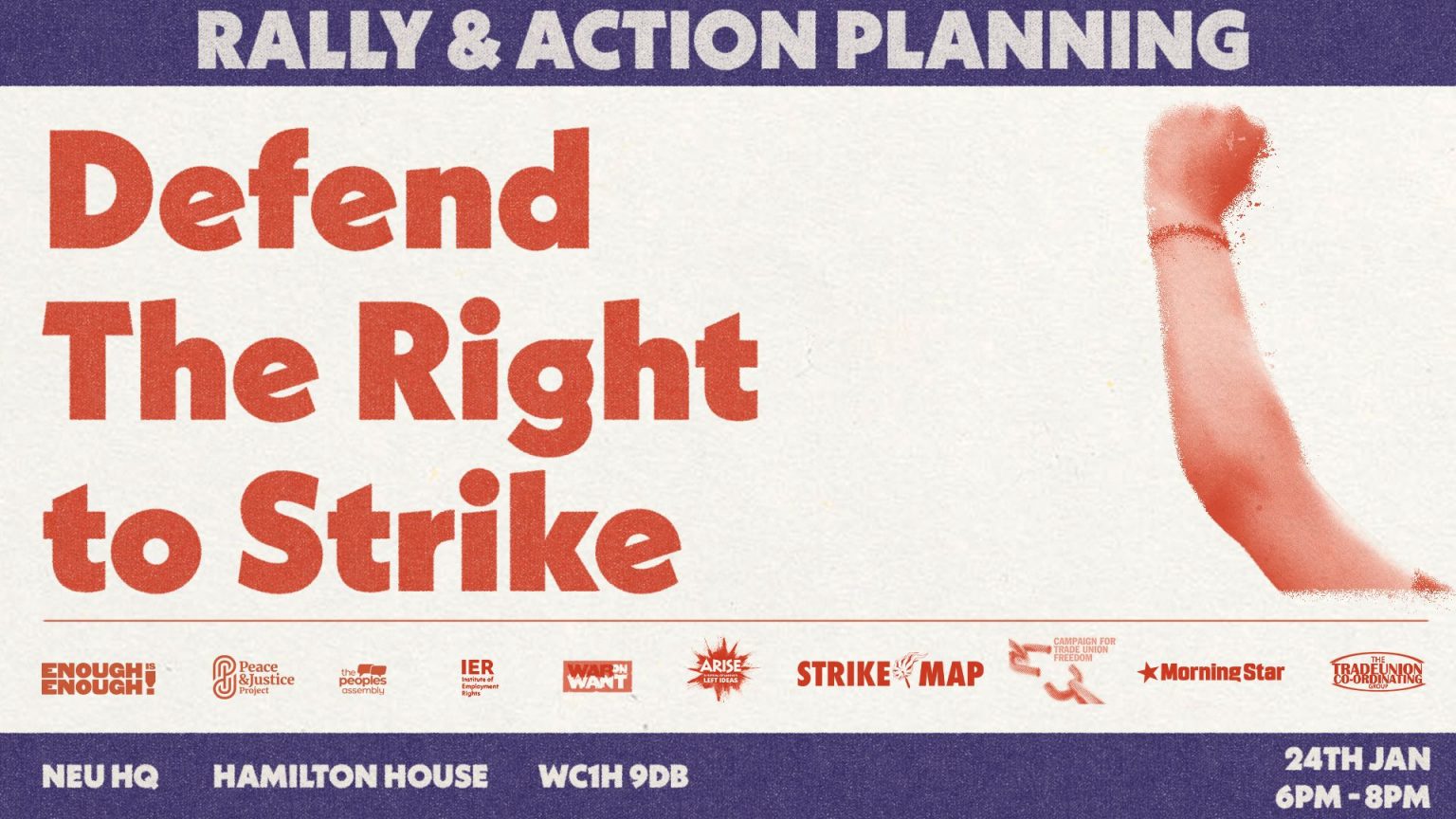
An attendee reports on the 24 January “Defend the Right to Strike” meeting called by Strike Map, the Campaign for Trade Union Freedom, and others, which was billed as an “action planning” meeting as well as a rally.

We very much need spaces in which we can consider, debate and decide on how to take forward the fight against the Tories’ assault on the right to strike, and push for the broad labour movement to take it forward. Unfortunately, this really wasn’t one.

I don’t write this in order to score points or “get one over” on anyone. If we are going to seriously fight back against this attack, our movement needs to do better.

I find myself reaching for the word “talking shop”. But in fact, the meeting wasn’t even a talking shop, i.e., an opportunity for participants to put forward opinions and ideas.

After several top-table speakers, there was half an hour given over to smallish breakout groups – but followed by another hour-plus of speakers, not collective whole-meeting discussion, let alone decision-making. “We look forward to reading your ideas later”, said the chair. In other words the breakout groups functioned to give a (very thin) illusion of participation, taking up time while providing no opportunity to shape the meeting or indeed anything.

We gave out a Free Our Unions leaflet calling for a national demonstration to stop the minimum service bill, based on this article. There was no way to put this idea to the meeting as such, except to mention it in breakout groups.

The meeting was similar to the Campaign for Trade Union Freedom and Institute of Employment Rights conference in the same venue in December; about a hundred people there; mainly an older crowd; with some representation from union reps and officers. Still, those hundred people could have usefully discussed what kind of action is needed and possible. Perhaps such discussion is outside the organisers’ comfort zone, or habitual way of functioning.

Instead of discussion, we had top-table speech after top-table speech about what’s wrong with the Tories, about the importance of strikes and about how the minimum service bill is bad. The last was actually the most useful element of the meeting, since Keith Ewing and John Hendy explained very clearly and informatively the draconian and sweeping nature of the Tories’ attack on the right to strike.

Several speakers said things along the lines of “We must fight this by every means available”, but without actually suggesting anything beyond the raising the issue, as proposed by the TUC, on the 1 February strike day. No speaker even hinted at a national demonstration against the bill.

RMT General Secretary Mick Lynch seemed to fall back to the narrative that was dominant in the unions before the bill was published, namely that if passes, well, we will fight harder in our struggles. He said the bill was certain to pass. Now, it may well be the case it passes, even given a much bigger campaign. And we should certainly work to get past and, where possible, defy all anti-strike laws. But, in practice if not in intention, this is fatalism parading as militancy.

The Tories are introducing these new restrictions for a reason, just as they had reason to introduce all the previous restrictions – which did, have and do continue to have an impact. Straightforward defiance of new restrictions is necessary, but it may not be easy or always effective – even more than with current restrictions (it’s also not clear that anyone is proposing a clear plan for defiance). We should do our best to stop the new law. And even if we fail in that, a strong and vibrant campaign will put us in a better position to not be intimidated, minimise the impact of new restrictions, defy as much as possible, and eventually win repeal.

By itself, a national demonstration is not going to stop this attack. But having one is necessary to building a serious campaign. Free Our Unions will continue to agitate for it to happen.

There was also very little mention of what the labour movement should demand in terms of repealing anti-union laws and in terms of positive legal rights. In a stumbling and not very radical way, Prison Officers Association general secretary Steve Gillan was actually the only one to raise this issue, rightly pointing out that winning repeal depends on a Labour government and that “we need to hold Labour to account on this”.

Unfortunately, in addition to not advocating anything concrete to achieve that, Gillan wrongly claimed that Labour’s “New Deal for Workers” commits to “repealing all anti-union laws” (his exact words). In fact it doesn’t say that, not even on paper – on the right to strike it is vague. But an organised fight to demand and win this commitment is certainly necessary. The fact the 24 January meeting avoided that discussion, too, was another thing that made it a missed opportunity.


Join Free Our Unions at our next open organising meeting on Tuesday 7 February, 7pm. Details here.

Rally and planing meeting, 24 January (called by CTUF, StrikeMap, and others)

The Campaign for Trade Union Freedom has called a rally and planning meeting for activity against anti-strike laws on 24 January, 6pm at the National Education Union HQ in central London (see here for details).

Free Our Unions supports this meeting and encourages activists to attend.

With 12 top-table speakers currently billed, the event seems to be more rally than planning meeting. We hope that a substantial amount of time in the meeting will be reserved for discussion and planning.

Discussion: The “Workers’ Bill of Rights” is welcome, but we need clarity and drive on right to strike

This discussion article was written by a Free Our Unions supporter. We welcome responses and further contributions. Email freeourunions@gmail.com with submissions.


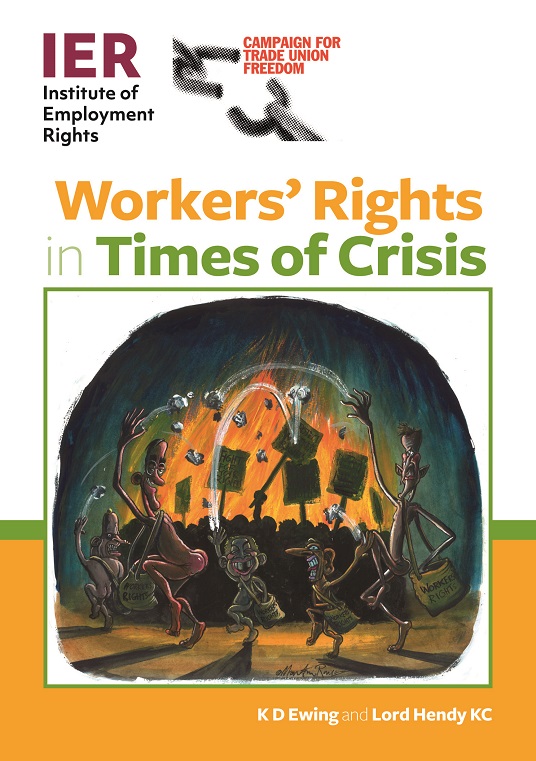
At its event in London on 3 December, the Institute of Employment Rights (IER) called for comments on and responses to its new Workers’ Rights in Times of Crisis pamphlet and the “Workers’ Bill of Rights for an Age of Crisis” that concludes it. Here are some comments. It would be much appreciated if IER, and connected organisation CTUF, republish this article on their websites.

The pamphlet is an excellent educational resource, drawing together key facts about the situation facing workers in the UK and how it is shaped by the increasingly disastrous framework of labour law. I hope the IER will put the text or a PDF online for free at some point.

The “Workers’ Bill of Rights” proposals, focused on restoring and expanding collective bargaining between unions and employers (but ranging much more widely), are welcome and useful. The pamphlet is also right to call for escalated pressure on the Labour Party, not complacency that a Labour government will automatically make a difference

I want to focus on the right to strike, the main focus of Free Our Unions and a decisive issue for workers’ rights more broadly, for the labour movement’s wider demands, and indeed for all struggles for social justice.

The fact we currently face a bitter defensive struggle is no reason to stop thinking about these longer-range demands. Whether or not we defeat the new minimum service law, the question will remain what the labour movement’s positive demands are and, very practically, which laws a Labour government will repeal and which it will keep. The labour movement must actively shape that argument – indeed ensure it is an argument at all – pushing for the strongest possible right to strike and the maximum trade union freedom. Otherwise we face a repeat of what happened under Blair, when all the anti-union laws were maintained, paving the way for new restrictions later on.

During the period when the IER was advising Jeremy Corbyn’s Labour leadership, it increasingly soft-pedalled and retreated on the question of repealing all anti-strike / anti-union laws.

The new pamphlet represents a shift back towards a clearer position. It eloquently explains the need for solidarity action – strikes in support of other workers, with a different employer – to be legalised, and for the labour movement to be forthright and unapologetic in making this demand.

Let us note but leave aside for now the question of why a left-wing Labour leadership was the occasion for the IER to make an opportunist shift: the exact opposite of what was necessary! On the right to strike at least, the demands in the Workers’ Bill of Rights are still insufficiently clear. What it says is good, but needs concretising.

It says:

“Every worker shall have the right to participate in industrial action for the protection and promotion of their economic, social and political interests and not to be penalised for doing so, and every union shall have the right to organise and support industrial action, subject only to the rules of the trade union in question.”

That is much stronger than what the IER mostly said in 2015-19, and particularly 2017-19, pointing strongly in the right direction.

But in addition to these general principles, we need clarity on the essential point that to establish those rights we need to win repeal of all the anti-strike / anti-union laws, back to the first one passed under Thatcher in 1980. We need their replacement with strong legal rights – but repeal is essential.

We also need to spell out more definitely, concretely and specifically the rights we want, both in terms of removing current restrictions and the positive legal rights that should replace them. This must include rights for workers and unions:

• To strike / take industrial action at times, for demands and by decision-making processes of their own choosing.
• To picket any workplace, in any numbers.
• To strike / take industrial action in solidarity with any workers.
• To strike / take industrial action over any issue, including any broader social or political question.

Last but not least, need a mass agitational campaign in the labour movement to establish clear and active support for these demands, as the precondition for winning them.

The IER should work with Free Our Unions and others to make this happen.

Discussion: unions must call national demo against new anti-strike laws

By a Free Our Unions supporter

After months of mainly silence or bullish dismissiveness, unions have started to sound the alarm about the Tories’ new proposals for a “minimum service” law, and at least nod to the need for protest. Fire Brigades Union general secretary Matt Wrack has called for a “mass movement of resistance”, and rail and transport union RMT has called an emergency protest (Monday 16 January, 6pm, Downing Street).

It’s a start but we need much more. Unions should call a national demonstration.

We need to bury the consoling notion that the introduction of such a law will lead to mass protests and unrest at some unspecified point in the future, after it has passed. It might, but we shouldn’t bank on it – and the time to protest is now. We need to bury the idea that such laws don’t really matter, because unions will just work harder to get over them. The Tories are introducing these new restrictions for a reason – just as they had reason to introduce all the previous restrictions. Of course we should work to get over and round the restrictions, but they do make a difference every day. We need to demand their abolition, through repeal of the anti-union laws.

We need mass protests now to stop the new law (and re-raise the idea of abolishing the other anti-union laws). Even if we fail to stop it, the more and the more vigorous our protests, the more likely we will get mass protest, defiance and determined industrial action in the future. (In 1972, when strikes defeated and rendered inoperative the Industrial Relations Act, they came after very big union demonstrations before it passed.)

We need a stream of local actions, protests, meetings and events. We need the message of protest against this new law, and all anti-union laws, to be woven into the messaging of ongoing strikes and demonstrations. We also need national action to show the government (and, in a different way, the Labour Party) we are serious. That’s why we need a national demonstration.

I mean a national demonstration specifically about the issue of the new anti-strike law (obviously it can say other things too, but that should be the clear and central focus), in London, on a Saturday, soon. I mean a serious attempt to mobilise tens of thousands.

Unions should call such a demonstration. If it comes to it, even just one union would do, obviously working as widely as possible with bits of unions and other organisations.

We should agitate in our unions, Labour Parties and other organisations for this to happen urgently.

Here’s a suggestion for a motion for union branches and other bodies:

Call a national demonstration against the new anti-strike law!

Notes:
1. The seriousness of the Transport Strikes (Minimum Service Levels) Bill, which would ban all-out strikes in a range of important sectors (not just transport).
2. That this comes on top of over a dozen anti-strike and anti-union laws passed since 1980.

Believes:
1. That we need a flowering of local action to stop the Bill, and national action too.
2. That unions should call an urgent national demonstration specifically on this issue, in London, on a Saturday, making a serious attempt to mobilise at least tens of thousands.

Resolves:
1. To discuss what action we can take locally, by ourselves and working with other unions.
2. To call on our union to call a national demonstration to stop the anti-strike Bill, in London, on a Saturday, soon, working with other unions as much as possible.
3. To call for, and push for our union and the whole movement to call for, repeal of all the anti-union laws.