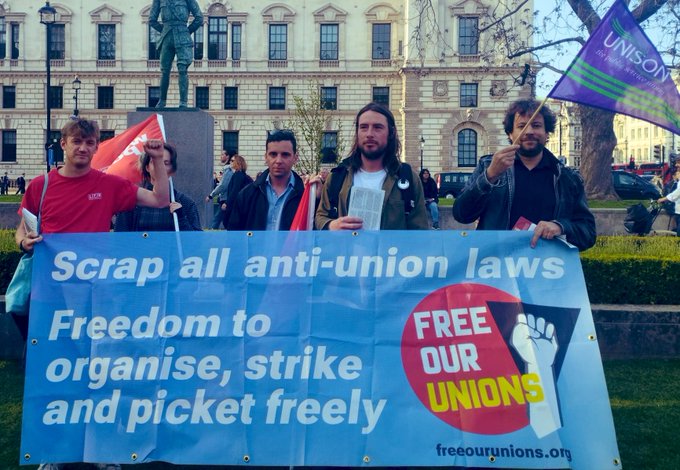
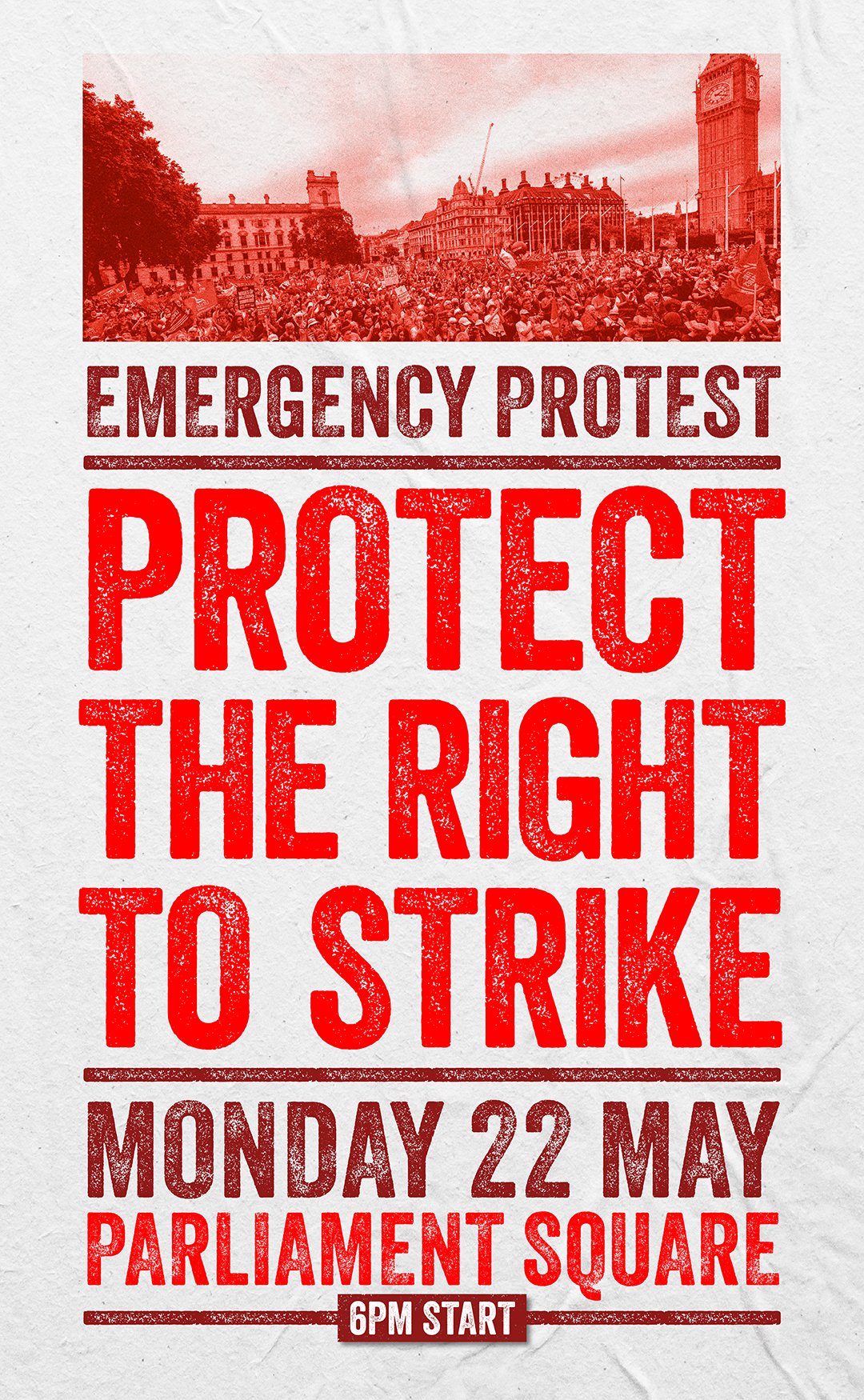
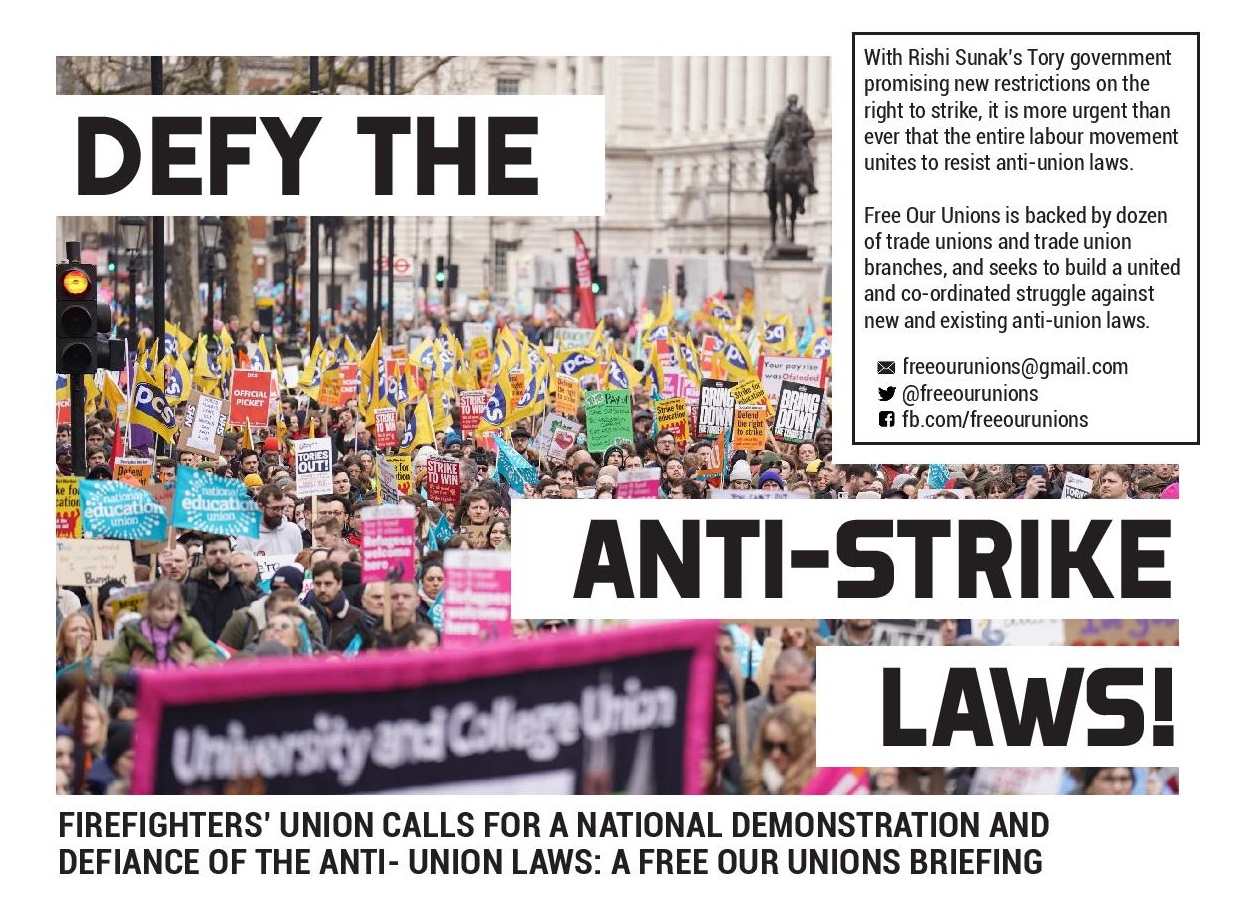
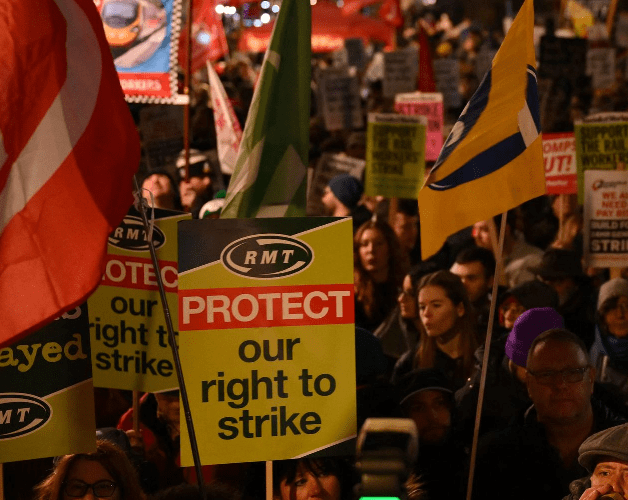
The TUC has called an emergency protest in Parliament Square at 6pm on Monday 22 May, when the Minimum Service Levels Bill is due for its next, and possibly final, Parliamentary reading and debate.
Get down with your union banners! Free Our Unions will be distributing our latest briefing, and we’re planning a discussion/organising meeting to discuss next steps in the fight.
New Free Our Unions briefing
We’ve produced a new campaign briefing for activists to help them push inside their unions for a national demonstration against anti-strike laws. The briefing includes a model motion for union branches, the recent policy passed by the Fire Brigades Union Executive Committee calling for a national demonstration and defiance of the laws, and a discussion article on what defiance could mean in practise.
Download the briefing as a PDF below. For printed copies for distribution in your workplace/union branch, email us at freeourunions@gmail.com.
Printer-ready version:
House of Lords amends anti-strike bill – but no room for complacency!
The House of Lords has approved amendments to the Tories’ Strikes (Minimum Service Levels) Bill which would blunt some if its worst effects.
The Lords voted for an amendment that extends protection from dismissal to striking workers who are named in a minimum service complement and refuse to work: “Failure to comply with a work notice shall not be regarded as a breach of the contract of employment of any person identified in the work notice, or constitute grounds for dismissal or any other detriment.”
The Lords also voted to exempt Scotland and Wales from the bill’s measures, meaning employers and government in those countries will not have to set minimum service levels, allowing all-out strikes to take place. It also voted to require a consultation on the bill’s impact on the right to strike.
These are positive developments, but they should not be hailed as decisive “victories”. There is no room for complacency; the bill still has to go back to the Commons, where the amendments will be discussed and voted on. And even if they are incorporated into the final version of the bill, it remains an enormous attack on workers’ ability to strike effectively.
We still need assertive political campaigning against the bill, including a national demonstration, and a serious discussion about defiance of the law if it is passed.
Court rules against nurses’ strike
The final day (2 May) of a planned strike by nurses’ union the RCN has been cancelled, after the government took the union to court to block the strike. The judge agreed with the government’s assertion that the RCN’s industrial action ballot mandate expired at 23:59 on 1 May, making the final day of the strike unlawful.
The RCN held a protest outside the Royal Courts of Justice, where protesters held placards including one reading “who takes their heroes to court?”
RCN leader Pat Cullen said: “The full weight of government gave ministers this victory over nursing staff. It is the darkest day of this dispute so far – the government taking its own nurses through the courts in bitterness at their simple expectation of a better pay deal. Nursing staff will be angered but not crushed by today’s interim order. It may even make them more determined to vote in next month’s reballot for a further six months of action.”
The law that the government’s case relied on, which stipulates that industrial action mandates expire and must be renewed on a six-monthly basis, is part of a complex network of bureaucratic and administrative restrictions placed on unions designed to slow down and obstruct strikes.
Other laws include the requirement for ballots to be conducted by individual postal ballot, rather than electronically or by votes in workplace meetings; minimum notice periods prior to balloting and taking action; and restrictions on the issues over which unions can strike, including a prohibition on striking in support of other workers.
Although it is understandable that Cullen focused on the RCN’s re-ballot in her response, we also need direct confrontation with anti-union laws. Almost all unions have policies committing them to campaign for the abolition of these laws, but these policies are rarely acted on, even to the limited extent of mentioning them in speeches.
With the Tories planning to impose yet more restrictions, the labour movement must urgently step up our collective efforts to campaign against anti-strike laws.
Emergency protest at Parliament, date TBC
Rail union RMT has announced to members in a circular that the TUC plans to call an emergency protest in Westminster on the evening of the next parliamentary reading of the Minimum Services Levels Bill.
This will take place sometimes between 10-25 May. (See below for the text of the RMT circular.)
Protests coinciding with parliamentary readings are important. When we know when the bill will be heard, a protest must certainly be called. However, the TUC – or a coalition of individual unions – does not have to, and should not, wait for the parliamentary timetable to be announced to call action. Unions must call a national demonstration, on a Saturday, and throw real resources into mobilising for it.
Several unions already have policy calling for this: it’s time they were enacted.

Dear Colleagues,
PROTECT THE RIGHT TO STRIKE – FIGHT THE ANTI-STRIKES Bill – UPDATE
I wanted to provide you with an important update on our campaign against the Strikes (Minimum Service Levels) Bill which continues to pose a fundamental threat to our democratic and human right to withdraw our labour.
Since I last wrote to you RMT along with TUC and other unions are still strongly campaigning against the Bill. The Bill has slightly stalled in the House of Lords with many peers ridiculing the Bill for “wasting Peers’ time” and that Government “should go back to the drawing board.”
However, the Government is still pushing ahead with this shocking Bill and the report stage in the House of Lords is set to take place this Wednesday 26 April. It will then go back to the House of Commons, with the final Commons debate probably being sometime 10-25 May but this has not been confirmed yet
On the night of the final Commons votes, the TUC is calling an Emergency Protest outside Parliament with the date to be confirmed but, like the previous Emergency Protests we have called, we’ll likely only get a week’s notice.
It is absolutely vital that we keep up the pressure against this bill so please be prepared and on-standby to urgently mobilise for an emergency protest at some point between 10-25 May and I will be in touch with more details as soon as I have them.
Yours sincerely,

Michael Lynch
General Secretary
Government threatens nurses’ strike: demonstrate at Royal Courts of Justice, 9:30am, 27 April
The government is pursuing a legal action against the upcoming planned strike by nurses’ union RCN. The legal action claims that, because RCN’s current ballot mandate expires on 2 May, the final day of their planned strike is invalid and should be cancelled.
Laws around balloting are deliberately restrictive, designed to slow down and obstruct workers’ action. RCN has called a protest outside the Royal Courts of Justice for 9:30am on Thursday 27 April, see details below. Please attend if you can.


TALKS NOT COURTS!


The RCN has been notified court proceedings are going ahead on Thursday 
CALL OUT: Come along to a demo at the High Court
Let’s show the government they should be negotiating, not trying to bully RCN members by trying to curtail your strikes through the courts!
Where? Royal Courts of Justice, Strand, London WC2A 2LL
When? 9.30AM onwards on Thursday 27 April
Can you make it? For more info email Emma – emma.laws@rcn.org.uk)
We Make Tomorrow conference, 20 May
Free Our Unions has worked extensively to draw links between the fight against anti-strike laws and the fight for climate justice. We have collaborated with networks in the climate movement such as Earth Strike UK, via the “Empower the Unions” initiative.
We’re therefore pleased to promote the We Make Tomorrow conference, organised by the Trade Union Caucus of the Climate Justice Coalition, which takes place in Manchester on 20 May:
“We Make Tomorrow is a one day conference for building workers’ power on climate and crisis. The conference will dig into how rising energy prices, inflation, falling wages and the climate crisis are not only connected but actually being driven by the same systems.
“Organised by the Trade Union Caucus of the Climate Justice Coalition, the conference brings together workers in key sectors with trade union officials, climate justice activists and scientists, providing an honest and open space to discuss the urgently needed strategies and tactics to build a tomorrow that works for the majority and not the billionaires.
“Register today to get involved and join the discussion on how we make concrete plans to build power in our workplaces and communities so that we can stop paying the price for the crimes of the billionaires and ultimately how we can retake control of an economy that is destroying people and the planet.”
Check out the conference website here.
Anti-strike law: what “defiance” means
By a Free Our Unions supporter
This article is a contribution to debate and discussion. To write a reply, please email freeourunions@gmail.com.
Fire Brigades Union leader Matt Wrack has called for a “mass movement of non-compliance” against the Minimum Service Legislation.
That’s good. But as I understand the legislation, “non-compliance” begs the question.
A union can refuse to enter into consultation about “minimum service” levels. Then, under the law, the levels are set by the government. A union can refuse to talk with the employer about which people will required to work on strike days to provide those levels. Then, under the law, the employer can name people unilaterally.
If the union refuses to “take reasonable steps to ensure that all members of the union who are identified in the work notice” will break the strike, then a court can grant an injunction against the whole industrial action.
And if the union can finesse it by a tongue-in-cheek “instruction” to members to comply, coupled with tacit union signals not to comply, then the boss can discipline those workers not complying. Under already-existing legislation, a court will grant an injunction against industrial action opposing the disciplinary action.
There is really no option of “non-compliance” just by folded arms. A union can really defy the legislation only by striking in direct conflict with an injunction.
Unions’ choice is to submit to the new law, or to go for high-stakes direct defiance (not just “non-compliance”) by strikes in conflict with injunctions.
Those strikes will make the union liable to a fine, or even to having its assets seized. The only answer then is further direct defiance, i.e. the union to appeal for wildcat action against the fine or seizure.
That will be a break from union policy ever since the Thatcher laws of the 1980s. We have had many strikes, generally workplace-level, in conflict with those laws, which the bosses and the government have considered too hot to handle with those laws. But not unions directly defying the courts.
Transferring assets abroad, as the National Union of Mineworkers tried to do in 1984-5, is not really an answer. Having accounts abroad so that the union cannot pay rent on its offices, wages to its officials, or strike-pay to its members, and has difficulty getting dues from its members, would paralyse union functioning as much as the government fining it.
In Australia, where anti-strike laws are harsher than they would be in Britain even with the Minimum Service Law, it has been fairly common for unions to strike in conflict with the law and pay the ensuing fines. But unions do that less and less. It’s not a long-term answer, because it erodes union capacities.
Direct defiance, breaking injunctions, can work, for the same reason that the bosses and the government have chosen not to deploy the laws against strikes. Strikes could push courts into imposing only nominal fines, and thus prepare the way for the Minimum Service Law to be abandoned as unworkable.
It won’t be easy. If employers and the government are cunning, they will make the prescribed “minimum service” really minimal, at first anyway. Employers will avoid naming union activists for the “minimum service” work. When individual workers defy “minimum service” prescriptions, strategically-thinking employers will impose only minor discipline (a written warning, say).
There will be many in the unions saying that we should box clever and find ways of effective industrial action while formally complying with “minimum service” law. In the short term it may be plausible.
Then, in the longer term, the government and employers can tighten the grip of the law, making the “minimum service” ever larger, the penalties for individual workers sharper, so that the law bites harder.
Cunning workarounds can also be counterproductive in the coming years, by giving an incoming Labour government an excuse on its promise to repeal the law – it seems to be doing little harm, Starmer can say, and in the meantime there are other priorities.
The first step is to get a proper national demonstration against the Minimum Service Law. But the next step – and it starts now: we walk on two legs – is to commit unions to defy injunctions introduced to implement that law.
Firefighters’ union calls for national demonstration and emergency TUC Congress to fight anti-strike bill: what next?
By Mohan Sen
The call from the national Executive Council of the Fire Brigades Union (FBU) for new and escalated mobilisation to stop the government’s Minimum Service Levels (MSL) anti-strike bill is extremely welcome. (See here for the statement from the FBU EC, here for the
union’s public announcement of it, and here for their tweet.)
The FBU calls for the TUC to organise a national demonstration and hold a special TUC Congress to discuss how to stop the MSL law (or, if it has passed, how to defeat it through “mass non-cooperation and non-compliance”). In somewhat vaguer terms, it calls for mobilisation and organisation to defeat the law whether or not the TUC acts.
Some questions are posed by the FBU’s welcome intervention.
Calling for the TUC to organise a demonstration is necessary: of course the FBU and others should also pursue things on on that level. But the TUC seems unlikely to do it (as TUC General Secretary Paul Nowak’s bland response to the FBU’s call), and time is short. What else should labour movement activists argue for? Particularly given the call for action regardless of the TUC, shouldn’t we also call on the FBU to initiate the organisation of a demonstration itself, drawing in as many others at different levels of the labour movement as possible? Although it is a relatively small union, it surely has the weight and profile to do so.
And if there is no special TUC Congress, will the FBU initiate a labour movement conference of some sort at which officers, reps and activists can discuss how to organise this fight?
The background
Free Our Unions has been calling for mass protests to stop the MSL proposals since last summer, before the actual bill was published. In October we organised the first on-the-streets protest specifically against this threat, at the Department of Business headquarters in London, together with Earth Strike and others. At that stage most union leaders were effectively dismissing the idea of protests, talking only about future defiance and civil disobedience after the law passed.
Early this year, after the bill was published, the RMT organised two protests. They were much bigger than the eighty or a hundred people we mobilised in October, but probably only in the region of a thousand (both held on Monday nights).
Then the TUC made opposition to the MSL bill part of the 1 February day of strikes (#righttostrike). That was good, but all reports indicated that off social media, on the picket lines and the streets, the issue was mostly not very prominent. In any case, there has been no follow up in two months since, a few thin TUC comments in the media aside.
The FBU EC is right. We need a serious national demonstration to stop the bill. By itself such a demonstration may well not be enough to win. But a vigorous real-world campaign against the bill is needed in order to maximise our chances of defeating or amending it; minimise how intimidated workers feel if it passes and therefore maximise the possibilities for defiance; and maximise how many restrictions we can get repealed under a Labour government.
Without relatively large on-the-streets protests, it will not be a vigorous campaign. Local protests are much needed too, but a national demonstration is an important way to catalyse a movement. People in the labour movement often talk, with more or less substance, about the strikes that neutralised the Industrial Relations Act in 1972 (the Pentonville Five). But they often miss out a crucial point: those strikes came after very large demonstrations to stop the Industrial Relations Bill in 1971 – in fact, the largest demonstrations in the UK since the 1920s.
In contrast, the 2016 Trade Union Act went through with minimal protests. We are at severe risk of that happening again. All that is why FOU has continued agitating for a national demonstration. It is why, in response to the FBU’s initiative, I pose the questions at the top of this article.
A final observation: it’s right to focus immediately on defeating the MSL Bill. But we also need to renew and escalate the fight to repeal all anti-strike/anti-union laws, back to the Thatcherite laws of the ‘80s. The statement discussing this that the FBU EC has put to the union’s upcoming conference expresses, in general form, the right position. How do we put it into practice?
Debating anti-union laws at union conferences
The issue of anti-union and anti-strike laws, and how the labour movement should respond, will be debated at most union AGMs this spring and summer. Here, we present a selection of motions submitted to various union conferences:
National Education Union (NEU)
National conference of Trades Councils
Fire Brigades Union (FBU)
Unison
Unite
National Education Union (NEU), 3-6 April, Harrogate
Full agenda online here
Motion 45: Anti-trade union laws
Proposer: Northumberland NEU
Seconder: City of Preston NEU
Conference notes that:
1. The UK currently has the most restrictive trade union laws in Europe
2. The introduction of ballot thresholds in 2016 was designed to prevent unions from taking part in industrial action
3. The Government has already removed the ban on the use of agency workers to cover workers on strike
4. Political parties can elect leaders through online ballots but trade unions must do this through fully postal ballots
5. These attacks on trade unions are accompanied by further plans to weaken workers’ rights.
6. One effect of the cost-of-living crisis and increased union action is that interest in and support for trade unions is higher than it has been for a generation.
Conference condemns Tory Government plans to introduce further restrictions on trade unions and their rights to organise to defend our pay and working conditions, including:
i. Further tightening laws governing strike ballots
ii. Attacks on facility time.
Conference congratulates those unions such as the CWU, RMT, PCS and UCU who have overwhelmingly beaten Government-imposed ballot thresholds and taken strike action in furtherance of their disputes on pay and jobs.
Conference welcomes the steps the union has taken to ensure that we are in the best possible place to beat the thresholds in the ballot on pay.
Conference further congratulates all those school reps and local officers who have worked so hard to organise the ballot turnout in their district.
Conference instructs the executive to:
a. Work with other unions and the TUC to campaign for the removal of all anti-trade union laws
b. Call on a future Labour government to repeal Tory anti-trade union laws
c. Work with other unions to lobby the Government and opposition parties to legalise the use of online ballots for union elections and strike ballots
d. Work with other unions and campaign groups to build the biggest possible alliance in support of workers’ rights – including mass demonstrations.
Motion 47: Free our unions – resist new anti-union laws, repeal existing ones
Proposer: Isle of Wight NEU
Seconder: Nottinghamshire NEU
Conference notes the Government’s plans for severe restrictions on the right to strike, including:
1. Introduction of the “minimum service requirement” outlawing all-out strikes in certain sectors that the Tories pledged in their 2019 manifesto for transport – but have now extended to other sectors
2. Doubling the minimum notice period for strikes from two to four weeks
3. Raising the threshold for strikes in certain “essential” sectors from 40% of the eligible membership voting to 50% and extending this to the whole economy
4. introducing a “cooling off period” meaning unions cannot strike at will after a ballot mandate
5. Outlawing or restricting strike pay.
Conference further notes that Britain already has what has been described as “the most restrictive union laws in the western world.”
Conference believes:
i. These new restrictions would further criminalise effective trade unionism
ii. The whole labour movement must resist
iii. That resistance must not only focus on threatened new laws but must demand the abolition of all existing restrictions on the right to organise and strike, and their replacement with a positive charter of union rights.
Conference instructs the executive to:
a. Produce a briefing for members explaining the threatened new laws, and the scale of existing restrictions
b. Support the Free Our Unions campaign
c. Work with other unions, via the TUC where possible, to organise wider campaigning, including plans for direct action such as demonstrations
d. Support calls for a national demonstration on this issue, and work with other unions to organise this.
Annual national conferences of Trades Councils
The fight against anti-TU laws
Proposed by the Greater London Association of Trades Union Councils (GLATUC)
GLATUC reaffirms its solidarity with the current actions of trade unions and the coordinating work carried out by the TUC and regional TUCs and supports the calls to continue to build further protests including a further national demonstration for the repeal of all anti-trade union laws.
We recognise that the fight to defeat the anti-union laws is a key part of the whole struggle to overcome the attack on workers’ pay and conditions and on services and jobs. We further recognise that there is also a wholesale attack on health and safety standards both at work and in the community as part of this attack and the massive challenge presented by the fight for a sustainable environment to ensure all our futures. To be successful this will require the building of bigger and stronger local campaigns in which trades councils play a key role. The battle will not be an easy one but is crucial for our whole future. That means we have to maintain the pressure to safeguard workers and communities whoever the occupant of 10 Downing Street.
Fire Brigades Union (FBU), 10-12 May, Blackpool
Preliminary agenda online here
From FBU Executive Committee policy statement, “preparing for a general election” (online in full here)
The FBU will demand that workers’ rights are prioritised to ensure that workplace relations are significantly altered to favour workers. Anti-worker policies have been the hallmark of successive Westminster governments. The Conservative government is pushing through the minimum service levels legislation that essentially bans effective strike action in various sectors. While the FBU is immediately building opposition to this attack, if the Bill becomes law the union demands its repeal in the first week of a future Labour government.
The FBU demands more than just the repeal of the minimum service levels legislation and the Trade Union Act 2016. All anti-trade union laws should be repealed including those that prohibit secondary action. The Labour Party’s ‘A New Deal for Working People’ should be implemented in full. The FBU supports legislation to introduce a positive right to strike, including the right to picket.
Motion 60: The Strikes (Minimum Service Levels) Bill – an attack on worker and human rights
Proposed by FBU Cheshire
Conference condemns in the strongest possible terms the government’s planned anti worker legislation, following the wave of industrial action ballots in response to the cost of living crisis which is nothing more than a biased political attack on workers and the trade union movement.
The proposed legislation targets minimum service levels for fire, ambulance, and rail services, education, other transport services, border security, health services and nuclear decommissioning. The strikes bill shows the government is working against trade unions, unwilling to properly negotiate and is instead focusing its energy on further limiting workers’ ability to strike.
Under the new legislation, employers will be able to issue a work notice to staff required to meet minimum service levels. Those workers who take industrial action, regardless of being requested to work, lose their right to automatic protection from unfair dismissal. Fire Brigades Union (FBU) Members were rightly angered by the recent criticisms made of our service and our profession by His/Her Majesty’s Inspectorate of Constabulary and Fire & Rescue Services (HMICFRS). These criticisms, set out in three reports issued by HMICFRS, were part of the preparation of a serious attack on our service, our Union and our Members.
This attack also targeted the pay, conditions and collective rights of firefighters, and the ability and role of the FBU, and now we have been included in this anti-strike legislation – at the very time we were balloting our Members over pay following 12 years of pay restraint and a service and industry struggling after losing a quarter of its workforce nationally under successive governments.
The FBU and the entire movement needs to be loud and clear in response to this political attack on our rights, our movement and our conditions of service – we will not accept any attempts to dismantle our collective labour rights or any attempt at silencing the voices of our Members.
Conference demands the Executive Council commits to opposing this legislation with all means necessary including a legal, political and industrial response.
Motion 64: Labour and Minimum Services Legislation
Proposed by FBU Essex
Conference notes the current Conservative government states that it supports the rights of workers to take strike action, however, given the proposed minimum service legislation, in reality it only supports the rights of workers to take strike action that is ineffectual. Although transparent and authoritarian, to some extent this is to be expected from a Conservative government.
Should this become law, the Labour Party, were it to win the next election, has committed to repealing this legislation. However, the Fire Brigades Union (FBU) need to be mindful, that promises made 18 months before any election can slip once a party becomes a Government. Conference instructs that the Executive Council with other trade unions or alone, inform the Labour Party through the appropriate means that, should the Labour Party not have begun the process of repealing the minimum services legislation within 6 months of taking power, that the FBU will begin the process of disaffiliation from the Labour Party.
Unison, 13-16 June, Liverpool
Preliminary agenda online here
Motion 17: Defend the right to strike
Proposed by Unison NEC
Conference is alarmed at the new Strikes (Minimum Services Levels) Bill for Great Britain which further attacks the right to strike and with draw your labour in this country. Conference believes that the right to strike is a fundamental human right and needs to be exercised now to win better wages and conditions in the middle of a cost-of-living crisis. Whilst there have been gains in individual employment rights over recent decades this country has seen a fall in collective bargaining coverage, a fall in living standards as a result and a concentration of power and money by the wealthy. There are now only 6.5 million trade unionists in the UK from a workforce of 31 million and the UK has some of the most restrictive laws in the western world.
This attack by the Conservative government in response should also be seen alongside the 2016 Trade Union Act, current threats from the Retained EU Law (Revocation and Reform) Bill, the rise of fire and re-hire as in the P&O scandal, the rise of zero hours contracts and the Public Order Bill restrictions on the right to protest in public. Plus, the threat to the Human Rights Act and the European Convention on Human Rights.
Conference believes that the right to strike underpins the right to collective bargain and have the following benefits:
1) Reducing inequality;
2) Raising income levels;
3) Stops under cutting by employers;
4) Tackling discrimination;
5) And gives workers a voice.
The new Bill will give politicians the power to impose Minimum Service Levels (MSL) during industrial action in health, fire and rescue, education, transport, nuclear and border security. This will be backed up by the right of employers to serve unions with ‘work notices’ to meet the MSL which can identify roles and workers forced to work. And if deemed to fail to comply with this notice immunity is lost from being sued for damages by employers with fines up to £1million and loss of unfair dismissal protection for striking workers. This Bill has nothing to do with public safety and is not comparable to provision in other European countries which have strong collective bargaining laws.
Conference believes we must send a clear message to the government, employers and other trade unions that we will not equivocate in demonstrating our solidarity in the strongest terms with any worker or union which falls foul of any new restrictive anti trade union laws. In doing so we believe this sends a message to our movement to be ready to be mobilised and sends a message to the Government that we will not stand idly by and watch our rights being stripped away.
Conference therefore re-affirms our existing support for the right to strike and the abolition of the anti-trade unions laws and calls on the National Executive Council to:
a) Oppose the Westminster Parliament’s Strikes (Minimum Service Levels) Bill;
b) Work with TUC on a mass campaign to defeat the Bill; including joint meetings and protests with other unions;
c) Work with campaign groups and political parties who align with UNISON policies to oppose the Bill;
d) Work with Self Organised Groups, Young Members, Retired members, service groups and Regions to strengthen our campaign;
e) Set out the case for the right to strike and the benefits of collective bargaining;
f) Fully support UNISON members taking industrial action in defence of their pay and conditions at work;
g) Work with Labour Link to call on the Labour Party to follow through on commitments to repeal these anti-trade union laws and further call on them to repeal all other anti-trade union laws.
Motion 19: Free Our Unions – Resist New Anti-Union Laws Repeal Existing Ones
Proposed by Birmingham Unison
Conference notes:
1) The full impact of the current anti-union laws has been seen in the recent strike wave (Jan 2023): The laws mean thousands of workers who vote to strike cannot do so. They strengthen the hand of the bosses in industrial disputes and result in widespread confusion amongst union members as to what action they can support;
2) That the Tories’ “Transport Strikes (Minimum Service Levels)” Bill is already making its way through Parliament (Jan 2023).
Rishi Sunak has also promised to bring forward further, as yet unspecified, legislation to place additional restrictions on workers’ and unions’ ability to organise and take action.
Conference further notes:
a) That Britain already has what Tony Blair once proudly called “the most restrictive union laws in the western world”.
Conference believes:
i) These new restrictions would further criminalise effective trade unionism. The whole labour movement must resist. That resistance must not only focus on threatened new laws, but must demand the abolition of all existing restrictions on the right to organise and strike.
Conference instructs the National Executive Council:
A) To produce a briefing for members explaining the threatened new laws, and the scale of existing restrictions;
B) To support calls for a national demonstration on this issue, and work with other unions to organise this;
C) To raise this issue through Labour Link asking Labour to commit to repealing the laws when next in government, in accordance with its Conference policy.
Unite, 11-14 July, Brighton
Motion 94: Repeal of Anti Trade Union Laws and prevention of future anti-trade union legislation
Proposed by Unite Education NISC
This Conference notes that for the past 13 years Conservative led governments have introduced anti-trade union legislation and are introducing more anti trade union laws. This not only stifles effective trade unionism, but also weakens our democracy and stops workers rightfully challenging employers.
This Conference resolves that Unite:
• Puts pressure on future United Kingdom and devolved governments to repeal this legislation
• Lobbies the TUC to co‐ordinate strike action if new anti trade union legislation is passed
Motion 95: Support Striking Workers
Proposed by Unite London and Eastern Regional Committee
Conference notes:
We already have some of the toughest anti‐trade union laws in Europe and now the Conservative government has announced new anti‐strike legislation, bringing in a minimum service level bill which will mean unions could be sued and workers such as nurses, bus and train drivers could be sacked in future if they go on strike.
We welcome the Labour Party’s response that any new anti‐strike legislation introduced would be repealed. We also welcome the proposals set out in Labour’s Employment Rights Green paper, ‘New Deal for Working People’, where Labour commits within 100 days of taking office to:
• Repeal anti‐trade union legislation, including the Trade Union Act 2016,
• Use public procurement to support good work
• Oversee the biggest wave of insourcing of public services for a generation
• Fair Pay Agreements will be negotiated through sectoral collective bargaining
• Give all workers from day one rights on the job
• Ban zero hours contracts and give workers predictable contracts
• Outlaw fire and rehire
• Close gender, ethnicity, disability pay gaps
However, our members find themselves in the middle of a cost of living and energy crisis, with possibly two more years of Tory mismanagement of the economy. We have inflation running at historically high levels, which disproportionately affects the lowest paid workers. The Bank of England Governor, Andrew Bailey acknowledging this has stated “Inflation is bad for the least well off generally and this inflation is particularly bad. The reason is that it is concentrated on energy and food – these are the essentials of living.”
Strong trade unions are vital to advance the interests of working people. Workers are fighting back, taking industrial action to protect their pay, terms, conditions, workplaces and public services from being destroyed. Workers cannot wait until the next General Election for a Labour government, they need to act now.
We applaud the thousands of Unite members across all Regions, Nations and Sectors, fighting back and winning. In other unions, too, many workers have taken and continue to take industrial action, fighting to protect pay, terms, conditions and services such as our NHS, railways and mail. We send solidarity to all unions and members involved in these disputes.
Conference reaffirms:
• support for Labour’s commitment to repeal the new anti‐strike legislation
• support for Labour’s Employment Rights Green Paper and welcomes the commitment from the Labour leadership to its full implementation within 100 days of taking office
Conference resolves:
• to call on the TUC to organise coordinated solidarity action if any union has this anti‐strike legislation used against them
• to do everything possible to ensure all wings of the Labour party, including those who sit on the front bench, demonstrate unequivocal support and show solidarity with striking workers by joining them on the picket line, standing shoulder to shoulder with them in their struggles.
• to call on the TUC to mount a coordinated campaign to ensure full implementation of the Employment Rights Green Paper, should there be any sign of delay.
Motion 96: Unite to Protect the Right to Strike
Proposed by Unite Barts Health NHS (an almost identical motion has also been proposed by Unite Waltham Forest Council)
This Conference stands opposed to the 2023 Tory trade union laws, proposing ‘minimum service levels’ during strikes, and all anti‐trade union laws designed to prevent workers fighting back against the cost‐of‐living squeeze and attacks on terms and conditions at work. The Tories put the profits of big companies and cuts to public services before the conditions of workers, customers and service users. The scale of opposition to the Tories and their big business friends has been immense. The large number of strikes organised by Unite in workplaces, plus regional and national strikes on London Underground, the railways, the NHS, education, etc., have shown the depth of anger against a system which refuses to give workers living wages. The fantastic demonstration in London of 20,000 CWU members in Royal Mail gives a glimmer of what could be achieved by a campaign against these proposed laws.
Unite cannot allow these laws to pass without a fight, and even if they do become law, must strive to make them unworkable and repealed. Unite should call on the TUC to launch a campaign of meetings, rallies, demonstrations and industrial action against these undemocratic laws. Local trades union councils should organise meetings and rallies involving trade union branches, workplace reps and all those opposed to the laws.
Nationally, this Conference believes Unite should call on the TUC to organise a mass demonstration against the proposed laws, to be held at a weekend. Furthermore, we should call on the TUC to coordinate action, in the form of a 24‐hour general strike, to highlight the opposition to the proposed laws, and to mobilise the maximum numbers of working‐class people against the Tories.
Motion 98: Anti-Union Laws
Proposed by Unite CYNFP Glasgow/Lanarkshire
Conference re‐affirms its policy of opposition to all anti‐union laws, as adopted at the 2021 Policy Conference: to campaign for the repeal of all anti‐union laws; to defy the anti‐union laws through organised action if necessary; to rally to the aid of any union targeted by the anti‐union laws; to take the lead in campaigning for the repeal of all anti‐union laws if the TUC fails to initiate such a campaign.
Conference notes with concern the lack of progress in implementing the policy agreed at the 2021 conference, especially given threats of further anti‐union laws by the Tories and the impact of the anti‐union laws on strike action in response to the cost‐of‐living crisis, e.g. strikes prevented by the 50% threshold or called off because of threats of legal challenges.
Conference therefore resolves to instruct the national Executive Committee to:
• ensure that campaigning against the anti‐union laws is an item on the agenda of every meeting of the national Executive Committee.
• ensure that Unite produces hard‐copy and online educational materials explaining the need for the repeal of all anti‐union laws and explaining Unite policy on this issue, for circulation to all members.
• encourage campaigning against the anti‐union laws by all levels of our union, from national Executive Council to local branches.
• approach other unions with similar policies on the anti‐union laws with a view to holding a national demonstration for the repeal of, and defiance of, all anti‐union laws.
• use its position as Labour’s biggest trade union affiliate to campaign for Labour Party conference to re‐affirm existing policy for the repeal of all anti‐union laws and for inclusion of this policy in the next Labour general election manifesto, and to seek to work with other Labour‐affiliated unions to achieve these goals.