With the RMT’s strikes on the national rail and London Underground leading the way for what will hopefully become a summer of strikes, the labour movement must build solidarity for all workers’ struggles – and mobilise to resist the threat of new anti-union laws.
The Tories have already responded to the RMT strikes by rushing through legislation to allow employers to use agency workers to break strikes, and by saying they’ll accelerate the implementation of the “minimum service” laws they promised in their 2019 manifesto.
Multiple unions have passed policy to campaign actively against anti-strike laws, with several having committed to organising demonstrations. Those demonstrations should take place locally wherever they can be organised, in solidarity with unions in dispute, and opposing the threat of new laws.
A campaign of local and national protests can help build up the confidence and courage we’ll need to defy the laws if they’re imposed.
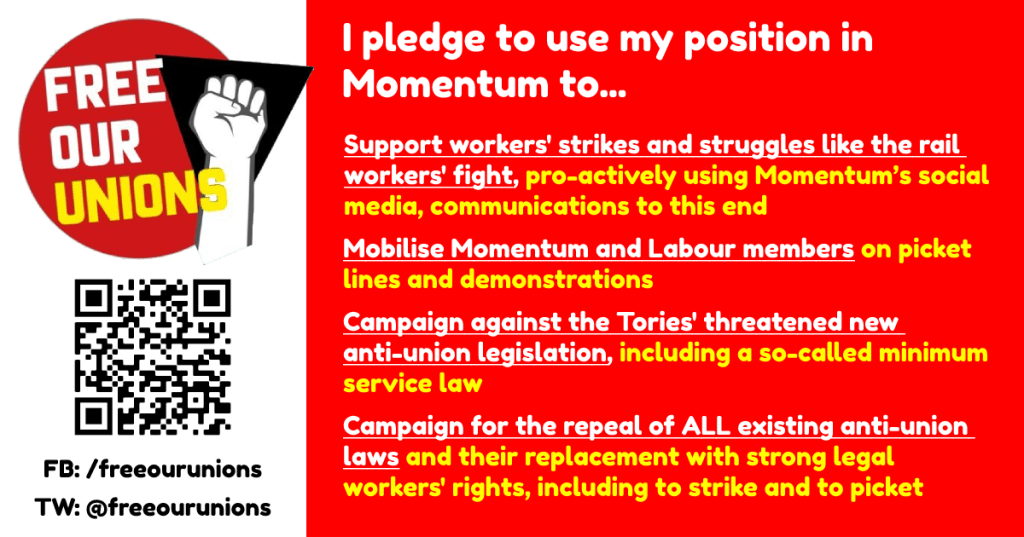
Momentum NCG candidates pledge
Momentum, the left-wing network in the Labour Party, is about to hold elections for its National Coordinating Group (NCG).
Free Our Unions has worked with Momentum before, collaborating with the Fire Brigades Union in 2021 to submit a motion to Momentum’s Policy Primary.
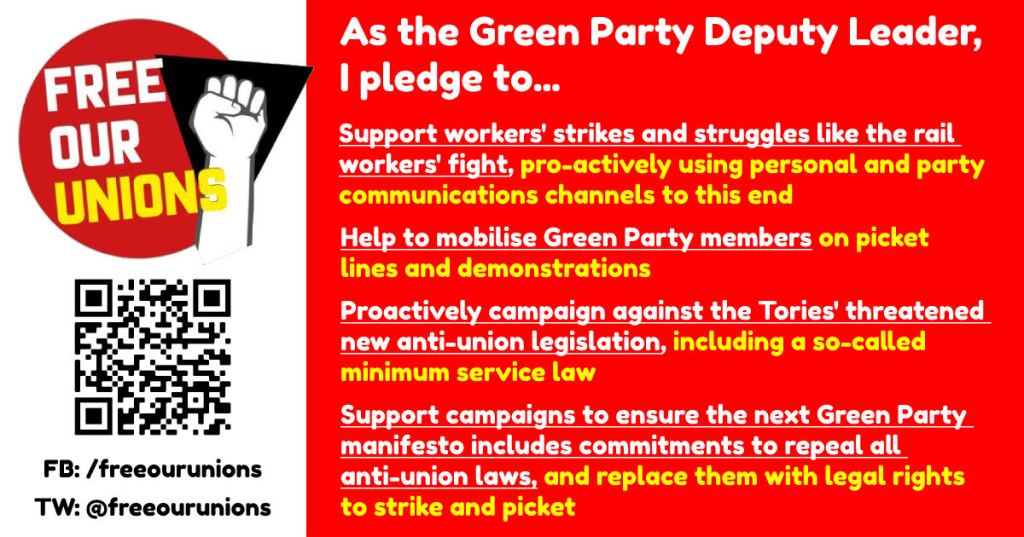
This year, we’re asking NCG candidates to commit to promoting strikes, and actively campaigning against anti-strike laws, and mobilising Momentum to do likewise. The pledge card is below; we’ll be contacting individual candidates electronically in the coming days.
Update:
The NCG elections concluded on 6 July. Thanks for the following candidates for backing our pledge:
Rochelle Charlton-Lainé (ELECTED)
Lorcan Whitehead (ELECTED)
Sonali Bhattacharyya (ELECTED)
Maisie Sanders
Abel Harvie-Clarke
Andy Warren
Si Oldham

New Free Our Unions leaflet
We’ve produced a new leaflet to promote our campaign, which will be available on the TUC demo on Saturday 18 June and beyond.
Download copies below for your workplace below!
GMB to renew campaigning against anti-union laws
The congress of the GMB union, Britain’s third largest, has resolved to renew the union’s campaigning against legal restrictions on workers’ right to organise and strike, after congress passed a composite motion from branches in Glasgow and Southampton.
The motion noted the policy passed in 2021 on the same issue, and called for further action to enact it.
This Congress notes and re-affirms:
• Policy adopted at the 2021 Congress to “campaign against the introduction of new anti-union laws and to campaign for the scrapping of all anti-union laws” and to “campaign for a comprehensive charter of workers’ rights to be put on the statute book”.
• The specific proposals for such campaigning contained in the motion passed at the 2021 Congress (production of GMB campaigning material, coverage of campaign in GMB publications, lobbying MPs, calling on MPs to support strikes in their constituencies, joint campaigning with other unions.)
Congress further notes that a number of unions have recently adopted policy advocating a national trade union demonstrations against the anti-union laws, and that the last TUC congress adopted policy in favour of a national rally against the anti-union laws.
In order to progress existing policy, Congress therefore instructs the Central Executive Council to:
• Support a national demonstration against the anti-union laws and approach other unions with the same policy, with a view to holding such a demonstration.
• Promote closer working with other unions and campaigns which share the policy of scrapping all anti-union laws.
• Pursue implementation of the proposals contained in the motion passed by the 2021 Congress.
• Present a report to the 2023 Congress on campaigning undertaken by the GMB against anti-union laws.
UCU Congress takes strong stance against anti-union laws
The recent congress of the University and College Union, held online from 1-3 June, passed a resolution committing the union to a strong stance, and campaigning, against anti-union laws.
The motion was proposed by the UCU branch at Birkbeck, which recently voted to support Free Our Unions, as well as UCU University of Brighton (Moulsecoomb), with friendly amendments from UCU University of Brighton (Grand Parade) and UCU Yorkshire and Humberside Regional Committee.
The text of the motion is below.
Campaign to repeal ALL anti-trade union laws
Congress notes:
1. the impact of anti-union laws inhibiting our and other workers’ recent struggles
2. the threat of new ‘minimum service’ legislation during transport strikes (which could be extended to other sectors)
3. 2019 Congress policy reiterating opposition to ALL anti-trade union laws
4. that TUC Congress and Labour conference voted to campaign to repeal all anti-union laws and their replacement with positive workers’ rights, including strong rights to strike and picket. However, this has remained on paper.
Congress believes:
a. the Tories anti-trade union laws are designed to prevent workers taking effective industrial action
b. despite the ballot thresholds UCU have been able to launch UK-wide action
c. the development of GTVO strategies and the use of disaggregated ballots have enabled branches to take on our employers.
d. P&O’s blatant disregard of employment law raises the question of why workers should obey anti-union laws.
Congress resolves:
i. to start campaigning, actively and vocally, for the repeal of and resistance to ALL anti-union laws and for a strong right to strike, including by: producing a leaflet; organising a week of action; organising an activists’ day school; and a joint union conference
ii. that UCU initiate an inter-union forum on strategies to combat the anti-union laws
iii. to stand in solidarity with RMT, which has pledged to defy any ‘minimum service requirement’, and to support their campaigns against this legislation
iv. to act in solidarity with P&O workers and other workers subject to unfair labour processes, supporting boycotts and demonstrations. UCU calls on its members and on universities and colleges to boycott P&O Ferries.
v. to call on the Labour Party to commit to abolishing all anti-trade union legislation when elected, and to enacting legislation to outlaw zero hours contracts, ‘fire and rehire’ and other unfair labour practices.
vi. to support all workers who defy anti-union legislation.
Defend the right to picket: protest at Hastings Magistrates Court, 9:30, 29 June
Hastings and District TUC has called a protest at Hastings Magistrates Court (Bohemia Road, Hastings TN34 1ND) for 9:30 on 29 June, when three GMB officials arrested on a Wealden council refuse workers’ picket line will appear in court.
The organisers write:
“Three GMB officials were arrested on the picket line at Amberstone Depot in Hailsham. They were taken away in handcuffs.
“These were clearly stage managed arrests after a political decision by East Sussex police to back the outsourced employer, Biffa, who are paying poverty wages to refuse collectors.
“The GMB officials will appear at Hastings Magistrates Court to face charges. Join the protest at Hastings Magistrates Court on 29 June 29 at 9.30am. Bring your banners and support the GMB 3.”
For more info, see the Facebook event here.
As Tories reassert anti-strike law threat, unions must resist
In response to the RMT’s national ballot of workers in Network Rail and 15 mainline Train Operating Companies, Transport Secretary Grant Shapps has said the government will accelerate plans for new laws to restrict transport workers’ strikes.
The plan is not new: the Tories’ 2019 manifesto included a commitment to implement the laws, which would impose a legally-mandated “minimum service” during transport strikes. The law was in the first Queen’s Speech in February 2020, and although the pandemic re-callibrated government priorities, when Business Secretary Alok Sharma was asked in July 2020 if the government still planned to introduce the laws, he confirmed they did. In September 2020, a statement launched by Free Our Unions saw seven Labour MPs and dozens of trade union officials and activists commit to a renewed campaign against both the existing anti-union laws, and proposed new ones.
At its October 2021 AGM, rail and transport union RMT passed a motion committing the union to a policy of non-compliance should “minimum service” laws be imposed. That would be a radical step, and would require the rest of the labour movement to rally round the RMT.
In the same month, Unite’s conference passed a motion reaffirming its opposition to all anti-strike laws, both existing and proposed. This motion also resolved to call on the TUC to organise a national demonstration against the laws, and to organise one directly via a “coalition of the willing” if the TUC did not.
The June 2021 congress of the GMB, Britain’s third biggest union, also passed comprehensive policy opposing anti-strike laws, and resolving to pursue joint-union campaigning against them. Labour Party and TUC conferences also have existing policy supporting the abolition of existing anti-strike laws, and opposing the imposition of new ones.
The Telegraph article which included Shapps’ remarks also included the announcement of plans to encourage teachers to bring lawyers or arbitrators with them to disciplinary hand grievance hearings, rather than union reps: we also need to be ready to resist new laws restricting unions’ role in workplace procedures.
The general secretaries of Unite, RMT, and TSSA have all made strong press statements in response to Shapps’ comments. We need grassroots resistance too.
Free Our Unions can send speakers to meetings and protests. We will be producing additional materials and resources in the coming weeks to help rank-and-file trade union activists organise against new restrictions on our rights.
Welwyn walkout shows how workers can win
By a Free Our Unions supporter
On 10 May, refuse workers in the Hertfordshire town of Welwyn Hatfield launched an unofficial strike to deal with a manager they said was sexist, racist, and bullying.
A hundred refuse, recycling, and maintenance workers employed by commercial waste contractor Urbaser, members of Unite, refused to work and made it clear they would not go back until the manager went.
A report in Socialist Worker quotes workers vividly describing the manager’s behaviour and how their workplace has been run. Workers also described how outsourcing had made their situation at work much worse. Union campaigns for insourcing have won important victories; this demand needs taking up and fighting for by the whole labour movement, including the Labour Party.
Workers signed a grievance letter and the manager was sent home while an investigation took place; but the investigation was not serious and the manager was set to return. The workers decided to walk out, stopped bin collections and gathered outside the council offices to discuss where to go next. And they won – the manager is gone.
This small strike demonstrates in miniature some hugely important things – including the power workers when they take action with determination and militancy, including power to challenge oppression. And the fact that effective workers’ action will very often mean not going through the hoops set up by the anti-union laws. As one striker said: “We knew what we were doing was an unofficial walkout and that it was illegal, but we all felt so strongly we knew we had to do it.”
Between the General Strike of 1926 and the 1966 seamen’s strike, there were no national strikes in the UK. There were large and growing numbers of smaller disputes, often extremely small local ones, in which workers took direct action with no or little reference to their national union, just walking out to bring their managers or bosses to heel.
One factor is that there were no anti-union laws of the sort introduced after 1979. Unions did not need to clear multiple procedural and bureaucratic hurdles to declare official action; they could decide to simply declare unofficial action official; local union organisations often had much greater leeway to make their own decisions; and all this helped the creation of both powerful working-class militancy and a situation in which it was very hard for bosses to treat even wildcat action as something illegitimate.
Like other small disputes in recent years, the Welwyn Hatfield workers’ action – refusing to buckle under to the anti-union laws – shows the way for workers to deal with the dire and mounting problems we face. At the same time, it shows the need for a concerted campaign to scrap the anti-union laws, all of them, to create the best possible conditions for such action to thrive.
Online meeting, Tuesday 17 May, 7pm: Why the fight against climate change needs free trade unions
In October 2021, Free Our Unions collaborated with Earth Strike’s “Empower the Unions” initiative to launch a statement calling for joint struggle between the labour and climate movements against anti-strike laws which constrain workers’ ability to fight for radical action on the environment.
This online meeting, co-sponsored by Free Our Unions, Earth Strike: Empower the Unions, and Extinction Rebellion Trade Unionists, brings together labour and environmental activists to discuss how that struggle can be built.
Tuesday 17 May, 7pm
Log in via Zoom here
Meeting ID: 889 6629 5409
Passcode: 850587
The meeting is also co-sponsored by a number of the other organisations with signed the October 2021 statement: Green Party Trade Union Group; Campaign Against Climate Change Trade Union Group; Workers’ Liberty; Anti-Capitalist Resistance; Scot E3

Momentum Policy Primary motion calls for repeal of all anti-union laws
Momentum, the left-wing organisation in the Labour Party, is conducting its second annual policy primary, to determine which motions Momentum will encourage members to submit to CLPs for submission to Labour conference.
The Fire Brigades Union and North Essex Momentum have submitted the motion below, reaffirming previous conference policy calling for the repeal of all anti-union laws.
The motions for the policy primary can be found here. Momentum members can vote for their preferred motions electronically.
Advancing Workers’ Agenda by Repealing All Anti-Trade Union Laws
Decades of anti-trade union laws have interfered with unions’ ability to organise and caused mass redistribution of wealth from workers to the wealthy; years of cuts and a lack of investment in public services, and now they want workers to pay for the costs of the pandemic.
The pandemic has amplified the need for workers to be in unions to guarantee health and safety and working conditions. Job cuts, attacks on terms and conditions, “fire and rehire” and the Police, Crime, Sentencing and Courts Bill are all direct attacks on the labour movement and should be called out publicly, opposed and challenged by the Labour Party leadership and the entire movement.
Conference condemns the disgraceful treatment of refuse collection drivers by Labour representatives in Coventry. Conference commits to always supporting striking workers.
Conference notes TUC policy that workers be: “represented by an independent union; strike/take industrial action by a process, at a time, and for demands of their own choosing, including in solidarity with any other workers, and for broader social and political goals; and picket freely.”
Conference commits to repealing all anti-union laws and commits to their replacement with a code of labour rights using the proposals set out in Labour’s 2017 and 2019 Manifestos. This commitment includes repealing anti-strike laws, such as the ban on striking in solidarity with other workers or political issues; preventing workers from taking action directly over climate change, NHS and equalities.
Conference demands the Party actively enforce trade union membership amongst all Party members.
Submitted by Momentum North Essex and FBU
Word count: 250