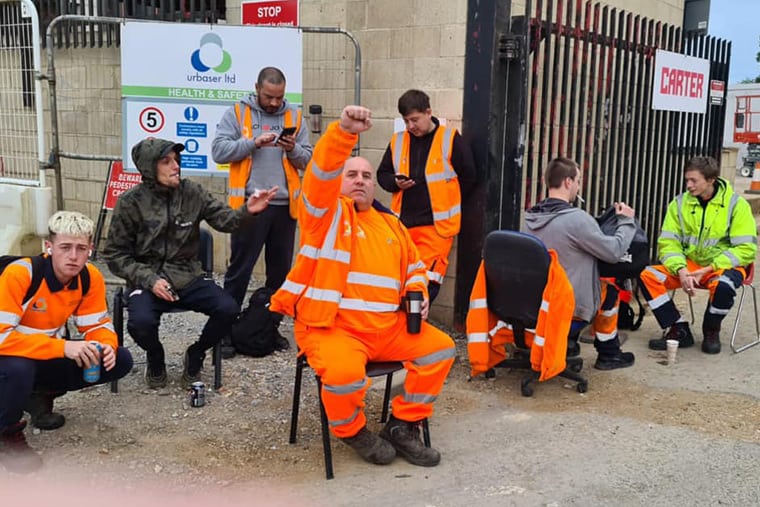
Solidarity with P&O workers! Defy the anti-union laws, and fight for their abolition!

By a Free Our Unions supporter

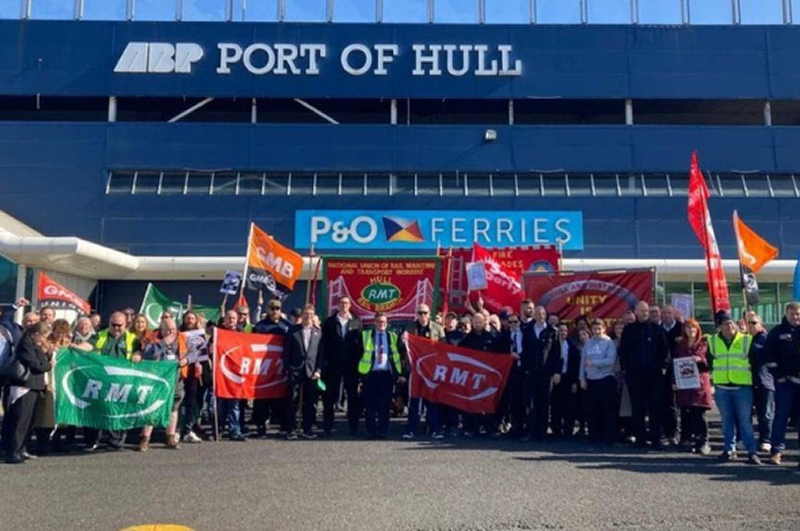
The disgraceful sacking of 800 P&O ferries workers, and the subsequent union campaign to reverse it, show the abject inadequacy and weakness of existing employment legislation.

P&O took their action in the full knowledge that it broke employment law. In the face of recent government threats to legislate to force them to reinstate the workers, they have refused to back down. And while bosses have flagrantly broken the law, so far without direct consequence, workers attempting to resist the injustice remain constrained by “the most restrictive union laws in the western world.”

Solidarity action by dock workers in Holland delayed the launching of a P&O vessel. Dockers elsewhere have said they will take similar action. But any workers looking to take this kind of action in the UK will have to do so in defiance of this country’s anti-union legislation, which has, since 1991, outlawed workers taking action in solidarity with other workers.

If workers do bravely defy those laws, the whole labour movement must rally round them. Free Our Unions has campaigned for the Labour Party to fight for the policy passed by successive party conferences, for the repeal of all anti-union and anti-strike laws. When Labour leaders mention the issue, rare enough in itself, they usually focus only on repealing the most recent set of laws, the Trade Union Act of 2016 which imposed ballot turnout thresholds. But in the wake of the P&O sackings, the injustice of the older anti-union laws is harder to ignore.

East Hull’s Labour MP Karl Turner, by no means on the left of the party, has said the last Labour government “should have overturned every anti-trade union law.”:

Left-wing Labour MP Richard Burgon has also used the moment to call for the abolition of anti-union laws and the right to take solidarity action:

RMT, one of the two trade unions representing P&O workers, is a supporter of Free Our Unions, as well as other groups that campaign on the issue, including the Campaign for Trade Union Freedom and the Institute for Employment Rights. With Tory plans for new anti-strike laws set to target transport workers, now is surely the time to act on union policy, shared by other unions such as Unite, to call a national demonstration against the anti-union laws.

TUC Disabled Workers’ Conference fringe meeting, 22 March, 11:30: Disabled People for Free Trade Unions!

Free Our Unions is co-sponsoring a fringe meeting, along with the RMT’s Disabled Members Advisory Committee, at the forthcoming TUC Disabled Workers’ Conference.

The meeting will take place on Tuesday 22 March, at 11:30, via Zoom.

Speakers include:

• Janine Booth, RMT Disabled Members Advisory Committee and Free Our Unions
• Sarah Woolley, General Secretary, Bakers Food and Allied Workers Union (BFAWU)
• John McDonnell, Labour MP, Hayes and Harlington

The meeting is open to people who aren’t delegates to the TUC conference. Register to attend here.

Birkbeck UCU says: free our unions!

The University and College Union (UCU) branch at Birkbeck, University of London, has become the latest trade union branch to support the Free Our Unions campaign. Birkbeck UCU will also be sending a motion to UCU’s Congress which aims to commit the union to active campaigning on the issue of anti-union and anti-strike laws.

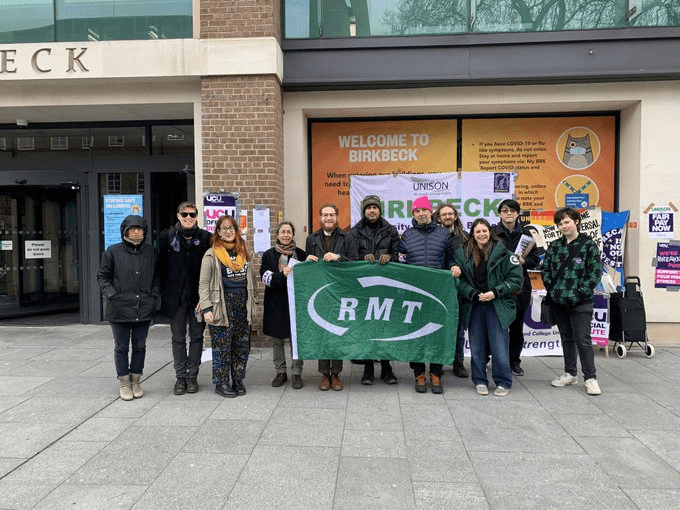
Free Our Unions recently participated in a teach-out at a Birkbeck UCU picket line, with Birkbeck worker and UCU NEC member-elect Rhian Keyse and RMT activist Daniel Randall leading a discussion.

Birkbeck UCU strikers and supporters, including UCU NEC member-elect Rhian Keyse, with Free Our Unions co-organiser and RMT rep Daniel Randall, following a Free Our Unions teach-out at the Birkbeck picket line on 28 February

The motion the branch passed, and their submission to congress, are below. Why not pass something similar in your union branch?


Campaign to repeal all anti-trade union laws

This branch notes:

1. The impact of anti-union laws inhibiting our and other workers’ recent struggles.
2. The threat of new “minimum service” legislation during transport strikes (which could be extended to other sectors).
3. 2019 Congress policy reiterating opposition to ALL anti-trade union laws.
4. That TUC Congress and Labour conference voted to campaign to repeal all anti-union laws and their replacement with positive workers’ rights, including strong rights to strike and picket. However this has remained on paper.

This branch believes:

1. That workers cannot fight disputes with our hands tied behind our backs.
2. That UCU should campaign strongly on these issues.

This branch resolves:

1. To bring a motion (Appendix 1 below) to Congress 2022 calling on UCU to strengthen its campaigns on anti-union laws.
2. To affiliate to the Free Our Unions campaign.

Appendix 1 – Draft Congress Motion: Campaign to repeal all anti-trade union laws

Congress notes

1. The impact of anti-union laws inhibiting our and other workers’ recent struggles.
2. The threat of new “minimum service” legislation during transport strikes (which could be extended to other sectors).
3. 2019 Congress policy reiterating opposition to ALL anti-trade union laws.
4. That TUC Congress and Labour conference voted to campaign to repeal all anti-union laws and their replacement with positive workers’ rights, including strong rights to strike and picket. However this has remained on paper.

Congress resolves:

1. To start campaigning, actively and vocally, for the repeal of and resistance to ALL anti-union laws and for a strong right to strike, including by: producing a leaflet; organising a week of action; organising an activists’ day school; and a joint union conference
2. To stand in solidarity with RMT, which has pledged to defy any “minimum service requirement”, and to support their campaigns against this legislation.

Give workers who refuse to unload Russian fuel legal back-up: repeal the anti-union laws!

Shadow Transport Secretary Louise Haigh has written to Transport Secretary Grant Shapps about the inspiring action of dockers who’ve blocked Russian oil and gas coming into the UK.

Haigh says:

“There is a real risk under existing laws that for taking a brave moral stand, trade unionists could risk litigation or other action for refusing to handle Russian cargo.

“I urge you to guarantee their protection, with legal changes if necessary, and act to ensure they do not pay the price for standing up for what is right.”

The reason that there is legal jeopardy is that for workers’ action to be protected, it must have trade union endorsement. And under the relevant “existing laws”, the Thatcherite anti-union laws, it is illegal for unions to endorse:

a) industrial action without a postal ballot (1984 Trade Union Act); and

b) industrial action for anything but narrowly-defined industrial issues (1982 Employment Act).

The tenor of Haigh’s comments is broadly welcome – but it’s not at all clear what she’s advocating.

The only consistent way to deal with this problem, also necessary for the interests of the working class and labour movement generally, is to repeal all the anti-union laws (and replace them with a strong legal right to strike), so that workers can take action when, how and for whatever reasons we see fit.

Political strikes, the war in Ukraine, and the anti-union laws

By a Free Our Unions supporter

Actions by UK dockers in Cheshire, Kent and Scotland’s northern isles to stop Russian fossil fuels from coming to the UK, in protest at the invasion of Ukraine, are part of a proud tradition of workers’ action here for political goals.

The ILWU union in the US’s West Coast ports has made a statement confirming that its members will not load or unload any Russian cargo coming in or going out. “With this action in solidarity with the people of Ukraine, we send a strong message that we unequivocally condemn the Russian invasion.”

The ILWU has a remarkable recent history of political strikes and industrial action – including a 2020 strike in support of Black Lives Matter, and before that action against the Iraq war and South African apartheid. In the UK you have to go back a bit further to find much such actions.

In the 19th century, some textile workers refused to work with cotton picked by enslaved people in the United States – preparing the way for mass working-class protests against the threat of British intervention in support of the slave-owners during the US civil war.

In 1920 dockers in east London refused to load weapons to be sent to the anti-Bolshevik White Armies in the Russian civil war.

In the 1970s, workers at the Rolls-Royce factory in East Kilbride, Scotland, refused to work on parts for the Chilean airforce in protest at the Pinochet dictatorship and its repression.

But since the 1980s, it has been illegal under anti-union laws for unions to endorse and organise such action, leaving workers who take it vulnerable. Without union protection, refusal to work is not legally recognised as industrial action, but is breach of contract. As a result strikes and industrial action for political goals have become less common.

Industrial action without cumbersome and atomising procedures including a postal ballot and long notice periods is also now illegal.

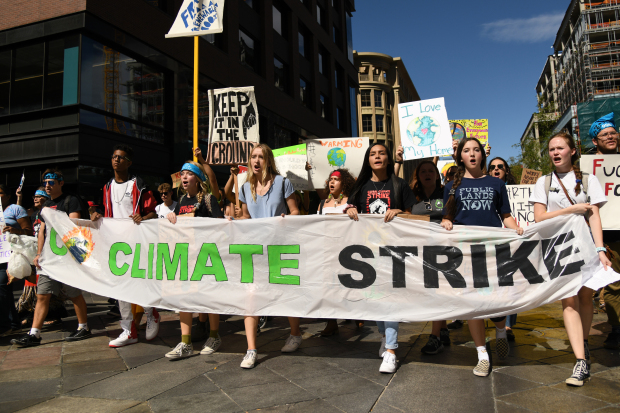
In September 2019, some workers in the UK tried to revive the tradition of political industrial action by finding ways to take action alongside the youth climate strikers, as part of the global climate strike. The idea of industrial action for the climate is something that urgently needs developing. Free Our Unions aims to contribute to this via our collaboration with Earth Strike UK in the “Empower the Unions” initiative.

The action by dockers around the country, in protest at the war in Ukraine – political industrial action, without a ballot, brave even given the general agitation around Ukraine – shows that the anti-union laws can be defied (as do other unofficial actions for more conventional industrial demands). We should use this opportunity to champion more industrial action for political freedom and social justice; and to challenge the anti-trade union laws and demand their repeal.

“Liberal” MLAs block repeal of laws restricting workers’ freedoms

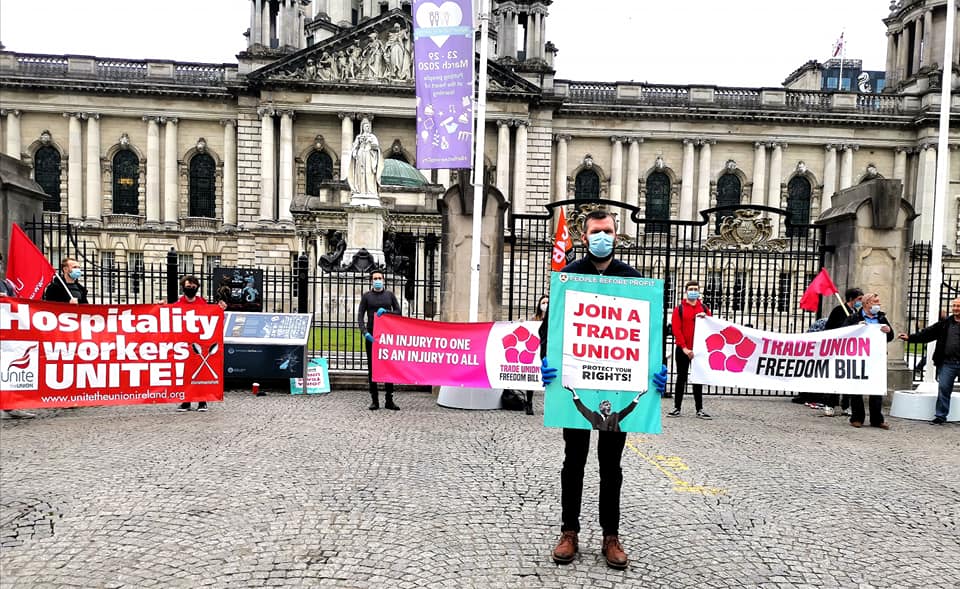
Disappointing news from Stormont, where socialist MLA Gerry Carroll’s Trade Union Freedom Bill fell on 1 March by just five votes.

The bill would have repealed Tory anti-union and anti-strike laws in Northern Ireland. Had Alliance Party MLAs backed it, it would have passed. Alliance claims to be a “liberal” party, but its MLAs appear to be “liberals” who support state restrictions on basic liberties such as the right to withdraw one’s labour.

The labour movement must continue to campaign for the demands of the bill.

Click here to read our interview with Gerry Carroll about the bill.

Pushing workers’ rights up the agenda: Labour Left Internationalists meeting, 5pm, 19 February

UCU activist Rhian Keyse will be speaking on behalf of Free Our Unions at a meeting on 19 February, organised by Labour Left Internationalists (LLI).

LLI write:

Unite, RMT, CWU, and the TUC passed resolutions in 2021 calling for a joint union demonstration for workers’ and union rights in spring 2022. Since then NHS workers, local government workers, and teachers have all run up against the impositions of the Trade Union Act 2016 when pushing for industrial action on pay. Labour has repeatedly-reaffirmed conference policy to repeal all anti-union laws, including the Thatcher-era ones, but failed to include that even in the 2019 manifesto. In 2021 Labour published a “Green Paper”, “New Deal for Working People”, focused on reinstating collective bargaining with unions across the economy and including many important demands, but Keir Starmer has been quiet about that too. We’ll discuss how Labour and union activists can work together to push workers’ rights up the agenda.

The meeting begins at 5pm. Log in via Zoom here.

Solidarity with striking Actavo scaffs – protest on 22 February

Unite activists write:

This dispute, which began in 2019, is a result of the scaffolders not being paid in line with the National Agreement for the Engineering Construction Industry (NAECI). The rates for the workforce are currently 10-15 per cent (depending on specific roles) below NAECI rates. The 62 workers have been on continuous strike action since Monday 4 October 2021.

The workers maintain 500 scaffolding structures at the British Steel site. This dispute has gone on long enough. We call on all construction activists who can to come along to the protest to support these trade unionists who have bravely taken action to defend the nationally agreed rate for the job. We cannot allow companies to undercut our terms and conditions and start a race to the bottom.

Join us on Tuesday 22 February from 06:00 to 10:00 at British Steel, Entrance D, Brigg Road, Scunthorpe, DN16 1DL.

GOSH bosses uses courts to break strike – protest at the Royal Courts of Justice!

Bosses at Great Ormond Street Hospital in London have used the courts to block effective picketing by striking security guards, who now face criminal charges if they attempt anything beyond the most tame, ineffectual activity within 200 metres of their workplace.

The injunction is another example of how the laws and judiciary are a tool in the hands of employers to restrict workers’ ability to assert themselves and improve their conditions.

The workers’ union, United Voices of the World, has called a protest at the Royal Courts of Justice at 10am on Wednesday 16 February, when the injunction will be contested.

Tories want to tax unions to pay for the Certification Officer

This article is reposted from the website of the Institute for Employment Rights, where it was first published on 28 January.


This week, legislation was passed in the House of Commons which not only imposes a levy on trade unions to cover the costs of the Certification Officer but could hit trade unions with huge financial penalties. The legislation – known as the draft Trade Union (Levy Payable to the Certification Officer) Regulations 2022 and the draft Trade Union (Power of the Certification Officer to Impose Financial Penalties) Regulations 2022 – was passed with the minimum of debate, as it came in the form of a ‘statutory instrument’, secondary legislation which authorises Ministers to implement legislation.

The regulations, passed on Wednesday by 296 votes to 176, with the DUP joining Conservative MPs in supporting the legislation, charges a levy of 2.5 per cent of total union income, to cover the costs of the Certification Officer, the trade union regulator.

Trade union officials, MPs and labour lawyers have pointed out the inconsistency of trade unions paying what is essentially a tax for the privilege of regulating themselves. Professor Keith Ewing, Professor of Public Law at King’s College London, said:

“It is surely very unusual – if not unique to impose taxes of this kind. Are MPs taxed to pay for the standards’ watchdog?”

In the committee debate in the House of Commons on Tuesday, Apsana Begum, the Labour MP for Poplar and Limehouse, pointed out that comparable organisations generally did not pay a levy to their regulator:

“There are other bodies that don’t pay tax to regulators. Broadcasters don’t pay tax for Ofcom. Data processors don’t pay tax for information commissioners.”

The legislation is part of a package of reforms contained in the much-criticised Trade Union Act of 2016 but has only now been introduced in Parliament. Amongst the new powers of the Certification Officer is the power to fine trade unions if rule breaches are deemed to have occurred.

In the lead up to the introduction of the legislation, the TUC highlighted that, in 2020-21, the Certification Officer dealt with only 34 complaints and that not a single one had resulted in further action. Clearly, however, the new powers have the potential to embroil the unions in red tape, whilst also encouraging ‘vexatious claims,’ something pointed out by the TUC’s Frances O’Grady:

“Rather than dealing with the problems working people face, the government is trying to tie unions up in more red tape. It is telling of the government’s real concerns that they choose to spend valuable parliamentary time on new anti-union rules. Now is the time to be working with unions, not undermining them. That’s why MPs should reject these cynical and ideological proposals — and instead join with unions and their members in delivering better pay and conditions for working people.”

Former Labour leader Jeremy Corbyn, in a comment to the Morning Star, said that the legislation amounted to “another piece of anti-union activity by the Tories,” adding, “We need a firm pledge from the Labour Party that they will reverse and repeal this as soon as coming into office.”

In the House of Commons, Opposition MPs branded the new levy a “trade union tax.” Imran Hussain, Labour MP for Bradford East & Shadow Employment Rights and Protections Minister, spoke passionately about the consequences of the legislation:

“When trade unions are empowered, working people are empowered and we all benefit. Yet this Tory Government have just embarked on the biggest assault on trade unions in years with their trade union tax.”

On the morning of the committee stage, Mr Hussain had written a piece for Labourlist, outlining what he called an “attack on working people”:

“It will be working people who lose out as unions are forced to spend money that should instead be spent on representing them. The truth is the levy has nothing to do with the government’s claim of improving transparency, but everything to do with their opposition to workers organising to improve their pay, terms and conditions.”

On Twitter, former Shadow Secretary of State for Employment Rights, Andy McDonald , called the changes ““sheer naked anti-trade unionism”, while Ian Lavery, MP for Wansbeck, said:

“This is bizarre in anyone’s world. Here we have the trade union police being given powers to investigate unions even where there has been no complaint or if they receive complaints from non-related parties. To top it off, the unions have got to use their members’ contributions to fund the investigation. This really does beggar belief. It’s rightfully been called a trade union tax which should be actively opposed by unions and politicians alike.”

The Institute of Employment Rights (IER) has been highlighting the concerns of trade unions and labour movement bodies over this new levy and the powers associated with it, periodically over the last few years. This week, IER Director Ben Sellers called the legislation “deliberately and unnecessarily punitive” and said:

“These ‘reforms’ should be seen in the context of the government’s whole approach to unions, which is to salami-slice their rights while at the same time feeding a false narrative that unions are somehow serial ‘rule breakers’ when genuine complaints against them are negligible.”