Know your enemy!

A discussion paper written by right-wing lobbyist Nicholas Finney arguing for further restrictions on strikes, and discussing how these restrictions could work, has been uploaded to the Academia website.

Although the paper is undated, and appears to be unfinished, it has clearly been written in the last few years, since the imposition of the 2016 Trade Union Act.

Free Our Unions encourages supporters to read the paper. It’s always worth knowing how the other side is thinking. Although Finney is not a politician, civil servant, or Tory official, his paper gives some insight into considerations the Tories are likely to be making with regards to their manifesto commitment to introduce “minimum service requirements” to restrict transport workers’ strike.

Finney is an arch-Thatcherite, and the former director of the National Association of Port Employers. In this capacity he led campaigning to scrap the Dock Labour Scheme, which enshrined certain workplace and union rights for dockers.

The paper can also be directly downloaded here (NB: clicking the link will download a .doc file to your computer).

Support Myanmar’s workers, striking for democracy

Free Our Unions salutes the struggle of workers in Myanmar for their rights and for democracy, and calls on the British labour movement to step up to support their fight.

We note and urge others to note the central role being played there by a political general strike against the military coup and for democracy, the “Civil Disobedience Movement”. The strike and associated protests have already faced repression: two people were killed at a protest by striking shipyard workers.

Workers everywhere in the world need the right to form, join and organise through independent unions; to strike by a process, at a time and for any demands of their own choosing, including in solidarity with any other workers and for wider social and political goals; and to picket freely, anywhere.

We must fight for free trade unions, untrammeled by state control, anti-union laws and employer interference, everywhere.

• One of Myanmar’s union federations, the All Burma Federation of Trade Unions, has launched an appeal for funds to support the “Civil Disobedience Movement” – see here. Please donate and share!

• Several UK trade unions and campaign groups including No Sweat and War on Want have published a statement supporting Myanmar’s workers’ struggle. Read the statement on the No Sweat website here.

Model motion for Labour Party conference

Free Our Unions encourages supporters active in the Labour Party to submit motions based on the below model text to their local parties, for submission to Labour Party conference 2021. The deadline for CLPs to submit motions to the conference is 13 September. If the motion is endorsed by your branch or CLP, email us at freeourunions@gmail.com to let us know!


The pandemic, in which many workers have needed to take fast, decisive action to guarantee safety for themselves, their loved ones, and the wider community, without going through an arduous bureaucratic process, has underscored the need to scrap all anti-strike laws. So does the wave of job cuts and attacks on terms and conditions (e.g., “fire and rehire”).

Other anti-strike laws, such as the ban on workers striking in solidarity with other workers, and on striking over political issues, are also an affront to democracy. They prevent workers from taking action directly over issues such as defence of the NHS, climate change, or racism.

Conference denounces the Tories’ plan to impose new restrictions on transport workers’ strikes through a “minimum service requirement”. It seems likely they will extend this to other groups of key workers.

Conference notes TUC Congress 2020 agreed to “organise a special conference… on opposing the anti-union laws” and a national demonstration. The party will encourage CLPs to support and get involved in these when they become possible.

Conference reaffirms the party’s opposition to all anti-union and anti-strike legislation, its commitment to repealing all such laws when next in government, and to legislating to enshrine workers’ rights to, as per TUC policy: “join, recruit to, and be represented by an independent union; strike/take industrial action by a process, at a time, and for demands of their own choosing, including in solidarity with any other workers, and for broader social and political goals; and picket freely”.

(248 words)

A letter to the Socialist Campaign Group of Labour MPs

Dear comrades,

We’re writing in response to your recent pamphlet Winning the Future: Socialist Responses to the Coronavirus Crisis. Well done on producing it – it’s a contribution to the urgent task of raising the labour movement’s ambitiousness and confidence in difficult times.

In the spirit of your call for the pamphlet to be “widely read and debated in the labour and trade union movement”, we’d like to propose a way in which its demands could be strengthened. As the pamphlet indicates, workers’ rights are key. In turn, the right to strike is key – both to underpinning all workers’ rights and to the fight for all our movement’s demands.

In the articles by Claudia Webbe and John McDonnell, the pamphlet calls for repeal of the 2016 Trade Union Act and other important changes. But it is less clear on repealing the other anti-union/anti-strike laws, those introduced in the 1980s and 90s under Thatcher and Major. The Covid crisis has highlighted how it is not just the Trade Union Act which stymies workers taking action. The ability of workers to act quickly and decisively to defend safety and rights is curbed by the earlier laws which created arduous procedures for strikes to be legal. The Trade Union Act of course made these procedures more arduous still.

Moreover these earlier anti-union laws prevent industrial action for anything other than narrowly defined “trade dispute” issues. It was illegal for unions in the UK to organise strikes alongside the student climate strikers; it would be illegal for unions to organise strikes to say Black Lives Matter (as some workers in the US have done).

Solidarity action between different groups of workers, which the Institute of Employment Rights rightly called fundamental to “the whole ethos of the trade union movement”, is also banned. The laws even before 2016 were a bosses’ charter to prevent strikes from happening in various ways. And while reasserting collective bargaining is crucial, it is surely true that “collective bargaining without the right to strike is collective begging”.

Yet over the years, a norm has developed in the labour movement of demanding repeal only of the 2016 Act and either saying nothing about the earlier anti-union laws or suggesting in an unclear way that they can be dealt with without repealing them. Greater clarity and radicalism is necessary.

We need positive legal rights to strike, to picket and so on. But we should be clear that these rights are not compatible with the restrictions contained in the Thatcherite laws. Those laws also need to be repealed. The formula popularised by Bob Crow of the RMT, “repeal and replace”, is still right.

This is also an issue of Labour Party and labour movement democracy. Labour conference has voted repeatedly for repeal of all the anti-union laws, most recently in 2019, when it voted in two separate motions that “in power Labour will… repeal all anti-union laws”. Conference 2017 made explicit that it was demanding “repeal” not just of the Trade Union Act, but also “anti-union laws introduced in the 1980s and 90s”.

Polling by Rebecca Long-Bailey’s leadership campaign found that Labour members supported this stance by a ratio of 5-1. TUC Congress 2019 noted that “the anti-trade union laws – not just the 2016 Trade Union Act, but multiple laws going back to 1980 – continually undermine workers’ ability to organise and campaign”; and voted “to campaign, and encourage affiliated unions and trades councils to campaign, for the repeal of all anti-union laws”. The left should be championing this policy decided democratically by party and union members.

Again, winning a strong right to strike is essential not just to guaranteeing workers’ rights but to the labour movement’s ability to fight for all its demands, and for social change more generally. We look forward to discussing and working with you on these issues.

Riccardo la Torre, for the Free Our Unions campaign

Free Our Unions public meeting, Tuesday 2 March, 6:30pm

CONFRONTING ANTI-UNION LAWS

Tuesday 2 March, 6:30pm-8pm

Log in via Zoom here.

How have recent and ongoing workers’ struggles confronted restrictive anti-strike and anti-union legislation, and what effect would it have on those struggles if those restrictions were removed?

We’ll hear from speakers involved in disputes and campaigns about how they’ve dealt with these issues, and how the labour movement can step up our fight for a real right to strike and organise.

Speakers:

Gerry Carroll MLA will discuss his “Trade Union Freedom Bill” in the Stormont Assembly, which aims to repeal Thatcherite anti-union laws in the north of Ireland.

Mark Porter, Unite convenor at the Rolls Royce plant in Barnoldswick, will discuss the recent “Battle for Barnoldswick”, sustained strikes which succeeded in staving off job cuts, and will discuss how the campaign dealt with the challenges posed by anti-union laws.

Michelle Rodgers, National President of the RMT union, will discuss the Tories’ proposed laws which will mandate “minimum service requirements” during transport workers’ strikes.

Also invited:

A striker from the Sage care home in north London, where the United Voices of the World union is navigating laws on union recognition which are weighted in favour of employers.

Log in via Zoom here.

Overturn Shrewsbury convictions – and scrap today’s anti-strike laws!

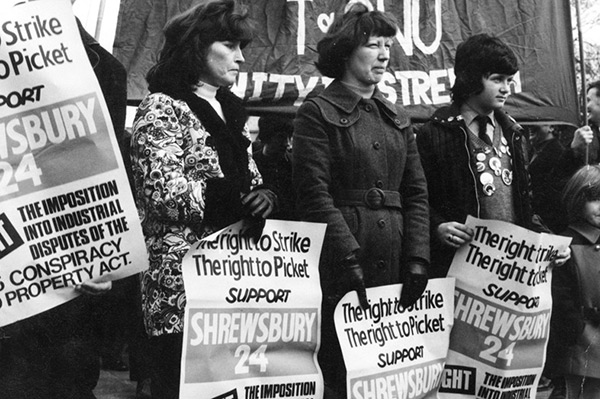
The Free Our Unions campaign sends its full support to the trade unionists currently pursuing a Court of Appeal case to overturn their 1972 convictions for their role in a construction workers’ strike over pay and health and safety issues.

The appellants are the 14 surviving members of the “Shrewsbury 24”. One of the long-running campaigns in their defence writes: “Our campaign is seeking to overturn the unjust prosecution of 24 building workers who were charged following the first ever national building workers strike in 1972. They picketed building sites in Shrewsbury during the dispute and were prosecuted in Shrewsbury Crown Court in 1973. They became known as the ‘Shrewsbury 24’.”

The court has heard how state departments, including MI5, colluded in securing the conviction, on grounds including affray, unlawful assembly, and conspiracy to intimidate.

These convictions predate the anti-union and anti-strike legislation introduced by the Thatcher and Major governments. MI5’s involvement is an indication of how worried the British state was about the power of organised labour. Today, our movement is weaker and less combative, but faces significantly greater formal legal shackles – which are both a product of, and a contributing factor to, the much lower levels of militancy.

As part of a campaign to support the overturning of these convictions, the movement must renew campaigning against all existing and proposed anti-strike and anti-union laws. As the Shrewsbury case shows, in periods of high class struggle, the state will seek to use the judiciary system to undermine effective trade unionism, whether or not it is equipped with specifically anti-strike/anti-union legislation. But the existence of such legislation gives the state and the ruling class significant additional weapons, and forces our side to fight with one hand behind our backs.

Solidarity with the Shrewsbury pickets – scrap all anti-strike and anti-union laws!

Labour Unions consultation

Labour Unions, the network of trade unions which affiliate to the Labour Party, is conducting a consultation on its future campaigning, and is inviting trade unionists to make suggestions for campaigns.

Free Our Unions encourages supporters, particularly those in Labour-affiliated unions (although members of non-affiliated unions can also participate), to respond to the consultation, and propose campaigning around the issue of anti-strike/anti-union legislation.

Supporters are welcome to use this model text in the “Do you have any other suggestions for us?” box:

Successive Labour Party conferences, and the TUC Congress, have passed policies calling for the abolition of anti-union and anti-union legislation, and supporting campaigning to achieve this. Labour Unions should campaign within the party for these policies to be acted on, as well as organising its own activity around this issue. This activityshould emphasise the need to scrap all anti-union/anti-strike legislation, not only the most recent, and replace it with positive legislation enshrining a full right to strike and organise at work.

Take part in the consultation here.

Enact TUC policy!

For the past two years, TUC Congress has passed radical policy on the anti-union laws. The 2019 policy stated: “Congress believes workers need strong rights to join, recruit to and be represented by an independent union; strike/take industrial action by a process, at a time and for demands of their own choosing, including in solidarity with any other workers and for broader social and political goals; and picket freely.”

It also agreed to “campaign, and encourage affiliated unions and trades councils to campaign, for the repeal of all anti-union laws which may be given effect by new permissive legislation and their replacement with strong legal rights, including to strike and picket; and for a clear commitment on this from Labour.”

A policy passed at the September 2020 congress urged the TUC to “organise a special conference open to workplace reps and shop stewards on opposing the anti-union laws”, and to “organise a Saturday London demonstration as soon as possible on the demands:

  • ‘Stop the Tory anti-union laws.’
  • ‘Defend the transport unions.’
  • ‘For workers’ unity against the Tories'”.

Despite these radical policies, the TUC has done little to activate them. Pandemic conditions make many forms of collective mass action unviable, but the TUC could organise online events and produce material to fulfil its commitments to step up campaigning against the anti-union laws.

Free Our Unions will be working with supporters in TUC-affiliated unions to press for these policies to be enacted.

Picketing is still lawful

Prior to the first day of the Sage care workers strike on 15 January, legal advice obtained by the United Voices of the World union suggested that picketing may be unlawful under the new lockdown.

After a physical picket line planned for the first day of the strike was called off, picket lines on subsequent strike days happened without obstruction. British Gas workers have also been picketing during their ongoing strikes.

Further legal advice has clarified that picketing remains lawful, and the confusion stemmed from the Crown Prosecution Service including misleading and out-of-date information on their website.

A court action pursued by the Unite union in November had previously established that picketing remains legal under lockdown restrictions.

Labour policy on the anti-union laws: build back better!

By Sacha Ismail

At a recent meeting organised by the Labour Representation Committee, I asked speaker Laura Pidcock, former shadow Secretary of State for Employment Rights, about Labour’s policy on the right to strike during Jeremy Corbyn’s leadership.

I asked why, in terms of scrapping anti-strike laws, the party generally limited itself to repealing the 2016 Trade Union Act, saying little about the many earlier anti-union laws or leaving things vague. Laura’s response was that Labour’s policy on workers’ rights was much broader than just scrapping the Trade Union Act. That’s undoubtedly true, but it didn’t answer the question, as I intended it at least.

Labour’s 2019 “Workers’ Rights Manifesto” can be read here. It is along the same lines as the sections on workers’ rights in the party’s main manifesto, but goes into more detail. As even a quick scan makes clear, the party did indeed put forward a wide range of policies to strengthen both individual workers’ rights and the position of trade unions. It was good – but nonetheless its policy specifically on the right to strike was inadequate.

Without a strong right to strike and the repeal of all anti-union laws necessary to achieve this, many of the other changes Labour advocated – for instance on reinstating and expanding collective bargaining – would be difficult to achieve and/or would not empower workers to organise and fight, at least not enough. (For what Free Our Unions said about the Labour manifesto in 2019, see “Labour’s manifesto and the right to strike: a welcome step forward, more to fight for”.)

• Like the general manifesto, the Workers’ Rights Manifesto went further than the party leadership had previously. It said it would “Repeal anti-trade union legislation, including the Conservatives’ undemocratic Trade Union Act 2016, and create new rights and freedoms for trade union unions to help them win a better deal for working people, negotiate better pay and quality of working life and enable people to organise in their workplace if they wish to.” That’s good but unclear. Would a Corbyn government have left some anti-union legislation in place?

• It promised to “Remove unnecessary restrictions on industrial action and allow people to take industrial action through their trade union when they feel it’s the only option left against bad and unreasonable employers.” Leaving aside the apologetic tone, which restrictions are “necessary”?

• It promised to “Allow workers and trade unions to use secure electronic and workplace balloting.” That would be an improvement, but the inescapable implication is that strict controls on how workers decide to take action would remain. There would be no return to workers and unions being able to decide themselves how to take decisions on action, as before the 1980s. No voting more informally in meetings, or walking out without warning the employer.

• The WRM said nothing about the right to take action in solidarity with other workers, or for demands on political issues like climate change. It clearly implied that these kinds of actions would remain illegal.

Other pledges, such as “restrict[ing] the grounds on which employers can resort to legal action based on technicalities to override legitimate, democratic decisions taken by the people who work for them”, were of course welcome.

All this was much, much more limited than the policy demanded by repeated Labour Party conferences, by numerous unions and by TUC Congress 2019. (And by the wider Labour membership, according to opinion polling.)

As Keir Starmer seeks to roll back from the pro-worker, pro-trade union policies advocated by the party in 2019, the left must unite to defend them. But we should “build back better” by fighting to put Labour policy on a clearer, more solid basis when it comes to the right to strike – in line with the position agreed by the democratic structures of the party and the unions.

First of all, repealing all the anti-union laws, not just the Trade Union Act, needs to become the established position of the Labour left.